
21 Best Sales Commission Software Reviewed For 2026

10 Best Sales Commission Software Shortlist
Here's my pick of the 10 best software from the 21 tools reviewed.


With so many different sales commission software available, figuring out which is right for you is tough. You know you want a more efficient and error-free approach to handling sales incentives but need to figure out which tool is best.
I've got you! In this post I'll help make your choice easy, sharing my personal experiences using dozens of different sales commission tools with various teams and accounts, with my picks of the best sales commission software.
Why Trust Our Software Reviews
We’ve been testing and reviewing RevOps software since 2022. As RevOps leaders ourselves, we know how critical and difficult it is to make the right decision when selecting software.
We invest in deep research to help our audience make better software purchasing decisions. We’ve tested more than 2,000 tools for different RevOps use cases and written over 1,000 comprehensive software reviews. Learn how we stay transparent & our software review methodology.
Best Sales Commission Software Summary
This comparison chart summarizes pricing details for my top sales commission software selections to help you find the best one for your budget and business needs.
| Tool | Best For | Trial Info | Price | ||
|---|---|---|---|---|---|
| 1 | Best for AI-driven compensation planning | Free 14-day trial | From $30/month (billed annually) | Website | |
| 2 | Best for built‑in approval workflows | Free demo available | Pricing upon request | Website | |
| 3 | Best for aligning comp to GTM strategy | Free demo available | Pricing upon request | Website | |
| 4 | Best for no-code commission plans | Free demo available | Pricing upon request | Website | |
| 5 | Best AI-adaptive, user-friendly comp management | Free demo available | Pricing upon request | Website | |
| 6 | Best for making selling fun while ensuring teams stay focused on goals | Free demo available | Pricing upon request | Website | |
| 7 | Best for mobile-first salespeople | Free demo available | Custom pricing upon request | Website | |
| 8 | Best enterprise-grade compensation management software that’s easy to use | Free demo available | Pricing upon request | Website | |
| 9 | Best for automating complex sales commission calculations | Free demo available | From $20/payee/month (15 user minimum) | Website | |
| 10 | Best for automated and transparent payout tracking | Free demo available | From $25/user/month | Website |

-

Pipedrive CRM
Visit WebsiteThis is an aggregated rating for this tool including ratings from Crozdesk users and ratings from other sites.4.3 -
Creatio CRM
Visit WebsiteThis is an aggregated rating for this tool including ratings from Crozdesk users and ratings from other sites.4.7 -
monday CRM
Visit WebsiteThis is an aggregated rating for this tool including ratings from Crozdesk users and ratings from other sites.4.6




Best Sales Commission Software Reviews
Below are my detailed summaries of the best sales commission software that made it onto my shortlist. My reviews offer a detailed look at the key features, pros & cons, integrations, and ideal use cases of each tool to help you find the best one for you.

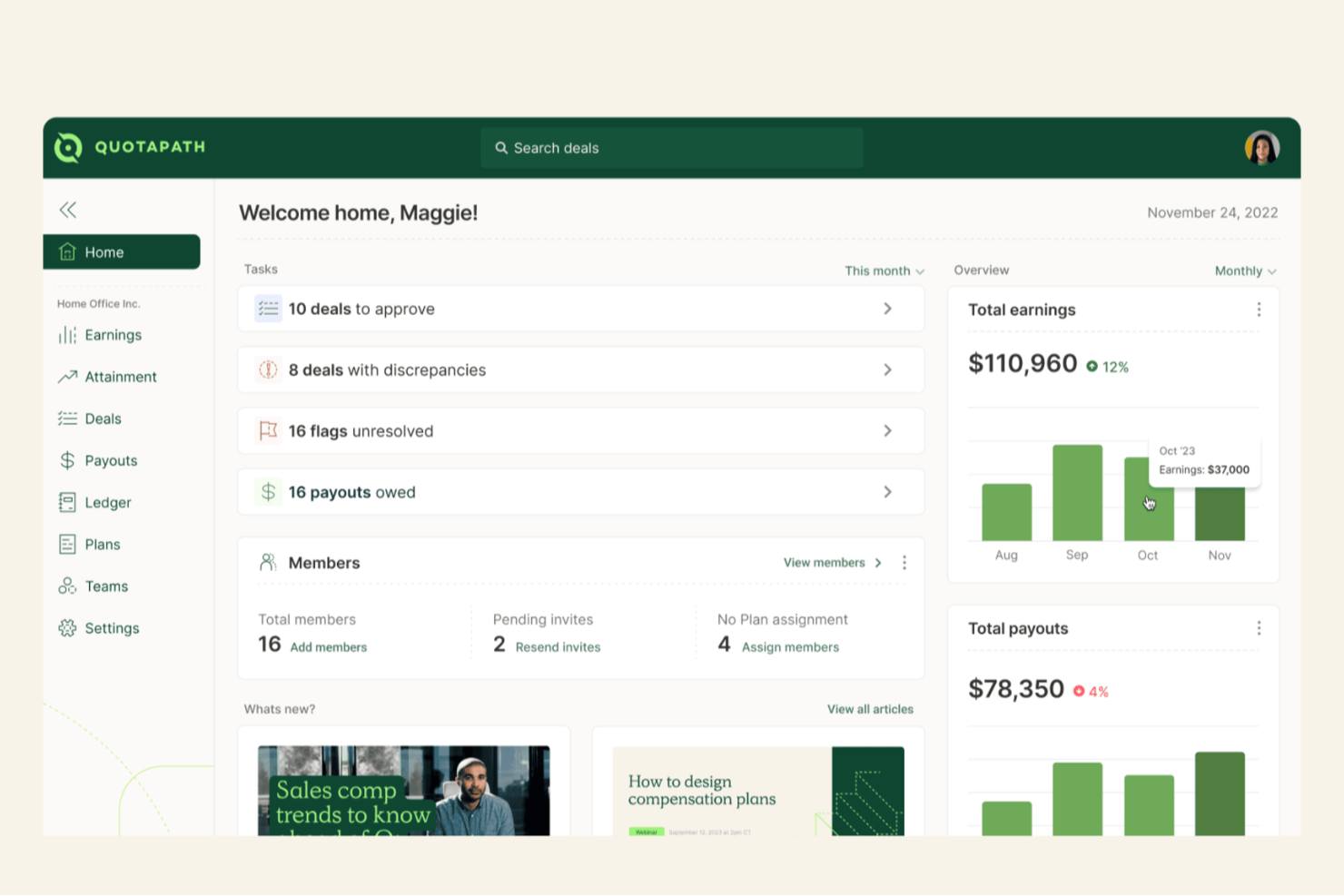
QuotaPath is a sales commission software built for sales leaders, RevOps, and finance leaders to plan, track, and pay commissions with confidence. It centralizes compensation structures, automates payouts, and gives sales reps visibility into their earnings.
Why I picked QuotaPath: I picked QuotaPath because it helps you build tailored compensation plans with its AI-driven plan builder and ensures fairness with payout approvals, data locking, and clear rules. These tools cut down disputes, keep everyone accountable, and let your team focus on selling instead of worrying about pay accuracy.
QuotaPath Standout Features and Integrations
Standout features include real-time earnings visibility, customizable compensation rules, data locking, tailored approval workflows, attainment dashboards, dispute resolution support, flexible payout rules, quota management, commission modeling, period management, and transparent reporting.
Integrations include native integrations with Close, Copper, HubSpot, Maxio, Salesforce, Stripe, SugarCRM, and Zoho CRM. You can also build custom integrations with the open API functionality.
Pros and Cons
Pros:
- Dedicated account manager
- Free forever plan
- Comprehensive free trial
Cons:
- Limited user-friendly visuals
- Feels like a finance tool

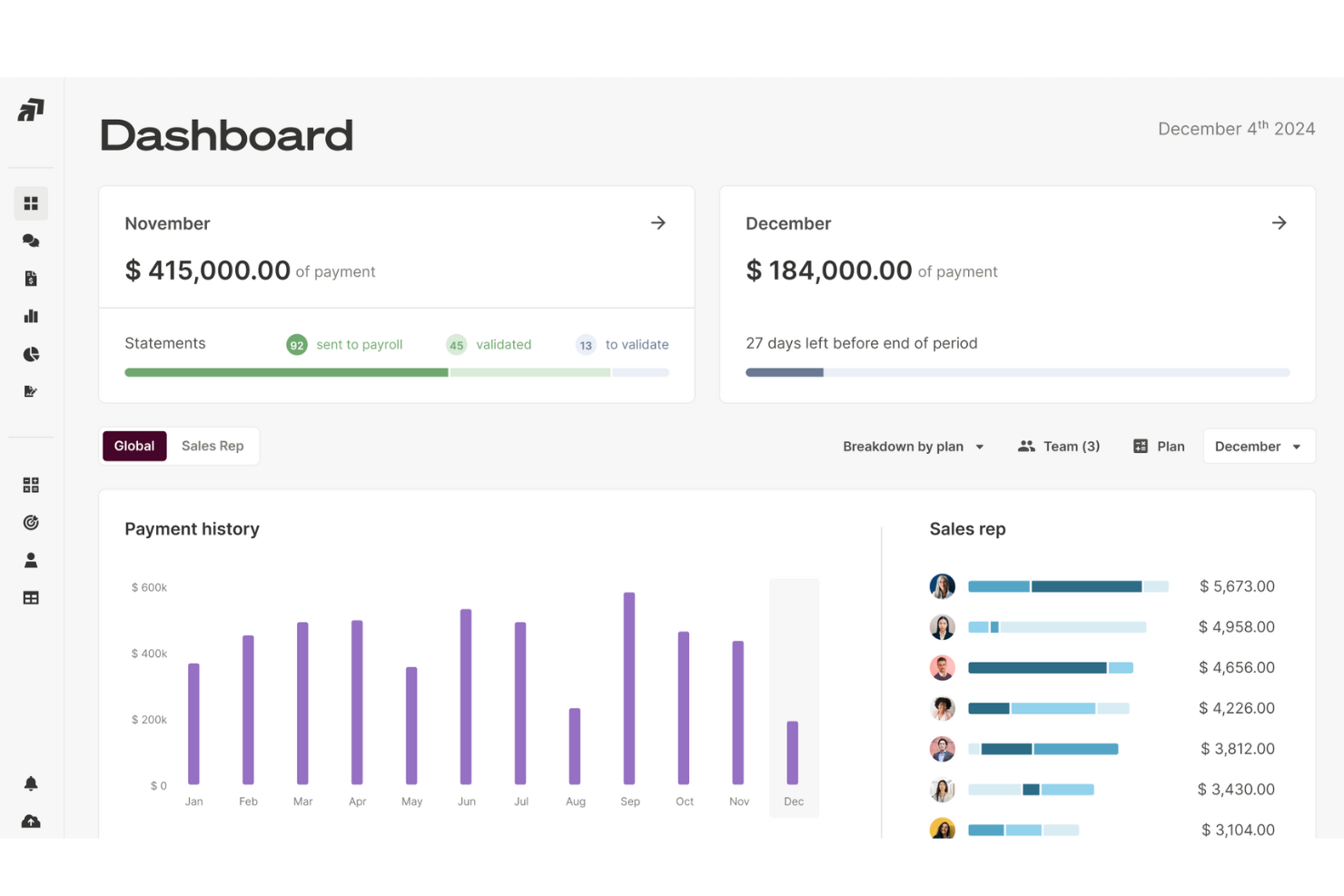
Qobra is a sales commission platform designed for revenue operations teams and sales leaders who need to automate complex compensation plans, reduce manual errors, and gain real-time visibility into commission data.
Who Is Qobra Best For?
Qobra is a strong fit for mid-market and enterprise sales organizations where finance and RevOps teams need structured, auditable commission processes across large or distributed sales teams.
Why I Picked Qobra
Qobra earns its spot on my shortlist because of how well it handles the approval side of commission management. I particularly like the lock and validation workflow, which lets managers, HR, and finance each sign off on commission amounts before anything gets paid out. My team can catch discrepancies at the right stage rather than chasing corrections after payroll closes. The built-in discussion feature lets stakeholders flag and resolve exceptions directly in context, so there's no back-and-forth over email when a deal needs special handling.
Qobra Key Features
- No-code plan builder: Design and manage compensation plans using a drag-and-drop interface without technical skills or developer support.
- Plan simulation and sandboxing: Test new compensation plans or changes in an isolated environment before rolling them out to your team.
- Real-time commission statements: Give each sales rep a clear, up-to-date commission recap that refreshes automatically as deals close in your CRM.
- Audit trail: Log all actions taken on the platform to maintain a secure, reviewable history of every change made to commission data.
Qobra Integrations
Integrations include Salesforce, HubSpot, Microsoft Dynamics 365, Google BigQuery, Snowflake, Workday, Slack, and an open API for custom integrations.
Pros and Cons
Pros:
- Instant visibility into commission breakdowns
- Automates manual commission calculation
- Supports complex pay models like accelerators and hybrid bonuses
Cons:
- Occasional issues with integration into existing systems
- Data synchronization or system updates can sometimes lag


Xactly is a sales commission platform built for revenue operations teams and sales leaders who need to automate complex compensation processes, improve payout accuracy, and gain real-time insights into sales performance.
Who Is Xactly Best For?
Xactly is a strong fit for mid-market and enterprise sales organizations that manage large, complex sales teams with multi-tiered compensation structures.
Why I Picked Xactly
Xactly earns its spot on my shortlist because it's one of the few commission platforms built to connect compensation design directly to GTM strategy. I like how Xactly's quota-setting and territory management tools let my team align rep incentives with pipeline targets from the start of each planning cycle. The compensation modeling features let me run "what-if" scenarios before rolling out new plans, so I can see how a plan change affects rep behavior and revenue outcomes before it goes live. Xactly's AI-driven insights also flag when comp plans are driving the wrong behaviors, a capability most commission tools don't offer.
Xactly Key Features
- Compensation configurator: Build and manage complex comp plans using reusable rules, quotas, and rate tables, with AI trained on 20 years of proprietary data.
- Customized incentive statements: Give reps a clear, detailed breakdown of how their commissions are calculated to reduce disputes and payout inquiries.
- Commission expense accounting: Automate amortization schedules and true-up changes while maintaining compliance with ASC 606 and IFRS 15 standards.
- Benchmarking dashboards: Compare your comp plans and attainment against industry peers using Xactly's proprietary pay and performance dataset.
Xactly Integrations
Integrations include Salesforce, Microsoft, Oracle, Workday, ServiceNow, and Amazon Web Services; an API is provided for custom integrations.
Pros and Cons
Pros:
- Automates complex commission rules easily
- Improves rep trust with transparent earnings
- Reduces manual errors in calculations
Cons:
- Requires clean data for accurate payouts
- Custom rules may need expert configuration

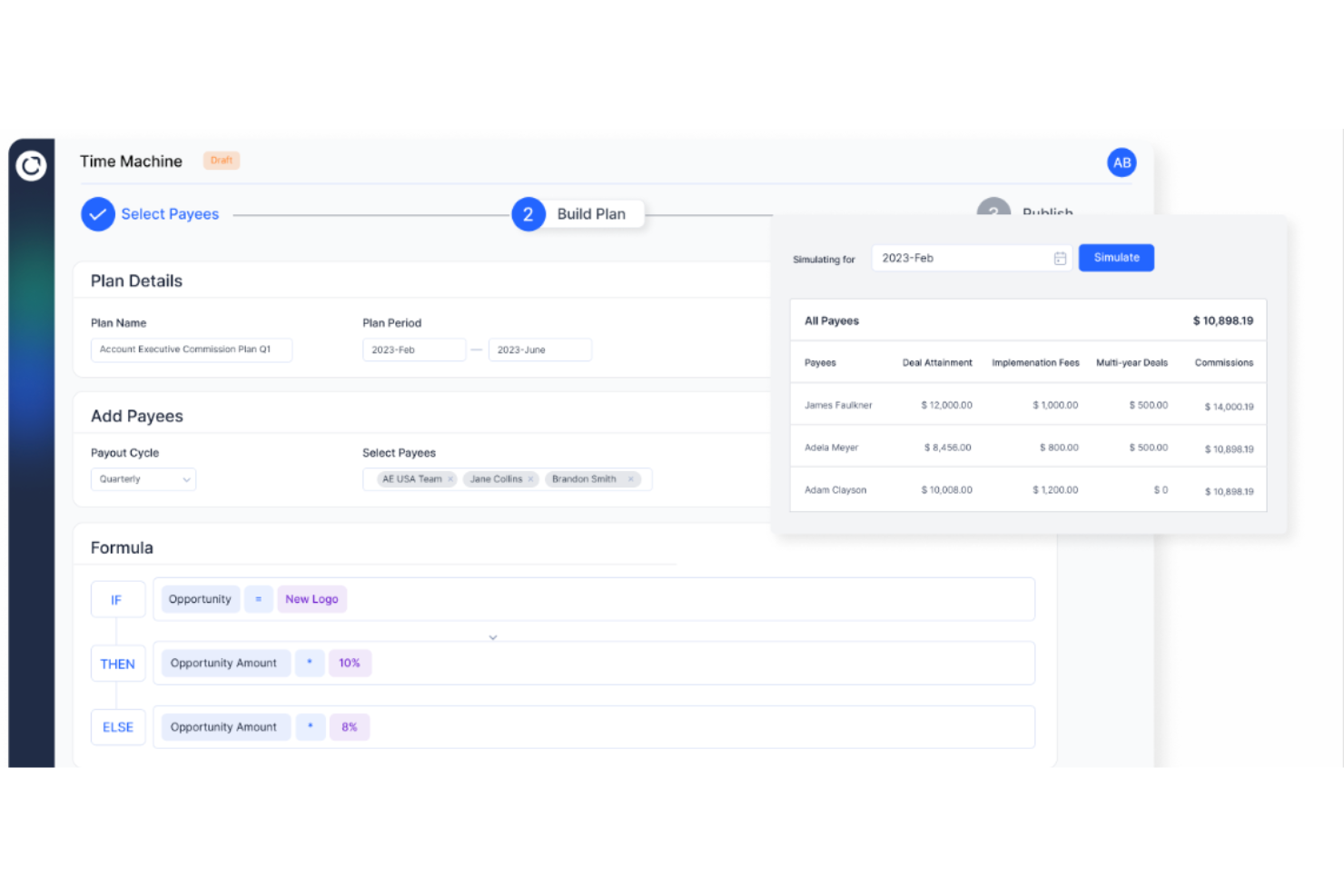
Everstage is a sales commission platform designed for revenue operations teams and sales leaders who want to automate complex commission processes, improve transparency, and give reps real-time visibility into their earnings.
Who Is Everstage Best For?
Everstage is a strong fit for mid-market and enterprise sales teams that need a flexible, scalable way to manage and automate commission plans without relying on engineering resources.
Why I Picked Everstage
I picked Everstage because its no-code plan designer removes the IT bottleneck that slows many RevOps teams. I can build, test, and deploy complex commission structures—tiered rates, accelerators, splits—without writing any code. The Time Machine feature lets me model how a new plan would have paid out against historical performance data before rolling it live, so my team can see the financial impact of a plan change.
Everstage Key Features
- Payout approvals and overrides: Manage commission approvals through a structured workflow with the ability to add manual overrides and comments before finalizing payouts.
- Crystal forecasting: Gives reps a real-time view of projected earnings based on current pipeline, reducing back-and-forth with RevOps over expected payouts.
- ASC 606 reporting: Automatically generates compliance-ready revenue recognition reports, tracking performance obligations, capitalization, and amortization.
- Query resolution tracking: Lets reps flag commission disputes directly in the platform, with a tracked resolution workflow so nothing gets lost in email threads.
Everstage Integrations
Integrations include Salesforce, HubSpot, Microsoft Dynamics CRM, Zoho CRM, Netsuite, Stripe, QuickBooks, Shopify, Bamboo HR, and Slack.
Pros and Cons
Pros:
- Enables collaboration among sales teams
- Provides actionable insights and alerts
- Easy access to performance tracks
Cons:
- Some login issues and slow access
- Trackers and statements may contain outdated information

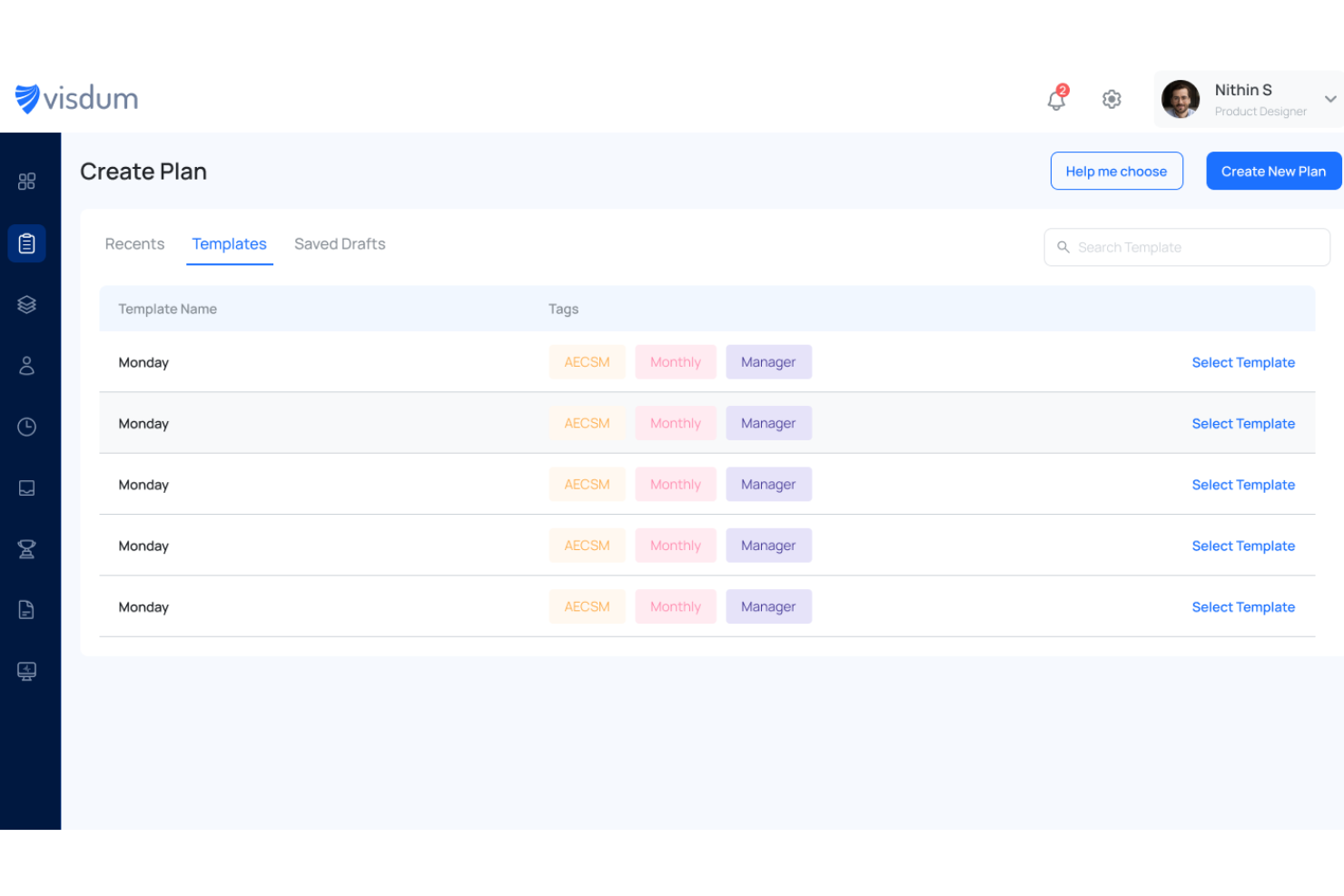
Visdum is a sales commission management platform designed for revenue operations teams and sales leaders who need to automate complex compensation plans, reduce manual errors, and gain real-time visibility into commission data.
Who Is Visdum Best For?
Visdum is a strong fit for mid-market SaaS companies where sales operations and finance teams need to manage and automate multi-tiered commission structures without relying on spreadsheets.
Why I Picked Visdum
Visdum earns its spot on my shortlist because its AI-Adaptive engine handles the parts of commission management that typically break down at scale. The AI Copilot simulates real-time payout scenarios while you build or adjust comp plans, letting my team catch logic errors before payroll runs and disputes arise. The no-code plan designer also means I'm not waiting on engineering to update a quota threshold or add a new commission tier. Additionally, the AI-guided validation layer monitors each compute cycle and flags errors automatically, reducing the back-and-forth between finance and RevOps during close.
Visdum Key Features
- Rep-facing commission estimator: Sales reps can run "what-if" scenarios directly in their payee dashboard to see projected earnings based on open pipeline deals.
- SPIFFs and contests management: Sales leaders can set up and run short-term incentive programs and competitions on top of existing comp plans without rebuilding the plan structure.
- Clawback and mid-cycle adjustment tools: Finance and RevOps teams can apply clawbacks, top-ups, or mid-cycle corrections in a few steps, with a full audit trail attached.
- ASC 606 and IFRS 15 compliance automation: Visdum automatically structures commission amortization to align with revenue recognition standards, reducing manual compliance work.
Visdum Integrations
Integrations include Salesforce, HubSpot, Oracle NetSuite, Microsoft Dynamics, Sage Intacct, QuickBooks, Workday, HiBob, ADP, and DocuSign.
Pros and Cons
Pros:
- Real-time performance dashboards
- Clear visibility into earnings
- Intuitive, user-friendly interface
Cons:
- Mobile user support limited to higher-tiered plans
- Initial setup can be complex

Best for making selling fun while ensuring teams stay focused on goals

Xoxoday Compass is a sales commission platform built for revenue teams who want to automate incentive programs, track performance in real time, and motivate sales reps with gamified rewards and recognition.
Who Is Xoxoday Compass Best For?
Xoxoday Compass is a strong fit for mid-to-large sales organizations looking to replace manual commission tracking with automated, gamified incentive programs.
Why I Picked Xoxoday Compass
Xoxoday Compass earns its spot on my shortlist because it turns commission tracking into something reps actually want to engage with. I love how the gamification layer—leaderboards, milestone badges, and sales contests—keeps reps focused on specific targets without requiring managers to constantly follow up. My team uses the real-time nudges feature to surface personalized performance updates directly to reps, so everyone knows exactly where they stand against their goals. The incentive program builder also lets me design tiered commission structures that reward incremental progress, not just closed deals.
Xoxoday Compass Key Features
- Low-code commission plan builder: Set up and modify incentive plans without writing code, using a visual interface that lets you configure rules, tiers, and payout logic directly.
- Automated commission calculations: Pull data from connected CRM and sales systems to calculate commissions automatically, reducing manual errors and ensuring reps are paid accurately.
- Sales performance analytics: Access dashboards that surface individual and team performance data, giving managers a clear view of quota attainment and payout trends.
- Rewards marketplace: Let reps redeem earned incentives from a catalog of 10M+ reward options across gift cards, travel, merchandise, and more in 175+ countries.
Xoxoday Compass Integrations
Integrations include Salesforce, HubSpot, Zoho CRM, SAP SuccessFactors, Workday, ADP, Oracle HCM, Slack, Microsoft Teams, QuickBooks, and an API is available for custom integrations.
Pros and Cons
Pros:
- Plans are completely customizable
- Intuitive user experience
- Support is available 24/7
Cons:
- No free trial
- Onboarding for complex organizations may take several weeks


SmartWinnr is a sales commission and incentive management platform designed for sales teams and organizations that want to automate commission tracking, motivate reps, and drive performance with real-time analytics and gamification.
Who Is SmartWinnr Best For?
SmartWinnr is a strong fit for mid-to-large sales organizations in industries like insurance, pharma, and financial services that manage distributed or field-based sales teams.
Why I Picked SmartWinnr
I picked SmartWinnr as one of the best because of how well it serves reps who spend most of their day away from a desk. The field coaching module is built mobile-first—managers can complete coaching forms, leave notes, and assign follow-up practice directly from their phone, even offline, with everything syncing once they're back online. I also like that live leaderboards update in real time on mobile, so reps in the field can check their contest standings and commission-linked KPI progress without logging into a desktop. For distributed sales teams where reps are rarely at a computer, that kind of on-the-go visibility into performance and incentives is genuinely useful.
SmartWinnr Key Features
- Incentive plan configuration: Build and manage multiple commission and incentive plan structures across different roles, regions, or product lines.
- AI-powered sales quizzes: Deliver bite-sized knowledge checks to reps to reinforce product knowledge and compliance training alongside performance tracking.
- Target vs. achievement tracking: Monitor individual and team progress against quota in real time with visual dashboards tied to commission outcomes.
- Contest management: Set up time-bound sales contests with custom rules, eligibility criteria, and reward structures to drive short-term performance.
SmartWinnr Integrations
Integrations include Salesforce, Microsoft Teams, Slack, SAP SuccessFactors, Oracle, Workday, Cornerstone OnDemand, Moodle, Zoom, and an API for custom integrations.
Pros and Cons
Pros:
- Responsive and fast support
- Multi-language availability
- Mobile-focused approach
Cons:
- No free trial
- Not a commission payout system

Best enterprise-grade compensation management software that’s easy to use

Performio is a sales commission software built for revenue operations and finance teams who need to automate complex compensation processes, improve accuracy, and provide clear visibility into commission data for large or fast-growing organizations.
Who Is Performio Best For?
Performio is a strong fit for mid-market and enterprise sales organizations that manage high volumes of commission calculations across large or distributed sales teams.
Why I Picked Performio
Performio earns its spot on my shortlist because it genuinely delivers enterprise-grade commission management without the usual implementation headaches. What I like most is the structured plan builder—you can configure targets, crediting logic, clawbacks, draws, and true-ups without writing a single formula or calling in professional services. I also find the AI Admin Assistant particularly useful for enterprise teams: it flags calculation anomalies and speeds up dispute resolution in real time, which cuts down the back-and-forth that typically bogs down comp admins at scale. The flexible data model is another standout for large organizations, since Performio adapts to your existing data format rather than forcing you to reformat everything before importing.
Performio Key Features
- Sales rep portal: A configurable portal where reps can view their commission results, deal-level details, leaderboard rankings, and what-if calculators on desktop and mobile.
- ASC606 compliance and audit logs: Built-in support for ASC606 accounting guidelines, with full audit history and override capabilities for exceptions and edge cases.
- Commission forecasting and simulation: Tools to model and predict commission expenses, manage accruals, and run scenario planning for sales capacity and territory design.
- Analytics Studio: An AI-powered BI reporting layer that generates custom dashboards, leaderboards, and data visualizations directly from your compensation data.
Performio Integrations
Integrations include Salesforce, NetSuite, HubSpot, Microsoft Dynamics CRM, QuickBooks Online, Xero, Workday, Bamboo HR, Amazon Redshift, and Google BigQuery.
Pros and Cons
Pros:
- White-glove services
- Fast to implement
- Easy and intuitive to use
Cons:
- Limited flexibility in user reports
- Enterprise focused

Best for automating complex sales commission calculations

Core Commissions is built for businesses that need to manage intricate sales commission structures, helping finance and sales operations teams automate calculations, track payouts, and reduce manual errors.
Who Is Core Commissions Best For?
Core Commissions is a strong fit for mid-sized to enterprise businesses running multi-tiered or high-volume commission programs that have outgrown spreadsheet-based tracking.
Why I Picked Core Commissions
Core Commissions is on my shortlist because it handles commission structures that would break most spreadsheets. I chose it for its rules-based calculation engine, which lets my team define multi-tiered plans, split credits, and override logic without custom code. Automated audit trails log every calculation, so when a rep disputes a payout I can pull the exact formula and data that produced it. That level of transparency is difficult to achieve with manual processes.
Core Commissions Key Features
- Dispute management: A built-in workflow for reps to submit commission disputes, which managers can review, respond to, or escalate directly within the platform.
- Core Portal: A white-labeled web portal where individual reps can log in to view their own pay statements and performance data.
- Drag-and-drop report designer: A customizable reporting module that lets you build commission reports and dashboards using a visual drag-and-drop interface.
- Flexible commission cycle scheduling: Supports unlimited commission cycles running concurrently, across any time period—monthly, quarterly, or custom.
Core Commissions Integrations
Integrations include Salesforce, Microsoft Dynamics, Oracle NetSuite, HubSpot, Freshsales, and QuickBooks.
Pros and Cons
Pros:
- Unparalleled level of support
- ETL module for data transformation
- Automated commission calculating process
Cons:
- No dedicated mobile application
- Occasional disruptive technical issues
- Limited cloud-based version

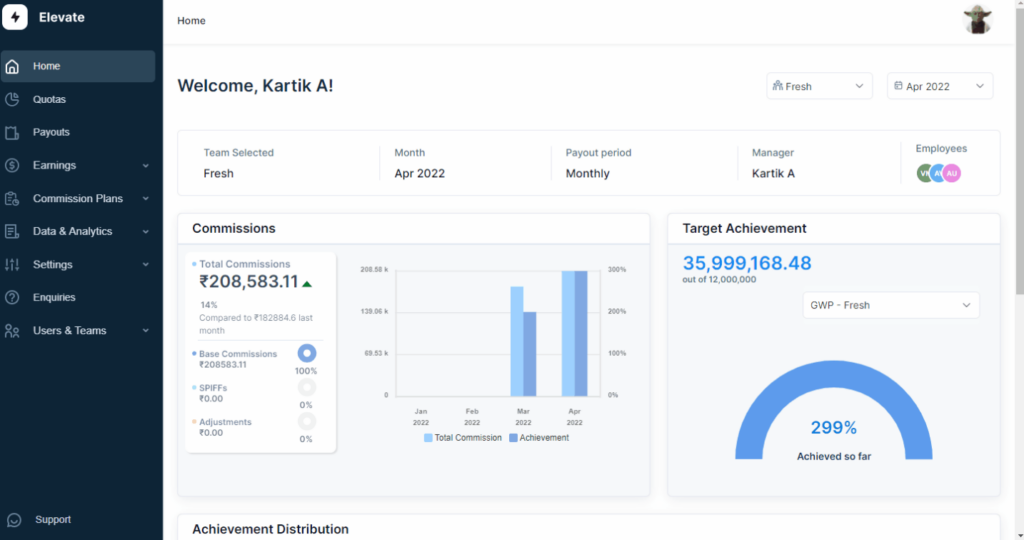
ElevateHQ is a sales commission platform designed for revenue teams who need to automate complex commission calculations, improve payout accuracy, and give sales reps real-time visibility into their earnings.
Who Is ElevateHQ Best For?
ElevateHQ is a good fit for growing B2B sales teams that need to move beyond spreadsheets and manage multi-tiered or quota-based commission plans at scale.
Why I Picked ElevateHQ
ElevateHQ earns its spot as one of the best on my shortlist because of how well it handles payout transparency and reconciliation. I particularly like the payout reconciliation feature—if your team pays commissions on invoice collections, ElevateHQ automatically matches inward payments to deals and reps, which reduces the manual back-and-forth at month-end. Additionally, the overrides and audit trails feature lets me make exceptions to commission rules while logging every change, so there's a clear, traceable record of what was paid and why. Reps can also see exactly how their commissions are calculated through transparent payout workflows, which cuts down on disputes significantly.
ElevateHQ Key Features
- Commission plan designer: Build custom commission structures using a no-code plan designer that supports complex rules, multiple conditions, and custom CRM fields.
- Plan simulations: Test new commission plans before rolling them out to see how they'll affect payouts and team performance.
- Behavioral nudges: Surface incentive-based insights that show reps where they can take action to earn more within their current commission plan.
- Query resolution: Manage commission disputes through a built-in ticketing system that logs conversations, supporting documents, and overrides in one place.
ElevateHQ Integrations
Integrations include Salesforce, HubSpot, Microsoft Teams, Pipedrive, Slack, Chargebee, QuickBooks, Salesloft, Xero, and NetSuite.
Pros and Cons
Pros:
- Simple and easy to use
- Notifications for commission or plan changes
- Efficient and accurate commission tracking
Cons:
- Software can lag with large file loads
- No gamification features
Other Sales Commission Software
Here are some additional sales commission software options that didn’t make it onto my shortlist, but are still worth checking out:
- Leaptree
For Salesforce-native sales-focused teams
- Varicent
Sales commission software for resolving mid-market commission problems
- Spiff
For scaling to any complexity and volume
- Palette
For small teams who need automatic, rules
- Commissionly
Sales commission software for quick and easy setup
- Creatio CRM
For no-code commission process automation
- QCommission
Commission software for GDPR, ASC 606, ISO, and SOC 1 and SOC 2 compliance
- Sales Cookie
Commission platform with incentive planning, designing, and tracking tools
- SparkPlug
Sales incentive software for frontline employees in retail and restaurant industries
- CaptivateIQ
Sales commission tool for flexible, variable workflows and inevitable adjustments
- Iconixx Sales
For automating commission, bonus, and merit programs to lower administrative costs


Sales Commission Software Selection Criteria
When selecting the best sales commission software to include in this list, I considered common buyer needs and pain points like accuracy in commission calculations and ease of integration with existing systems. I also used the following framework to keep my evaluation structured and fair:
Core Functionality (25% of total score)
To be considered for inclusion in this list, each solution had to fulfill these common use cases:
- Automate commission calculations
- Generate commission reports
- Integrate with CRM systems
- Track sales performance
- Handle multiple commission plans
Additional Standout Features (25% of total score)
To help further narrow down the competition, I also looked for unique features, such as:
- Customizable dashboards
- AI-driven analytics
- Mobile app access
- Real-time data updates
- Multi-currency support
Usability (10% of total score)
To get a sense of the usability of each system, I considered the following:
- Intuitive interface
- Minimal learning curve
- Clear navigation
- Responsive design
- Customization options
Onboarding (10% of total score)
To evaluate the onboarding experience for each platform, I considered the following:
- Availability of training videos
- Step-by-step product tours
- Access to templates
- Interactive chatbots
- Scheduled webinars
Customer Support (10% of total score)
To assess each software provider’s customer support services, I considered the following:
- 24/7 support availability
- Multiple support channels
- Response time
- Knowledgeable staff
- Comprehensive help center
Value For Money (10% of total score)
To evaluate the value for money of each platform, I considered the following:
- Pricing transparency
- Competitive pricing
- Flexible pricing plans
- Free trial availability
- Cost-effectiveness
Customer Reviews (10% of total score)
To get a sense of overall customer satisfaction, I considered the following when reading customer reviews:
- Overall satisfaction rating
- Commonly praised features
- Frequent complaints
- Customer retention rates
- Feedback on updates and improvements
How to Choose Sales Commission Software
It’s easy to get bogged down in long feature lists and complex pricing structures. To help you stay focused as you work through your unique software selection process, here’s a checklist of factors to keep in mind:
| Factor | What to Consider |
|---|---|
| Scalability | Can the software grow with your business? Consider future needs and whether the tool can handle increased users and transactions without a hitch. |
| Integrations | Does it work with your current systems? Check compatibility with your CRM, ERP, and other essential tools to avoid data silos. |
| Customizability | Can you tailor it to your workflows? Look for options to adjust settings, reports, and dashboards to suit your team's processes. |
| Ease of use | How user-friendly is it? Evaluate if your team can quickly adopt it without extensive training or frustration. |
| Implementation and onboarding | How long will it take to set up? Consider the time and resources needed to get up and running, including any required training sessions. |
| Cost | Is it within your budget? Compare pricing plans and watch for hidden fees. Ensure the value matches the price. |
| Security safeguards | How secure is your data? Look for encryption, access controls, and compliance with data protection standards. |
| Support availability | What support options are there? Check if the vendor offers timely assistance through chat, email, or phone when you need help. |
Trends In Sales Commission Software For 2026
The evolution of sales commission software reflects broader trends in business technology, emphasizing automation, transparency, and strategic insights. Let's delve into the specific trends that are currently shaping sales commission software:
Automation and Integration
- Enhanced Automation: There's a clear trend toward more sophisticated automation features, reducing the manual effort needed for calculating and distributing commissions. Automation extends to data imports, rule application, and even dispute resolutions, streamlining the commission process.
- Deeper CRM and ERP Integrations: Sales commission tools are offering deeper, more seamless integrations with CRM and ERP systems, enabling real-time data flow and ensuring that sales performance and commission calculations are always aligned with the latest business data.
Analytics and Transparency
- Advanced Analytics: Rapid advancements in analytics within sales commission software allow for more detailed performance tracking and trend analysis. These insights can drive strategic decisions in sales and finance, optimizing commission plans for better results.
- Greater Transparency: Tools are increasingly providing features that enhance transparency for all stakeholders. This includes detailed dashboards and reports accessible by sales reps, managers, and finance teams, fostering trust and understanding across the organization.
Evolution of Demand
- Declining Demand for Standalone Solutions: As businesses seek to consolidate their tech stacks, the demand for standalone sales commission tools is diminishing. Instead, there's a preference for comprehensive platforms that offer end-to-end sales performance management.
- Decreased Emphasis on Basic Calculation Features: While core functionalities remain crucial, there's a notable shift away from basic calculation features toward more complex, value-adding functionalities like scenario planning and predictive analytics.
By understanding these trends, revenue operation leaders can select sales commission software that not only meets their current operational needs but also positions them well for future challenges and opportunities. The right software should offer a blend of depth in functionality, ease of use, and strategic insights, enabling organizations to optimize their sales incentives and drive revenue growth effectively.
What Is Sales Commission Software?
Sales commission software is a digital tool that automates the calculation and management of sales commissions. It is used by businesses to handle complex commission structures, track sales representative performance, and ensure accurate commission payouts. The software integrates with sales and payroll systems to streamline the commission process, from calculation to distribution.
Features
When selecting sales commission software, keep an eye out for the following key features:
- Automated calculations: Automatically compute commissions based on sales data to reduce errors and save time.
- CRM integration: Sync with existing CRM systems to ensure accurate data flow and real-time updates.
- Customizable reports: Generate tailored reports to analyze commission trends and performance metrics.
- Multiple commission plans: Support various commission structures to accommodate different sales roles and strategies.
- Real-time data updates: Provide instant access to the latest sales and commission information for informed decision-making.
- Mobile access: Enable users to view and manage commission data on the go, enhancing flexibility and accessibility.
- Security safeguards: Protect sensitive financial data with encryption and access controls to maintain compliance.
- User-friendly interface: Ensure ease of use for quick adoption by sales teams and administrators.
- Training resources: Offer tutorials, webinars, and guides to help users get the most out of the software.
- Customer support: Provide timely assistance through multiple channels to resolve issues and answer questions.
Benefits
Implementing sales commission software provides several benefits for your team and your business. Here are a few you can look forward to:
- Increased accuracy: Automated calculations reduce errors in commission payouts, ensuring fairness and trust.
- Time savings: By automating data entry and calculations, your team can focus on more strategic tasks.
- Enhanced motivation: Clear and accurate commission tracking motivates sales teams by linking pay directly to performance.
- Improved transparency: Customizable reports and real-time updates provide a clear view of sales and commissions.
- Flexibility: Multiple commission plans and mobile access allow you to adapt to different sales roles and work environments.
- Better decision-making: Real-time data updates help managers make informed decisions based on current sales performance.
- Security and compliance: Strong security safeguards protect sensitive data, ensuring compliance with industry standards.
Costs & Pricing
Selecting sales commission software requires an understanding of the various pricing models and plans available. Costs vary based on features, team size, add-ons, and more. The table below summarizes common plans, their average prices, and typical features included in sales commission software solutions:
Plan Comparison Table for Sales Commission Software
| Plan Type | Average Price | Common Features |
|---|---|---|
| Free Plan | $0 | Basic commission tracking, limited users, and basic reporting. |
| Personal Plan | $5-$25/user/month | Advanced calculations, CRM integration, and customizable reports. |
| Business Plan | $30-$60/user/month | Multiple commission plans, mobile access, and enhanced security features. |
| Enterprise Plan | $70-$100/user/month | Real-time data updates, dedicated support, and full customizability options. |
Sales Commission Software FAQs
Here are some answers to common questions about sales commission software:
How do I know if my business needs sales commission software?
If your team spends too much time on manual commission calculations or you face frequent errors, it’s time to consider sales commission software. It’s especially useful if your sales team is growing or if you use complex commission structures. Evaluate your current processes, and if they seem cumbersome or error-prone, software could be a smart investment.
Is sales commission software secure?
Yes, reputable sales commission software includes security measures like encryption and access controls. Always check the software’s security features and compliance with data protection regulations. This is crucial for protecting sensitive financial information. Ask vendors about their security certifications and how they handle data breaches.
How does sales commission software improve payout transparency?
Make sure reps can see earnings, goals, and upcoming payouts. Transparency reduces disputes and builds trust.
What’s Next:
If you're in the process of researching sales commission software, connect with a SoftwareSelect advisor for free recommendations.
You fill out a form and have a quick chat where they get into the specifics of your needs. Then you'll get a shortlist of software to review. They'll even support you through the entire buying process, including price negotiations.