

Struggling to separate high-quality leads from the noise? In 2026, the best lead scoring software can be the difference between closing deals and chasing dead ends. This guide breaks down 25 top tools that help you focus your energy on the prospects most likely to convert, so you can stop wasting time and start winning more business.
Why Trust Our Software Recommendations
6,700+
Reviews
20
Industry experts
16+
Evaluation factors
14
Years
Our reviews reflect our independent judgment—not a sales pitch. Learn how we stay transparent.
For this guide, we evaluated tools using hands-on testing and independent research, scoring tools using our selection criteria.
Our reviews reflect our human editorial judgment, not a sales pitch.
| Tool | Best For | Trial Info | Price | ||
|---|---|---|---|---|---|
| 1 | Best with real-time verified B2B lead data | Free plan + 14-day free trial + free demo available | From $49/user/month (billed annually) | Website | |
| 2 | Best for affordable advanced features | 14-day free trial | From $15/month (billed annually) | Website | |
| 3 | Best for data-driven insights | Not available | Pricing upon request | Website | |
| 4 | Best for small-to-medium enterprises (SMEs) | Free demo available | From $60/user/month (billed annually) | Website | |
| 5 | Best for enterprise-level businesses | Free demo | From $895/month | Website | |
| 6 | Best for B2B using Salesforce | From $1,250/month | Website | ||
| 7 | Best for enterprise customization | Free demo available | Pricing upon request | Website | |
| 8 | Best for enterprise predictive scoring | Free demo available | Pricing upon request | Website | |
| 9 | Best for advanced predictive analytics | Free demo available | Pricing upon request | Website | |
| 10 | Best for low budgets | Free Demo And Free Trial | From $37 a month for 250 lead | Website |


Best Lead Scoring Software Reviews
Here are the 10 leading lead scoring software solutions to help you identify qualified leads and optimize your sales pipelines.
 Best with real-time verified B2B lead data
- Free plan + 14-day free trial + free demo available
- From $49/user/month (billed annually)
Visit WebsiteCustomer Rating:4.5/5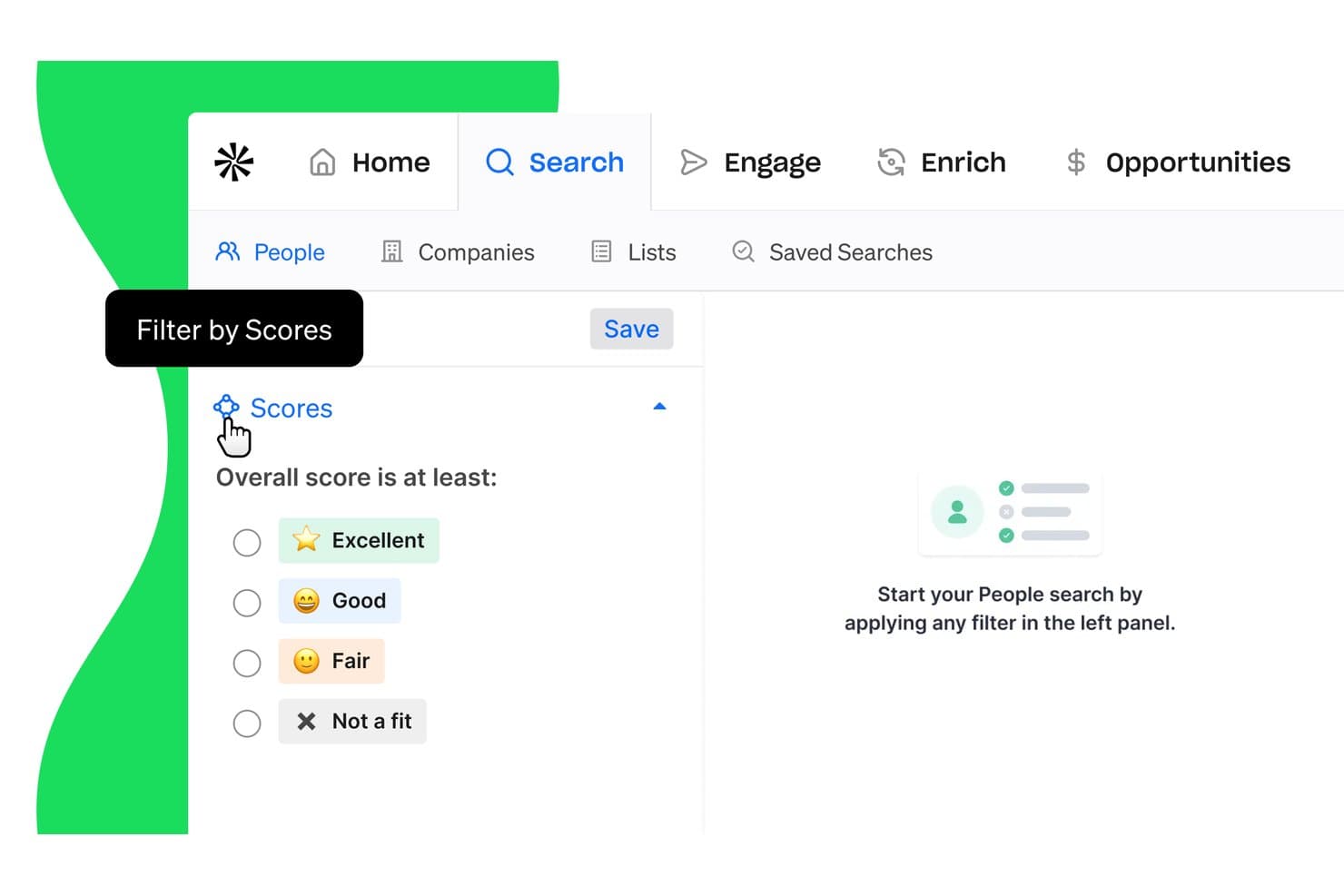
Apollo.io offers a 'Filter by Scores' panel that lets users filter people by overall lead score categories including Excellent, Good, Fair, and Not a fit. Apollo.io is an AI-powered sales intelligence platform that combines lead scoring, B2B contact database prospecting, and behavioral and firmographic signal ingestion with built-in sales engagement tools in a single workspace.
Who Is Apollo.io Best For?
Apollo.io is a strong fit for B2B sales and revenue operations teams at growth-stage and mid-market companies running high-volume outbound prospecting.
Why I Picked Apollo.io
Apollo.io earns its spot on my shortlist because the lead scoring runs directly on top of a live, continuously verified database of 210M+ contacts. When I filter by score in Apollo's search, I'm scoring against real-time enriched data, not a stale export. The AI auto-score models train on my CRM's historical conversion data and layer in buying intent signals based on active prospect behavior online, so the inputs feeding my scores are already verified before I touch a model.
Apollo.io Key Features
- Custom scoring model builder: Build and tune scoring models using both rules-based and AI-driven criteria.
- Multi-source data enrichment: Pulls firmographic, demographic, and behavioral data directly into lead profiles from hundreds of sources.
- Native CRM integration: Syncs lead scores and records bidirectionally with Salesforce, HubSpot, and Pipedrive.
- Score transparency: Lets users see exactly which attributes and activities contribute to each lead’s composite score.
Apollo.io Integrations
Apollo.io offers native integrations with Salesforce, HubSpot, Pipedrive, Marketo, Outreach, Salesloft, and SendGrid. An API is available for custom integrations.
Pros and Cons
Pros:
- Intent signals surface in-market accounts automatically
- AI scoring trains on historical CRM data
- Verified contact data strengthens scoring model inputs
Cons:
- Data accuracy drops outside North American markets
- Scoring features are secondary to prospecting tools
Learn more about Apollo.io: Best for affordable advanced features
- 14-day free trial
- From $15/month (billed annually)
Visit WebsiteCustomer Rating:4.4/5
ActiveCampaign enables users to sort leads by lead score ActiveCampaign is a marketing platform with advanced lead scoring functionality, a comprehensive CRM, and end-to-end marketing automations.
Why I picked ActiveCampaign:
If you need complex features but you have a limited budget, I think ActiveCampaign is well-equipped with advanced lead scoring features at a fair price. Its dynamic lead scoring made it easy for me to create highly-targeted lead segments, and the visual automation builder was a breeze when I was setting up automated workflows. Honestly, I was surprised how easy it was to streamline the whole lead nurturing process. Plus, it’s also a powerful all-in-one CRM and marketing automation solution.
Standout Features and Integrations
Features include lead capture forms, a landing page builder, and dynamic lead scoring. I like how well ActiveCampaign complements these core features with their conditional content and a visual automation builder for creating marketing workflows and their A/B testing and advanced analytics.
Integrations include a variety of ecommerce and marketing tools such as Salesforce, Adobe Commerce, Shopify, WooCommerce, BigCommerce, Leadpages, ClickFunnels, Typeform, and Zapier.
Pros and Cons
Pros:
- Good customer support
- Intuitive interface and visual builder
- Advanced automation and lead scoring features
Cons:
- No native integrations with popular CRMs like Salesforce
- Limited customization options for forms and landing pages
- Some users have reported occasional technical issues or bugs
- Limited A/B testing options for email campaigns
Learn more about ActiveCampaign:

Clearbit’s simple-to-use platform makes it easy to find high-value leads. Clearbit is a data enrichment platform that scores leads using machine learning, based on their firmographics, technographics, and behavioral data.
Why I picked Clearbit:
Clearbit is one of my top picks when it comes to data-driven insights. Lead scoring works using data enrichment and machine learning to improve lead quality and segmentation. I really appreciate how seamlessly the tool integrates with most popular CRM platforms, enabling organizations to make informed data-driven decisions and implement them directly through their current CRM platform.
Clearbit Standout Features and Integrations
Features include data enrichment and machine-learning lead scoring for smarter segmentation and improved lead quality. I gave extra points for the real-time data updates that ensure scoring is based on the latest information and for the API that allows for powerful custom integrations.
Integrations include a whole range of sales, marketing, and automation tools, including HubSpot, Segment, Salesforce, Zapier, Outreach, Drift, and Intercom.
Pros and Cons
Pros:
- Regular data updates validate data so you’re working with the latest information
- Seamless integration enables entire lifecycle management
- Machine learning-powered scoring improves predictions over time
- Provides comprehensive, enriched lead data for accurate scoring and segmentation
Cons:
- If you want to use the API successfully, you’ll need technical skills
- Lead scoring customization options are limited
- It’s not geared toward smaller businesses, so pricing is expensive
Learn more about Clearbit: Best for small-to-medium enterprises (SMEs)
- Free demo available
- From $60/user/month (billed annually)
Visit WebsiteCustomer Rating:4.4/5
LeadSquared enables users to assign values that add or subtract from a lead’s score. LeadSquared is a customer acquisition platform with easy-to-use lead scoring tools to monitor and analyze lead behavior, so sales teams can focus on the leads most likely to convert.
Why I picked LeadSquared:
LeadSquared is designed for SMEs. It offers an affordable all-in-one marketing automation solution with an intuitive lead scoring tool built in. I picked LeadSquared for this list because of its straightforward lead qualification features that funnels leads through multi-channel marketing automations for omnichannel lead nurturing.
Standout Features and Integrations
Features include multi-channel lead tracking, progressive profiling, and personalized lead nurturing campaigns to segment, manage, and nurture prospects. I’m a huge fan of the drag-and-drop tools such as the lead scoring builder, landing page builder, and lead capture forms creator that made for straightforward lead management setup.
Integrations include marketing tools like Mailchimp, JotForm, Constant Contact, and Hootsuite, as well as a bunch of customer lifecycle management tools like Salesforce, Microsoft Dynamics CRM, and HubSpot.
Pros and Cons
Pros:
- Good customer support
- Easy-to-use interface and drag-and-drop builder
- Robust lead management and marketing automation features
- Affordable pricing with no hidden fees
Cons:
- No mobile app
- Some users have reported bugs or technical issues
- Limited reporting and analytics features
- Limited third-party integrations compared to some other tools
Learn more about LeadSquared:

Marketo’s platform has highly customizable lead scoring functionalities. Marketo is an advanced lead scoring tool that enables large enterprises to customize scoring based on complex rules.
Why I picked Marketo:
I chose Marketo for this list because it is unmatched when it comes to lead scoring tools for large, enterprise-level businesses. Plus, It’s advanced capabilities and complex scoring models made it easy to incorporate a wide range of behavioral and demographic factors.
Not only does it integrate with lots of popular enterprise-level applications, but I found its analytics dashboards to be powerful enough for even large-scale business intelligence. Alongside its lead scoring and nurturing functionalities, it also offers marketing automation to create seamless sales and marketing workflows.
Standout Features and Integrations
Features include advanced scoring models based and automate lead nurturing workflow tools to collect and manage leads. There are also campaign management, email marketing, and landing page optimization features to enhance marketing campaigns. Advanced analytics and reporting tools make it easy to monitor progress.
Integrations include CRMs, such as Salesforce, Microsoft Dynamics CRM, SugarCRM, and Zoho CRM, as well as marketing and communication tools, like Zendesk, Hootsuite, Zoom, and Slack.
Pros and Cons
Pros:
- Strong integrations with popular third-party applications
- Comprehensive analytics and reporting features
- Highly customizable and configurable scoring models
- Robust lead scoring and lead nurturing capabilities
Cons:
- Requires a dedicated marketing team to fully utilize all features - why it’s best for enterprise
- Limited support options for lower-tier plans
- Steep learning curve for new users and complex setup process
- Expensive pricing plans make it unsuitable for smaller businesses
Learn more about Marketo:

Pardot users can assign lead scores to activities to see which strategies work best A Salesforce-based marketing automation software, Pardot helps you generate, nurture, and score leads to identify promising prospects and optimize sales efforts.
Why I picked Pardot:
For me, Pardot is a top choice for B2B businesses using Salesforce. You get advanced lead scoring software that integrates easily with your CRM for seamless data sharing and customer relationship lifecycle management. Plus, I like Pardot’s easy-to-use tools that help automate lead nurturing workflows for an all-in-one sales funnel solution.
Standout Features and Integrations
Features include advanced scoring models and automated lead nurturing workflows for straightforward segmentation and management. The email marketing and campaign management tools were great for streamline marketing campaigns, and I really enjoyed the in-depth reports on progress the analytics tools provide.
Integrations include lead capture integrations like Gravity Form and SurveyMonkey, as well as CRMs like Salesforce, Microsoft Dynamics CRM and SugarCRM. There are also customer service integrations such as Zendesk, and advertising tools like Google, Facebook, and Twitter Ads, and AdRoll.
Pros and Cons
Pros:
- Easy-to-use interface and user-friendly tools
- Comprehensive analytics and reporting features
- Advanced scoring models and lead nurturing workflows
- Salesforce integration provides seamless data sharing and lead management
Cons:
- Limited customer support for lower-tier plans
- Limited third-party integrations beyond Salesforce
- Limited customization options for landing pages and forms
- Expensive pricing plans - not for smaller businesses
Learn more about Pardot:

Oracle Eloqua users can assign weight to different activities to influence lead scores. Oracle Eloqua is a highly customizable marketing automation platform that helps businesses to segment and prioritize leads based on their engagement, behavior, and characteristics.
Why I picked Oracle Eloqua:
Oracle Eloqua is geared toward large-scale businesses. Out of the enterprise lead scoring options, I found that Oracle Eloqua has the best set of customizable tools, coupled with extensive analytics and advanced segmentation. There’s also a wide range of templates and workflow automations to simplify campaign creation and execution.
Standout Features and Integrations
Features include advanced automation for multi-step marketing and sales campaigns, plus comprehensive reporting for improving future marketing efforts. I’m a huge fan of how much thought the developers put into the customizable lead scoring and qualification rules, and the robust personalization features for forms, landing pages, and emails.
Integrations include sales and marketing tools like Salesforce, Marketo, HubSpot, Pardot, ClickDimensions, 6sense, ReachForce, and Bombora.
Pros and Cons
Pros:
- Highly customizable lead forms and segmentation options
- Advanced reporting and analytics options
- Strong, in-depth customer support
- Robust customization and integration options
- Advanced lead scoring and automation features
Cons:
- While customer support is good, it’s often slow
- Limited third-party integrations compared to some other tools
- Steep learning curve and complex setup
- It’s pricey, starting at $2,000/month for up to 10,000 contacts
Learn more about Oracle Eloqua:

Infer’s lead scoring system is comprehensive but complex. Infer is a predictive lead scoring platform that uses machine learning algorithms to pinpoint the most valuable leads based on highly-customizable criteria.
Why I picked Infer:
For enterprises that need predictive lead scoring, Infer is my top pick. Designed for mid-market to large B2B organizations, Infer leverages machine learning-based predictive analytics to prioritize the highest value leads based on your predetermined criteria. The more the tool analyzes leads, the better it gets at predicting which prospects will produce the most value.
Standout Features and Integrations
Features include a proprietary dataset of over 20 billion customer interactions, along with automated lead scoring and prioritization plus customizable scoring models. I liked the real-time analytics and reporting which help prioritize leads based on prospect data.
Integrations include marketing and data management platforms such as Eloqua, Marketo, Pardot, and HubSpot, as well as LiveRamp, LeanData, Demandbase, and Bombora.
Pros and Cons
Pros:
- Integrates with a wide range of other tools
- Easy to use and configure
- Comprehensive analytics and reporting
- Highly accurate predictive modeling capabilities
Cons:
- Some users report that customer support is slow
- Limited support for SMBs
- Very complex for beginners
- Expensive - not good for smaller companies
Learn more about Infer: Best for advanced predictive analytics
- Free demo available
- Pricing upon request

Explorium enriches data and uses AI to predict lead quality. Explorium utilizes predictive modeling and machine learning to identify the most valuable leads and improve lead scoring over time.
Why I picked Explorium
Explorium claims to be a revolution in lead scoring, and while I am typically skeptical of that kind of marketing fluff, I was impressed by its AI-driven lead scoring tools.
Explorium offers advanced predictive analytics based on internal and external data, so not only do you benefit from comprehensive insights based on your own leads, the platform’s AI algorithms train the software based on external data to predict better-quality leads.
Explorium Standout Features and Integrations
Features include advanced predictive lead scoring analytics and AI-driven lead quality prediction, as well as automate feature engineering for high-quality lead scoring and management. What stood out to me the most was how well their data enrichment functionality helped to ensure all data is of top quality.
Integrations include a range of marketing and cloud services include Salesforce, marketo, HubSpot, Amazon Web Services, Google Cloud Platform, and Azure.
Pros and Cons
Pros:
- Utilizes both internal and external data sources for comprehensive lead insights
- Seamlessly integrates with popular CRM and marketing automation platforms
- Automated feature engineering for improved lead quality prediction
- Advanced predictive analytics and AI-driven lead scoring
Cons:
- Limited lead scoring customization options
- Requires technical expertise to fully leverage platform capabilities
- No predefined pricing plans available
- Pricing can be expensive for small businesses
Learn more about Explorium:

Leadformly users can organize leads by score or value. Leadformly is a straightforward platform that provides lead capture mechanisms and built-in lead scoring to capture new customers at the top of the funnel.
Why I picked Leadformly
If you’re looking for a budget-friendly option, I’d recommend Leadformly. The pricing is affordable and the interface is easy-to-use, so training costs are low. There’s built-in lead scoring, along with customizable lead generation forms and surveys. This makes it easy to score leads as you capture them.
Standout Features and Integrations
Features include customizable lead forms and surveys, along with built-in lead scoring capabilities. I was impressed with the A/B testing and optimization features, and enjoyed using the real-time analytics to monitor progress and understand which campaigns were working.
Integrations include marketing tools like HubSpot, Marketo, ActiveCampaign, and Mailchimp, as well as task management software like Pipedrive, Trello, and Asana. There are also integrations for advanced analytics like Google Analytics, and automation tools like Zapier.
Pros and Cons
Pros:
- Good customer support
- Built-in lead scoring capabilities eliminate the need for a separate tool
- Easy-to-use interface and drag-and-drop form builder
- Affordable pricing options for businesses with a limited budget
Cons:
- Limited integrations compared to more established marketing and CRM tools
- No option for custom scoring criteria or algorithms
- Limited advanced features compared to more expensive lead scoring tools
Learn more about Leadformly:
Other Lead Scoring Software
Still haven’t found the right tool for you? I also recommend these tools.
- 11SalesflareBest for SMBs selling B2B
- 12Zoho CRMBest for total beginners
- 13LeadfeederBest for lead enrichment
- 14Lead LiaisonBest for businesses looking for a customizable lead scoring tool that integrates easily
- 15LeanDataBest for lead routing
- 16SalesloftBest for integration with multiple sales platforms
- 17InsideSalesBest for B2B pipeline management
- 18Autopilot Best for advanced lead nurturing
- 19LeadGeniusBest for a data-driven approach to lead scoring
- 20SalesWingsBest for lead scoring that tracks website visitors
- 21SalesfusionBest for small companies that need integrated marketing automation
- 22MarketBrightBest for B2B companies who want to automate lead scoring to accelerate sales
- 23SalesPredictBest for sales intelligence based on lead scores
- 24Lattice AtlasBest for integration with marketing automation tools
- 25EngagioBest for B2B companies looking for account-based sales solutions with lead scoring capabilities
Related Lead Scoring Software Reviews
If you still haven't found what you're looking for here, check out these tools closely related to lead scoring software that we've tested and evaluated.
- Sales Software
- Lead Management Software
- Business Intelligence Software
- Contract Management Software
- Revenue Management System
- CPQ Software
How I Evaluate Lead Scoring Software
I look at lead scoring tools in two layers—the non-negotiables like CRM-synced scoring models that RevOps teams depend on, and the differentiators that make one tool the right fit for your stack.
Core Functionality (Table Stakes For This List)
When I'm selecting tools for my list, I rank each one on a scale from 0 (does not offer the functionality) to 5 (excels in this area) for each core functionality listed below. Then, I calculate the tool's total score into a percentage. Each tool needs to achieve a minimum total score of 65% to be considered for inclusion.
- Scoring Model Builder: I evaluate whether you can create rules-based models with custom attributes, weights, and score decay—like penalizing leads who haven't engaged in 30+ days.
- Behavioral & Firmographic Signals: Both data types matter. I check that a tool can ingest page visits and email clicks alongside company size, industry, and job title data.
- Predictive/AI Scoring: I look for ML models trained on your actual conversion data, not just static rules. Tools like HubSpot and Salesforce each take different approaches here.
- CRM/MAP Integration: Scores are only useful where reps work. I check for bidirectional sync with major CRMs and MAPs so scores update in real time on lead records.
- Score-Based Routing & Alerts: The scoring engine should trigger downstream actions. I look for threshold-based workflows that assign hot leads to reps or notify SDRs instantly.
- Score Analytics & Tuning: Conversion rates by score band, model performance dashboards, and the ability to recalibrate—these tell you whether your model is actually working.
Once I have a list of tools that meet this criteria, I consider what sets each platform apart.
Differentiating Factors (What Sets Vendors Apart)
Here's how I compare and contrast different vendors:
Standout Features
Score explainability is a big one for me—reps are far more likely to act on a lead when they can see exactly which signals drove the score. I also evaluate account-based scoring, which rolls individual lead scores up to the account level so teams running ABM plays can spot when multiple contacts at a target company are engaged. Third-party intent data integration adds another layer, surfacing buying signals from sources like G2 or Bombora that your first-party data alone can't capture.
Beyond Features
Tech stack compatibility is where I start. A scoring tool that doesn't plug into your CRM, MAP, and data warehouse creates manual workarounds that defeat the purpose. I also look at how pricing scales—some vendors charge by contacts scored, which can get expensive fast as your database grows. Data quality matters just as much; tools with built-in enrichment or partnerships with providers like ZoomInfo or Clearbit help fill firmographic gaps that would otherwise weaken your model's accuracy.
How To Choose Lead Scoring Software
With so many different lead scoring software solutions available, it can be challenging to make decisions on what tool is going to be the best fit for your needs.
As you're shortlisting, trialing, and selecting lead scoring software, consider the following:
- What problem are you trying to solve - Start by identifying the lead scoring software feature gap you're trying to fill to clarify the features and functionality the tool needs to provide.
- Who will need to use it - To evaluate cost and requirements, consider who'll be using the software and how many licenses you'll need. You'll need to evaluate if it'll just be the revenue operation leaders or the whole organization that will require access. When that's clear, it's worth considering if you're prioritizing ease of use for all or speed for your lead scoring software power users.
- What other tools it needs to work with - Clarify what tools you're replacing, what tools are staying, and the tools you'll need to integrate with, such as accounting, CRM, or HR software. You'll need to decide if the tools will need to integrate together or if you can replace multiple tools with one consolidated lead scoring software.
- What outcomes are important - Consider the result that the software needs to deliver to be considered a success. Consider what capability you want to gain or what you want to improve, and how you will be measuring success. For example, an outcome could be the ability to get greater visibility into performance. You could compare lead scoring software features until you’re blue in the face but if you aren’t thinking about the outcomes you want to drive, you could be wasting a lot of valuable time.
- How it would work within your organization - Consider the software selection alongside your workflows and delivery methodology. Evaluate what's working well and the areas that are causing issues that need to be addressed. Remember every business is different — don’t assume that because a tool is popular that it'll work in your organization.
Trends In Lead Scoring Software For 2026
Lead scoring software is evolving fast, and staying on top of the latest trends can make or break your lead generation strategy. If you're looking for smarter, more efficient ways to prioritize leads and close deals, these emerging trends are exactly what you need to know:
AI and Machine Learning: The Smarter Way to Score Leads
Forget manually adjusting lead scoring rules—AI and machine learning are transforming how we prioritize prospects. These tools analyze massive data sets, identify hidden patterns, and automatically update scoring models to stay accurate.
This isn’t just a trend; it’s the new standard for predictive lead scoring. Think of it as having a data scientist on autopilot to boost your lead conversion rates.
Real-Time Lead Scoring: Engage Prospects at the Right Moment
Lead behavior changes fast, and so should their scores. Real-time lead scoring ensures scores update instantly as prospects interact with your business—whether they’re clicking emails, signing up for webinars, or visiting your pricing page.
This real-time data keeps sales teams informed and ready to act at the perfect time, which can dramatically improve your sales cycle efficiency.
Seamless CRM Integration: No More Data Silos
Lead scoring tools that don’t integrate with CRMs or marketing automation platforms are on their way out. Modern software syncs seamlessly with systems like Salesforce or HubSpot, creating a unified view of every lead.
By connecting sales and marketing data, you’ll streamline workflows and improve lead management. It’s not just convenient; it’s essential for scaling your SaaS business.
Big Data Analytics: Elevate Your Lead Scoring Accuracy
Gone are the days of basic scoring models based on a few email clicks. Today’s lead scoring software taps into big data, analyzing social media activity, website visits, intent signals, and demographic info to paint a detailed picture of each prospect.
By using these data-rich insights, you can create more personalized outreach strategies that convert.
Predictive Scoring: The Crystal Ball for Lead Generation
Predictive lead scoring is the secret sauce for prioritizing high-value leads. Using historical data and behavioral trends, these tools predict which prospects are most likely to convert.
This allows your team to focus their time on leads that matter, improving both efficiency and revenue potential. It’s like a crystal ball for your sales funnel, powered by machine learning.
The future of lead scoring is all about working smarter, not harder. By adopting these cutting-edge features, you'll not only save your team time but also ensure you're always one step ahead in converting the leads that matter most.
What’s Lead Scoring Software?
Lead scoring software is a tool used by sales and marketing teams to evaluate and rank leads based on their potential to become customers. It assigns scores to each lead by analyzing various factors such as demographic information, interaction with marketing materials, and behavior on a company’s website. This process helps in quantifying a lead's likelihood to convert, based on predefined criteria and algorithms.
The benefits of using lead scoring software include improved efficiency in the sales process, as it helps teams prioritize leads that are more likely to result in successful sales. It enables more targeted and personalized marketing efforts, focusing resources on high-potential leads. This strategic approach leads to higher conversion rates and more effective use of sales and marketing resources. Additionally, lead scoring fosters better alignment between sales and marketing teams by providing a clear, data-driven understanding of lead quality and potential.
Features Of Lead Scoring Software
Lead scoring software plays a vital role in effectively managing revenue operations, enabling businesses to prioritize leads based on their likelihood to convert. Here are the most important features to look for in lead scoring software to enhance your revenue operations management:
- Dynamic Scoring Capabilities: Adjusts scores based on real-time interactions and behaviors. This feature ensures that your sales team focuses their efforts on leads most likely to convert, increasing efficiency and effectiveness.
- Integration with CRM Systems: Seamlessly syncs with customer relationship management platforms. Integration is key to ensuring that lead scoring insights are readily accessible and actionable within your sales team's primary workflow.
- Customizable Scoring Criteria: Allows for tailored scoring models that align with your specific business goals and sales processes. Customization enables you to accurately reflect the unique value and potential of each lead.
- Predictive Analytics: Utilizes historical data to forecast future behaviors and lead potential. Predictive analytics helps you anticipate which leads are most promising, enabling proactive and strategic sales engagement.
- Behavioral Scoring: Evaluates leads based on their interactions with your brand. Understanding a lead's behavior provides crucial context for their scoring, highlighting those who are actively engaging and showing genuine interest.
- Demographic Scoring: Assesses lead quality based on specific demographic attributes. This ensures that leads are evaluated not just on their actions but also on how well they fit your ideal customer profile.
- Lead Segmentation: Groups leads based on similar scoring attributes. Segmentation helps in organizing follow-up strategies and personalizing sales approaches for different lead categories.
- Reporting and Analytics: Offers detailed insights into the effectiveness of your scoring models. Access to robust analytics allows you to refine your lead scoring criteria continuously, ensuring they remain aligned with your sales objectives.
- User-Friendly Interface: Ensures ease of use for sales and marketing teams. A straightforward interface reduces the learning curve and helps teams quickly adopt and leverage the software.
- Scalability: Adapts to your business's growth and evolving needs. As your organization grows, your lead scoring software should be able to scale accordingly, maintaining its utility and effectiveness.
Selecting lead scoring software with these features will empower your sales team to prioritize and engage leads more effectively, driving improved outcomes for your revenue operations. By focusing on these key functionalities, you can ensure that your lead scoring process is dynamic, insightful, and closely aligned with your sales strategy.
Benefits Of Lead Scoring Software
Lead scoring software is an essential tool for organizations striving to optimize their sales processes and enhance their revenue operations. By prioritizing leads based on their likelihood to convert, businesses can allocate their resources more effectively and increase their chances of closing deals. Here are five primary benefits of using lead scoring software:
- Improved Sales Efficiency: Prioritizes leads, ensuring sales efforts are focused on prospects with the highest potential for conversion. This benefit streamlines the sales process, enabling teams to concentrate on engaging with leads that are more likely to result in successful outcomes.
- Enhanced Lead Qualification: Automates the evaluation of lead relevance and readiness, providing a data-driven approach to lead assessment. By objectively quantifying lead quality, the software helps organizations identify the most promising opportunities.
- Better Alignment Between Marketing and Sales: Facilitates a common understanding and criteria for lead prioritization, fostering collaboration between marketing and sales teams. This alignment ensures that both teams work towards the same goals, improving overall operational coherence.
- Increased Conversion Rates: By focusing on high-priority leads, businesses can improve their conversion rates, driving more revenue and achieving better sales results. Targeting efforts on more qualified leads reduces time wasted on unlikely prospects.
- Data-Driven Insights: Offers analytics and reporting features that provide valuable insights into lead behavior and scoring model effectiveness. These insights allow businesses to refine their strategies, making informed adjustments to improve future performance.
Costs & Pricing For Lead Scoring Software
Different vendors offer various pricing plans tailored to meet the needs of diverse businesses, from small startups to large enterprises. Understanding these plan options will help you choose a solution that provides the best value for your organization. Below is a typical breakdown of the plan options and their pricing for lead scoring software:
Plan Comparison Table For Lead Scoring Software
| Plan Type | Average Price | Common Features Included | Best For |
|---|---|---|---|
| Plan TypeBasic | Average Price$10 - $50 per user/month | Common Features IncludedStandard lead scoring, basic integration, essential analytics | Best ForSmall businesses, startups, or individual users new to lead scoring |
| Plan TypeProfessional | Average Price$50 - $150 per user/month | Common Features IncludedAdvanced scoring models, CRM integration, enhanced analytics | Best ForGrowing businesses needing more sophisticated lead scoring and CRM integration |
| Plan TypeEnterprise | Average Price$150 - $500+ per user/month | Common Features IncludedCustom scoring algorithms, full integration suite, premium support | Best ForLarge enterprises requiring full customization and premium support |
| Plan TypeFree | Average Price$0 | Common Features IncludedLimited scoring capabilities, basic analytics, community support | Best ForFreelancers or small teams with minimal lead scoring needs and budget constraints |
When considering a lead scoring software purchase, it's essential to assess not only the immediate needs of your sales team but also anticipate future requirements as your business grows. Look for a plan that strikes the right balance between cost and features, ensuring it can scale with your organization and provide ongoing value to your revenue operations.
Lead Scoring Software Frequently Asked Questions
Still unsure what lead scoring software is and why you need it? Read our FAQs.
Additional Lead Software Reviews
Here are some other software reviews for you to consider if you are looking for other lead management tools.
- Lead Generation Software
- Lead Routing Software
- Lead Capture Software
- Sales Leads Software
- Lead Mining Software
- Lead Retrieval Software
- Lead Intelligence Software
What’s Next:
If you're in the process of researching lead scoring software, connect with a SoftwareSelect advisor for free recommendations.
You fill out a form and have a quick chat where they get into the specifics of your needs. Then you'll get a shortlist of software to review. They'll even support you through the entire buying process, including price negotiations.