

10 Best Contact Management Software Reviewed In 2026

10 Best Contact Management Software Shortlist


Contact management software helps you organize your contacts, streamline communication, and build stronger relationships with clients and partners—all in one place.
With so many options out there, choosing the right platform can feel overwhelming. Using my hands-on experience with revenue operations tools, I’ve tested and reviewed the top contact management software so you can find the best fit for your team.
Why Trust Our Software Reviews
We’ve been testing and reviewing RevOps software since 2022. As RevOps leaders ourselves, we know how critical and difficult it is to make the right decision when selecting software.
We invest in deep research to help our audience make better software purchasing decisions. We’ve tested more than 2,000 tools for different RevOps use cases and written over 1,000 comprehensive software reviews. Learn how we stay transparent & our software review methodology.
Best Contact Management Software Summary
This comparison chart summarizes pricing details for my top contact management software selections, helping you find the best one for your budget and business needs.
| Tool | Best For | Trial Info | Price | ||
|---|---|---|---|---|---|
| 1 | Best for AI-powered voice & messaging | Free demo available | From $25/user/month | Website | |
| 2 | Best for a full customer service suite with a robust contact management module | 14-day free trial | From $19/agent/month (billed annually) | Website | |
| 3 | Best for call-centric contact tracking | 14-day free trial + free demo available | From $25/user/month (billed annually) | Website | |
| 4 | Best for multichannel customer communication features | Free plan available; 15-day free trial | From $14/user/month (billed annually) | Website | |
| 5 | Best for social-driven relationship building | Free trial available | From $5.30/GB (pay-as-you-go) | Website | |
| 6 | Best for relationship intelligence | Not available | Free to use | Website | |
| 7 | Best for service providers | 14-day free trial + free demo available | From $29/month (billed annually) | Website | |
| 8 | Best for contact enrichment | Free plan available | From $9.99/user/month (billed annually) | Website | |
| 9 | Best for sales-focused teams | 14-day free trial + free demo available | From $9/user/month (billed annually) | Website | |
| 10 | Best for legal practices | Free demo available | From $49/user/month (billed annually) | Website |

Best Contact Management Software Reviews
Below are my detailed summaries of my shortlist’s best contact management solutions. My reviews thoroughly examine each tool’s key features, pros and cons, integrations, and ideal use cases to help you find the best one.

Best for AI-powered voice & messaging

Squaretalk is a cloud-based contact center platform that blends voice, messaging, and contact management tools to support distributed sales and support teams. It’s designed for organizations that want centralized visibility into contact activity while maintaining flexibility across communication channels.
Why I picked Squaretalk: Squaretalk stood out to me for its built-in contact management, which lets you access customer data and past interactions in real time—no switching tools mid-call. I also like its lead follow-up features and the ability to customize call routing and workflows to match your team’s structure. On the higher tier, you can add AI tools for sentiment analysis, call summarization, and auto-generated messaging templates, which can offer meaningful insights into your outreach efforts.
Standout features & integrations:
Features include AI-generated call summaries, smart lead capture and tracking, and customizable IVR and call routing workflows. You can also enable predictive dialing, spam detection, and WhatsApp messaging, depending on your tier.
Integrations include Zendesk, Telegram, Freshdesk, Zoho, Hubspot, Salesforce, Mailchimp, and Microsoft Teams.
Pros and Cons
Pros:
- AI‑powered insights
- Multi‑channel communications
- ISO‑certified security
Cons:
- Advanced features cost extra
- No built‑in CRM
New Product Updates from Squaretalk
Squaretalk Adds TradeCore Integration for Brokerage Workflows
Squaretalk adds a TradeCore integration that connects customer conversations with BrokerIQ CRM workflows. This helps brokerage teams trigger AI-driven follow-ups, tasks, and other actions from calls and messages. For more information, visit Squaretalk’s official site.
 .
.
Zendesk
Best for a full customer service suite with a robust contact management module

Zendesk Sell is a sales CRM that gives your team tools to manage contacts, track communications, and organize deals in one place. It’s designed to support businesses of any size that want to improve how they manage leads and customer interactions. From the dashboard, you can follow conversations, view contact details, and save records of every exchange.
Why I picked Zendesk:
You can keep your contacts organized and segment them by leads, companies, phone numbers, contracts, or deals. This makes it easy to build automated pipelines that gather customer details and keep your team engaged with the right audience. The dashboard is simple to use, so your team can get to the features they need without extra steps. Pre-defined reports also give you ready-made insights, saving you time on setup and customization.
Standout features & integrations:
Features include a communication hub that tracks interactions across calls and messages, predefined reports that cover common sales needs, and list management that helps you segment customers by key details. You can also build automated pipelines to move leads through your sales process.
Integrations include Slack, HubSpot, Mailchimp, Zoho CRM, Jira, Microsoft Outlook, Google Workspace, QuickBooks, Trello, and Zapier.
Pros and Cons
Pros:
- Dashboard access to key features
- Easy contact segmentation options
- Predefined reports save setup time
Cons:
- Limited advanced sales forecasting
- Reports lack deep customization
New Product Updates from Zendesk
Zendesk Updates AutoQA Tone Scoring
Zendesk updates AutoQA tone scoring to focus on professional conduct instead of inferred emotions. This gives QA teams a more concrete basis for evaluating agent responses. For more information, visit Zendesk’s official site.

Best for call-centric contact tracking

CloudTalk is a cloud-based calling and communications platform that includes contact management features built into its system. It lets you centralize contact details, call histories, messaging, tags, and notes so your team doesn’t have to hop between tools.
Why I picked CloudTalk: I picked CloudTalk because it integrates your entire call and message flow directly with contact profiles, offering context and continuity without extra setup. Each contact record shows full call histories, messages, notes, and integrations to tools you already use, making sure you see everything in one place. The system also supports tagging and custom fields, so you can filter, segment, or prioritize contacts based on your business logic.
Standout features & integrations:
Features include call activity tracking that automatically logs every inbound, outbound, and missed call with timestamps and linked recordings, so you can monitor interactions without manual entry. Additionally, the notes and attachments feature lets you document call outcomes, next steps, or customer preferences directly within the contact record, creating a living history of communication.
Integrations include HubSpot, Pipedrive, Zoho CRM, Salesforce, MS Dynamics, OdooCRM, Intercom, Zendesk, Salesloft, Outreach, Bullhorn, and monday.com.
Pros and Cons
Pros:
- Detailed notes enhance follow-up accuracy
- Automatic call and message logging
- Centralized contact and communication records
Cons:
- Duplicate contacts may appear with multi-numbers
- No built-in lead scoring tools
Zoho CRM
Best for multichannel customer communication features

Zoho CRM is a customer relationship management platform designed for small teams that need to handle large contact lists. It helps your team track customer activity across multiple channels and gives you the tools to engage people directly where they are. You can manage calls, emails, live chats, and social media conversations in one place.
Why I picked Zoho CRM:
You can reach customers across channels like LinkedIn, chat, email, and calls without switching tools. Every contact file updates automatically, so your team always has the latest details ready for the next interaction. The multichannel setup makes it easier to connect with people and build stronger relationships. I also like the gamification features that reward your team with trophies and badges, which can boost motivation and performance.
Standout features & integrations:
Features include workflow automation that saves time on routine tasks, analytics that show you how your sales pipeline is performing, and lead scoring that helps your team focus on the right opportunities. You can also customize dashboards so each team member sees the information most relevant to their role.
Integrations include Google Workspace, Microsoft 365, Mailchimp, QuickBooks, Slack, Zapier, Trello, DocuSign, Shopify, and LinkedIn.
Pros and Cons
Pros:
- Automatic updates on contact activity
- Gamification to boost team performance
- Multichannel communication in one place
Cons:
- Automation rules can be complex
- Customization requires admin oversight
New Product Updates from Zoho CRM

Zoho CRM Adds Reusable Canvas Templates for Forms
Zoho CRM now supports Canvas templates in the Forms view, so you can design a form layout once and reuse it across records for a consistent, faster experience. For more information, visit Zoho CRM's official site.
 .
.
Nimble
Best for social-driven relationship building

Nimble brings social context into your CRM, helping small and medium-sized businesses cultivate relationships across channels. It’s ideal for teams that rely on social media to engage prospects and track interactions.
Why I Picked Nimble
I picked Nimble for its strong social integration, which enriches your contacts with updated social and business information. The platform’s unified inbox consolidates communication, so your team never loses track of conversations. Automatic contact enrichment keeps profiles accurate, giving you a more informed understanding of each relationship.
Nimble Key Features
- Contact enrichment: Update records with the latest online data.
- Unified inbox: View all messages in one interface.
- Social media integration: Connect profiles and interactions across platforms.
- Interaction tracking: Monitor communication history easily.
- Contact organization: Categorize and segment relationships.
Nimble Integrations
Integrations include Gmail, Outlook, Hootsuite, Mailchimp, HubSpot, QuickBooks, Xero, Zendesk, Evernote, and Microsoft 365.
Pros and Cons
Pros:
- Enhances relationship building
- Effective for small businesses
- Unified communication inbox
Cons:
- Basic reporting tools
- Limited advanced features

Affinity
Best for relationship intelligence

Affinity is a CRM platform for teams focused on relationship-driven deal-making and networking. It primarily serves investment firms, financial institutions, and professional service providers.
Why I picked Affinity: Affinity's relationship intelligence feature enables users to analyze and visualize relationship data for better decision-making. The platform offers a solid contact management platform with automated contact tracking, which helps you stay on top of your network. Its pipeline management feature allows for deal tracking and collaboration.
Standout features & integrations:
Features include automated customer contact tracking, which helps your team maintain up-to-date customer journey records. The relationship intelligence dashboard provides valuable insights into lead generation and how your connections interact. Additionally, pipeline management tools allow you to track deals and collaborate easily.
Integrations include Gmail, Outlook, Slack, LinkedIn, Zapier, Mailchimp, Calendly, HubSpot, and Salesforce.
Pros and Cons
Pros:
- Visual data analytics
- Relationship intelligence insights
- Automated contact updates
Cons:
- Complex for small teams
- Limited customization options

vCita
Best for service providers
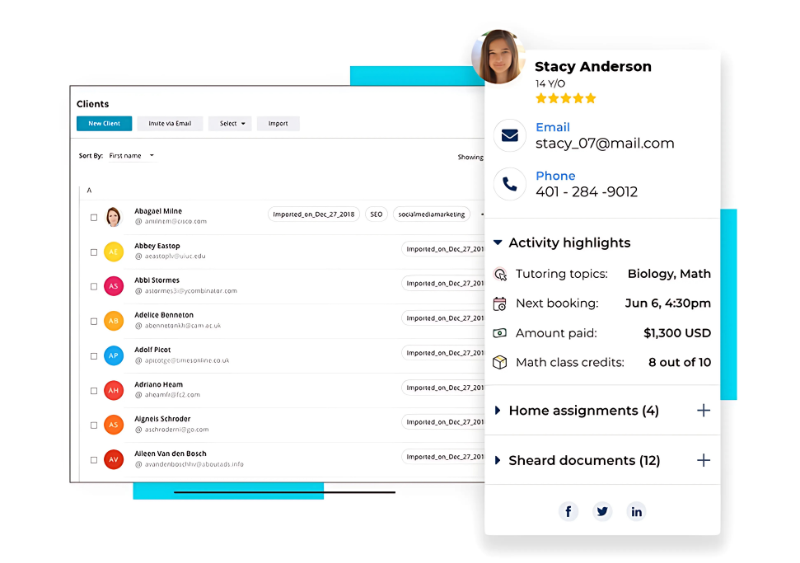
vcita is a business management platform tailored for small service providers, helping them manage client interactions and streamline business operations. It serves freelancers, consultants, and small business owners by offering tools for client management, scheduling, and payments.
Why I picked vcita: vcita is ideal for service providers with its all-in-one approach to managing client interactions and business tasks. It includes features like online scheduling, which helps your clients book appointments effortlessly. The platform also offers invoicing and payment processing to simplify financial transactions. With client communication tools, vcita ensures you stay connected with your clients efficiently.
Standout features & integrations:
Features include online scheduling, allowing clients to book appointments directly through your calendar. The invoicing and payment processing feature helps you manage financial transactions smoothly. Additionally, client communication tools keep you in touch with your clients, improving service delivery.
Integrations include QuickBooks, Google Calendar, Zoom, PayPal, Square, Stripe, Mailchimp, WordPress, Facebook, and Wix.
Pros and Cons
Pros:
- Simplified payment processing
- Efficient appointment scheduling
- Tailored for small services
Cons:
- Requires learning for new users
- May not suit large teams

Covve
Best for contact enrichment

Covve is a personal CRM designed for professionals looking to maintain and build meaningful relationships. It primarily serves individuals and small teams who need a reliable way to manage contacts and networking efforts.
Why I picked Covve: Covve offers contact management features like automatic contact updates and reminders to keep your database fresh. Its standout functionality includes a business card scanner, which allows you to digitize contacts. The platform also provides insights and analytics to help you understand your networking patterns. These features make Covve a unique choice for those focused on maintaining a dynamic contact list.
Standout features & integrations:
Features include a solid business card scanner that allows you to digitize and organize your contacts easily. Automatic contact updates ensure your address book is always current. You can also set reminders to reach out to contacts, helping you maintain strong professional relationships.
Integrations include Zapier, Microsoft 365, Mailchimp, Gmail, Google Workspace, QuickBooks, Xero, and Capsule.
Pros and Cons
Pros:
- Automatic contact updates
- Business card scanning
- Networking insights
Cons:
- No desktop app
- Requires internet connection


Close is a CRM platform designed for sales teams that require efficient lead management and communication tools. It primarily serves small to medium-sized businesses looking to enhance their sales processes and close deals faster.
Why I picked Close: Close offers sales-focused features like built-in calling, which helps your team connect with leads directly from the platform. The email automation feature simplifies follow-ups, ensuring consistent communication with prospects. Its lead management system allows for easy tracking and organization of sales opportunities. These features make Close an attractive option for teams focused on optimizing their sales efforts.
Standout features & integrations:
Features include built-in calling, which lets your team make calls directly from the CRM. The email automation feature ensures timely and consistent follow-ups with leads. The lead management system also allows you to track and organize sales opportunities effectively.
Integrations include Zapier, Slack, Gmail, Google Calendar, Zoom, Mailchimp, Zendesk, HubSpot, Salesforce, and Pipedrive.
Pros and Cons
Pros:
- Quick setup process
- Optimized for sales teams
- Strong lead management
Cons:
- Fewer advanced features
- Requires training for use

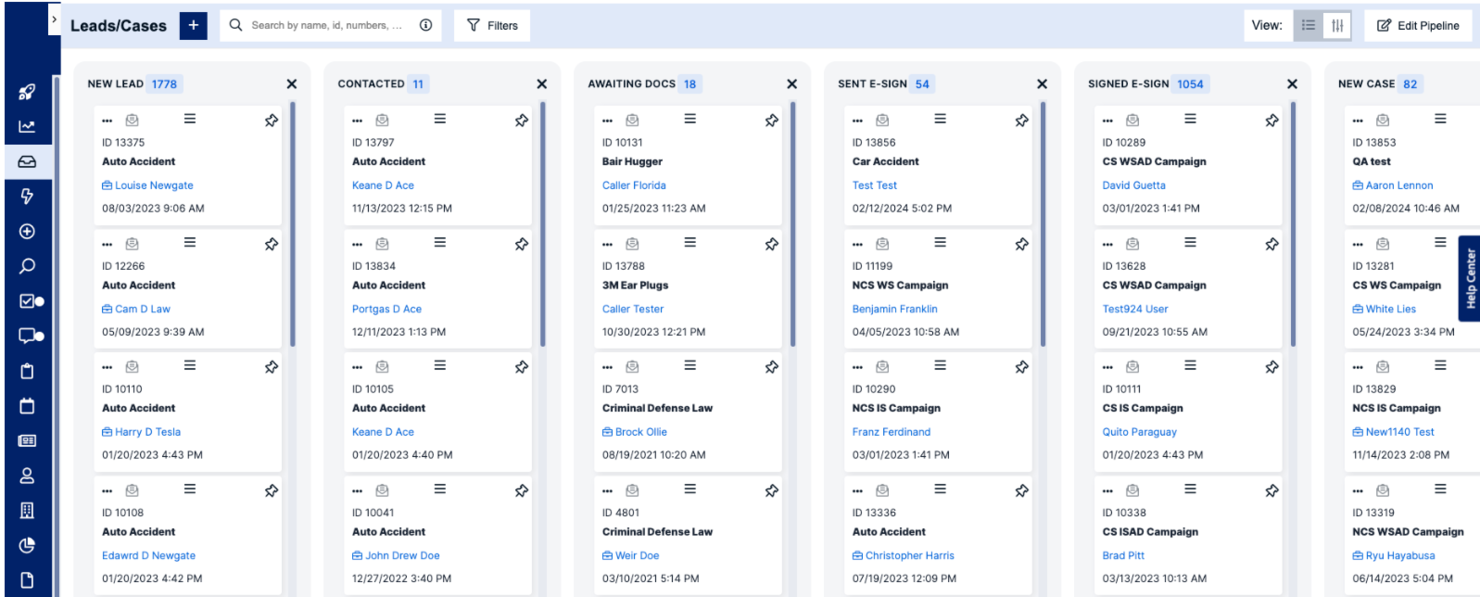
Law Ruler Software is a specialized CRM designed for law firms. It focuses on simplifying client intake and case management processes. It primarily serves legal professionals by offering features that help manage client relationships and automate routine tasks.
Why I picked Law Ruler Software: Law Ruler Software targets legal practices with its client intake and management features tailored for law firms. It offers automated text and email reminders, ensuring your firm stays connected with clients. The platform also includes legal case management tools that help organize case files and documents. By providing a tailored experience for legal professionals, Law Ruler Software helps firms manage client communications effectively.
Standout features & integrations:
Features include automated text and email reminders that keep your clients informed and engaged. The client intake forms simplify gathering necessary information from new clients. Legal case management tools help you organize case files and documents.
Integrations include Clio, QuickBooks, Zapier, LawPay, Microsoft Office 365, Gmail, RingCentral, and Slack.
Pros and Cons
Pros:
- Efficient case management
- Automated client reminders
- Tailored for legal practices
Cons:
- Limited customization options
- Requires training for staff
Other Contact Management Software
Here are some additional contact management software options that didn’t make it onto my shortlist but are still worth checking out.
- Visual Planning
For customizable workflows
- Repfabric
For manufacturers' reps
- Contactboss
For event management
- InfoFlo
For one-time purchase
- Creatio CRM
For no-code customization
- Capsule
For small teams
- monday CRM
For customizable contact management
- Copper
For Google Workspace users
- Streak
For Gmail integration
- Bigin by Zoho CRM
For small businesses
- Pipedrive
For visual sales pipeline management


How I Evaluate Contact Management Software
I split my evaluation into two layers: baseline requirements a tool must meet—like CRM sync and deduplication—and differentiators that matter most for RevOps teams managing pipeline data.
Core Functionality (Table Stakes For This List)
When I'm selecting tools for my list, I rank each one on a scale from 0 (does not offer the functionality) to 5 (excels in this area) for each core functionality listed below. Then, I calculate the tool's total score into a percentage. Each tool needs to achieve a minimum total score of 65% to be considered for inclusion.
- Centralized Contact Database: I look for custom fields, tags, and flexible record structures that let RevOps teams organize contacts by account hierarchy, lifecycle stage, or deal role.
- Data Enrichment & Deduplication: Clean data drives pipeline accuracy, so I evaluate how each tool handles auto-enrichment from external sources and flags or merges duplicate records.
- CRM & Tool Integrations: I check for native, bidirectional sync with platforms like Salesforce, HubSpot, Marketo, and Outreach—plus open API access for custom data flows.
- Contact Segmentation & Lists: Dynamic list-building matters here. I look at filter depth, saved views, and the ability to segment contacts by attributes and behaviors for GTM motions.
- Activity & Engagement Tracking: Each tool should log emails, calls, and meetings against contact records automatically, giving your team a shared timeline of every touchpoint.
- Import/Export & Bulk Management: Large-scale migrations and ongoing data hygiene require CSV support, field mapping, and bulk editing—so I evaluate how each tool handles volume.
Once I have a list of tools that meet this criteria, I consider what sets each platform apart.
Differentiating Factors (What Sets Vendors Apart)
Here's how I compare and contrast different vendors:
Standout Features
Relationship mapping is a big differentiator. I look for tools that visualize stakeholder connections across accounts, which helps RevOps teams support multi-threaded deal strategies. Data governance controls also matter—field-level permissions and validation rules keep your database clean as multiple teams touch the same records. I evaluate workflow automation too, like auto-routing new contacts to the right rep or triggering lifecycle stage updates based on engagement activity.
Beyond Features
Integration depth matters beyond just having native connectors. I evaluate whether a tool supports real-time, bidirectional sync with configurable field mapping across your CRM, MAP, and engagement platforms. Compliance is another key factor—I check for GDPR and SOC 2 readiness, plus built-in consent tracking, since RevOps teams often manage contact data across multiple regions. Pricing transparency plays a role too, especially whether per-seat or per-contact models scale reasonably as your database grows.
How To Choose Contact Management Software
It’s easy to get bogged down in long feature lists and complex pricing structures. To help you stay focused as you work through your unique software selection process, here’s a checklist of factors to keep in mind.
| Factor | What to Consider |
| Scalability | Will the software grow with your team? |
| Integrations | Does it work with your existing tools? |
| Customizability | Can it be tailored to your specific needs? |
| Ease of Use | Is it user-friendly for your team? |
| Budget | Does it fit within your financial limits? |
| Security Safeguards | Are your data protection needs met? |
| Support | Will you get the help you need when issues arise? |
| Security Safeguards | Does it provide insights into usage and performance? |
Trends In Contact Management Software
In my research, I sourced countless product updates, press releases, and release logs from different contact management software vendors. Here are some of the emerging trends I’m keeping an eye on.
- AI-driven insights: More tools use AI to analyze contact data, helping users identify patterns and make smarter decisions. This trend is helpful for businesses looking to personalize customer interactions and predict future behavior.
- Enhanced data privacy: With increasing concerns over data security, vendors are focusing on compliance with regulations like GDPR. This is relevant for users who prioritize the safe handling of customer information.
- Voice-enabled interactions: Some platforms integrate voice commands for hands-free navigation and information retrieval. This feature caters to users who need quick access without interrupting their workflow.
- Unified communication hubs: Tools are changing to integrate all communication channels into a single interface. This makes managing emails, calls, and messages easier without switching between apps.
- Customizable analytics dashboards: Vendors offer more flexibility in how users view and interpret data. This trend is essential for businesses that want tailored insights to meet specific goals.
What Is Contact Management Software?
Contact management software is a tool that stores and organizes details about people you do business with. Sales reps, marketers, and customer support teams use it to keep track of conversations, follow up easily, and remember important info about clients. It saves time, helps you stay on top of relationships, and makes sure no one slips through the cracks.
Features of Contact Management Software
When selecting contact management software, keep an eye out for the following key features:
- Centralized contact database: Keep all your contacts organized in one secure place, making it easy for you to search, filter, and access information whenever you need it.
- Customizable fields: Tailor contact records with fields specific to your business—anything from birthdays to favorite snacks—so you always have the details that matter most to you at hand.
- Interaction tracking: Record emails, phone calls, meetings, and notes, so you never forget who said what and can pick up every conversation right where you left off.
- Task and activity management: Schedule follow-ups, set reminders, and assign tasks to yourself or others, keeping your team proactive (and never ghosting a client by accident).
- Integration capabilities: Seamlessly connect your software with your favorite tools—email clients, calendars, or marketing platforms—so you aren’t stuck copying and pasting data all day.
- Permission and access controls: Decide who in your team can view or edit each contact, so you control sensitive info and keep your contacts safe.
- Mobile access: Stay connected on the go with mobile apps or responsive web interfaces, making sure your contacts are always just a tap away.
- Reporting and analytics: Generate reports on your contacts, their engagement, and your activities, helping you spot trends and optimize your outreach.
Common Contact Management Software AI Features
Beyond the standard contact management software features listed above, many of these solutions are incorporating AI with features like:
- Intelligent data enrichment: Instantly fill in missing contact details, pulling from public sources and business databases to save you the manual lookup work.
- Predictive lead scoring: Analyze your interactions and automatically highlight contacts most likely to convert, so you focus on the people who matter most.
- Automated follow-up reminders: Get smart nudges at just the right time, letting AI spot when you’re slipping on staying in touch and prompting you before relationships cool off.
- Natural language search: Quickly find contacts or details just by typing how you’d ask a colleague, so no more hunting through endless fields or menus.
- Smart contact deduplication: Identify and merge duplicate contacts using AI-powered matching, so you aren’t embarrassed by mixing up names or missing important history.
Benefits Of Contact Management Software
Implementing contact management software provides several benefits for your team and your business. Here are a few you can look forward to:
- Improved organization: Helps keep all your contact information and interactions in one place, making it easier to manage relationships.
- Enhanced communication: Centralizes various communication channels, making client interactions more efficient and effective.
- Increased productivity: Automates tasks like reminders and updates, allowing your team more time to focus on core activities.
- Better insights: Provides analytics and reporting tools that help understand customer behavior and improve strategies.
- Stronger customer relationships: Enables personalized interactions through data enrichment and social media integration, building trust and loyalty.
- Streamlined workflows: Offers features like task management and voice commands, which simplify day-to-day operations.
- Secure data management: Ensures compliance with data regulations, protecting your business and customer information.
Costs And Pricing Of Contact Management Software
Selecting contact management software requires understanding the various pricing models and plans available. Costs vary based on features, team size, add-ons, and more. The table below summarizes standard plans, average prices, and typical features of contact management software solutions.
Plan Comparison Table for Contact Management Software
| Plan Type | Average Price | Common Features |
| Free Plan | $0 | Basic contact management, email support, and limited storage. |
| Personal Plan | $5-$25/user/month | Contact tracking, task management, and email integration. |
| Business Plan | $30-$60/user/month | Advanced reporting, team collaboration tools, and customizable dashboards. |
| Enterprise Plan | $70-$150/user/month | Enhanced security features, dedicated support, and full API access. |
Contact Management Software FAQs
Here are some answers to common questions about contact management software.
What is the difference between CRM and contact management software?
Contact management software manages contact data, while CRM software offers broader functionalities, including sales, marketing, and service management. Contact management software might suffice if you focus on organizing and accessing contact details. However, a CRM could be more suitable for your business if you need to integrate sales and marketing processes.
How do you manage contact management software?
To manage contact management effectively, choose the right tool that fits your business needs. Automating workflows and regularly updating your contact data are essential. Synchronize information across platforms to ensure consistency and enrich profiles with relevant details.
How can contact management software improve productivity?
Contact management software automates repetitive tasks like data entry and follow-ups. It enables quick access to contact information, saving time and reducing errors. By streamlining these processes, your team can focus more on core business activities.
Can contact management software integrate with other tools?
How To Choose Contact Management Software
It’s easy to get bogged down in long feature lists and complex pricing structures. To help you stay focused as you work through your unique software selection process, here’s a checklist of factors to keep in mind.
| Factor | What to Consider |
| Scalability | Will the software grow with your team? |
| Integrations | Does it work with your existing tools? |
| Customizability | Can it be tailored to your specific needs? |
| Ease of Use | Is it user-friendly for your team? |
| Budget | Does it fit within your financial limits? |
| Security Safeguards | Are your data protection needs met? |
| Support | Will you get the help you need when issues arise? |
| Security Safeguards | Does it provide insights into usage and performance? |
Yes, contact management software often integrates with tools like email platforms, calendars, and social media. This integration enhances functionality by keeping all communication channels connected and helps maintain a seamless flow of information across different platforms.
What's Next?
Want to take your RevOps game to the next level?
Subscribe to The CRO Club newsletter for expert advice, software reviews, and other resources to help you deliver predictable growth at scale.