
A use case story with Mike Althoff, COO at Keen Decision Systems
For most growing companies, commissions are the last process to graduate from spreadsheet status.
Sales, marketing, finance, and customer data all migrate to systems of record… but sales compensation lingers as a quarterly tab-fest, with someone (usually a COO or RevOps lead) acting as the “master of the spreadsheet.”
Mike Althoff, COO at Keen Decision Systems, has been on both sides of that line.
Keen, a marketing operating system that connects every dollar of marketing spend to outcomes for large CPG brands, runs commissions across about 15 reps, split between new business and account management, with three payout tiers: individual contributors, team leaders, and a VP roll-up.
This is how Mike moved Keen's comp process from a quarterly reconciliation project to an end-to-end system of record while highlighting three pillars.

The Job To Be Done: Turn Commissions Into Infrastructure
The job Mike wanted done was bigger than just calculating commissions faster.
His goal:
- Stop running compensation as a recurring quarterly project that a few people own - Make every commission dollar traceable, defensible, and visible to the rep, the manager, the VP, and finance
- Have one system that survives plan changes, role changes, and year-over-year evolution
In Mike's words: "We all have a system of record for what's being paid out."
That single sentence is the difference between comp as a project and comp as infrastructure.
Before: A Folder, a Spreadsheet, an Email Approval Chain
Before QuotaPath, Keen ran commissions the way most companies do until they can't anymore.
- One folder per quarter
- A spreadsheet inside each folder, exported from HubSpot and reconciled by hand - Email threads to the sales team lead and revenue leader for sign-off, so there was some form of audit trail
It worked. It also concentrated the entire process inside whoever owned the spreadsheet that quarter.
"Could I ever go back to that process? Absolutely not,” Mike said.
The cost of staying in that model involved hours and the inability to defend the math.
Every rep question turned into a "let me show you my spreadsheet" conversation, and every plan change risked breaking continuity with the previous quarter.
Pillar 1: Multi-Tier Roll-Ups That Calculate Themselves
Keen's comp structure has three layers, and most deals touch all three:
- Individual contributors earn on their own deals
- Team leaders earn on their own deals and on their team's production
- The VP earns on everything the team does
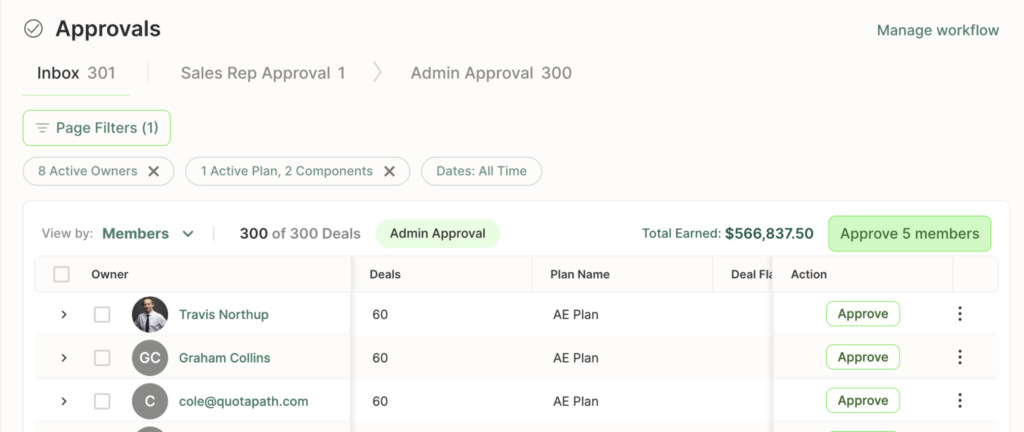
Before, every roll-up was a manual lookup. Now, when an IC closes a deal, the team lead and VP credits are calculated automatically and visible to everyone, with the math laid out transparently.
“Being able to have that type of clarity on who's getting what for every deal and why has been really invaluable,” said Mike.
This matters more as orgs add layers. Most comp tools handle individual contributors well. The break point usually shows up at the manager and exec layer, where credits get muddled and leadership ends up auditing the auditors.
Pillar 2: HubSpot Upstream, Rippling Downstream, and One Engine in the Middle
The second pillar involves integrations and putting QuotaPath at the center. Two integrations do most of the heavy lifting at Keen.
HubSpot → QuotaPath. As the CRM of record, HubSpot drives every commissionable deal. The integration matters more than it might sound, because comp depends on closed-won data, and comp becomes a forcing function for CRM hygiene.
“The number of deals that are closed-won that are not exactly accurate in their numbers until I check them against their commissions is not insignificant,” said Mike.
CRM accuracy goes up. Day-to-day confidence in deal data goes up. Stakeholders who never thought of themselves as data-quality stakeholders suddenly are.
QuotaPath → Rippling. On the payroll side, the QuotaPath and {{deeplink:76450:[Rippling integration]:rippling_integration}} is invisible… and that's the point. Mike pushes commissions to payroll with one action; his payroll manager validates them in Rippling and moves on.
"It's literally as simple as I send the commissions, and she says, 'Cool, thanks.' That's a much simpler path than 'Did I type every number correctly? Did I map the upload right?' every payroll cycle,” said Mike.
Pillar 3: Plans That Mature, Not Plans That Get Rewritten
The last pillar highlights the need for adjustable plans.
Comp plans aren't static, but they shouldn't reset every January, either. For 2026, Keen rebalanced their incentives toward expansion and renewal. The mechanics inside QuotaPath were straightforward:
- Duplicate 2025 plans
- Adjust the rate split between expansion and renewal
- Apply the new logic to any deal closing in 2026
The result: reps see how they earned in 2025 and how they're earning in 2026, side by side. No reinvention. No “trust me, this is how it works now.”
"It's a seamless maturation as our team has grown and our comp strategies have evolved. You start from the systems we had last year and mature them into the plans for this year,” said Mike.
That continuity matters most for reps. Comp changes that break with the past create friction; comp changes that build on the past create alignment.
Where the ROI Actually Shows Up
Ask Mike where {{deeplink:76450:[QuotaPath]}} earns its keep, and the answer isn't time saved — though there's plenty of that. It's:
- Transparency. Every payout has a system of record, not a private spreadsheet.
- Defensibility. The numbers don't lie. Disagreements happen inside the system, not over email.
- Continuity. Plan changes evolve from prior plans instead of replacing them.
- Forward visibility. Reps see what they've earned and what they may earn as they forecast — turning comp into a planning tool, not just a payout tool.
What Mike Would Tell Another COO
Mike's recommendation to other COOs and revenue leaders evaluating {{deeplink:76450:[commission tools]:demo_url}}:
If you’re outgrowing spreadsheets, and you want confidence, consistency, and tighter operational control, QuotaPath is a great place to find those things,With the CRM connectivity, it really makes one seamless end-to-end engine — a clear way to address something that really matters in motivating your team, and confidence that you’ve paid your reps accurately and clarified what they’ve earned and may earn as they forecast the rest of the year.
For COOs running an early-stage org, comp on a spreadsheet works.
For COOs running a scaling one, the question isn't whether to graduate… It's how late you'll be when you finally do.