

10 Best AI Contract Management Software in 2026

Best AI Contract Management Software Shortlist


AI contract management software uses artificial intelligence to automate, organize, and analyze every stage of your contract lifecycle. If you’re researching the best tools to cut manual reviews, manage risk, or speed up negotiation, you want options that fit your complex workflows and scale as you grow. In this guide, I’ll help you cut through the noise, compare the top-ranked AI contract management solutions, and show you how each can help your team stay in control of contracts and compliance.
Why Trust Our Software Recommendations
Our reviews reflect our independent judgment—not a sales pitch. Learn how we stay transparent.
For this guide, we evaluated tools using hands-on testing and independent research, scoring tools using our selection criteria.
Our reviews reflect our human editorial judgment, not a sales pitch.
AI Contract Management Software Comparison Table
This comparison table summarizes pricing details for my top AI contract management software selections:
| Tool | Best For | Trial Info | Price | ||
|---|---|---|---|---|---|
| 1 | Best for browser-based contract collaboration | Free demo available | Pricing upon request | Website | |
| 2 | Best for fast implementation and drafting | Free demo available | Pricing upon request | Website | |
| 3 | Best for AI-powered contract portfolio analysis | Free demo available | Pricing upon request | Website | |
| 4 | Best for collaborative negotiation and editing | Free demo available | From $499/month (billed annually) | Website | |
| 5 | Best for integration with finance and HR systems | Free demo available | Pricing upon request | Website | |
| 6 | Best for seamless e-signature and approval flows | Free demo available | Pricing upon request | Website | |
| 7 | Best for customizable contract automation | Free plan available | Pricing upon request | Website | |
| 8 | Best for dynamic workflow automation | Free demo available | Pricing upon request | Website | |
| 9 | Best for complex enterprise integrations at scale | Free demo available | Pricing upon request | Website | |
| 10 | Best for advanced clause analytics and compliance | Free demo available | Pricing upon request | Website |
Best AI Contract Management Software Reviews
Below are my detailed summaries of the best AI contract management software that made it onto my shortlist. My reviews offer a detailed look at the features, capabilities, and integrations of each platform to help you find the best one for you.
Juro
Best for browser-based contract collaboration
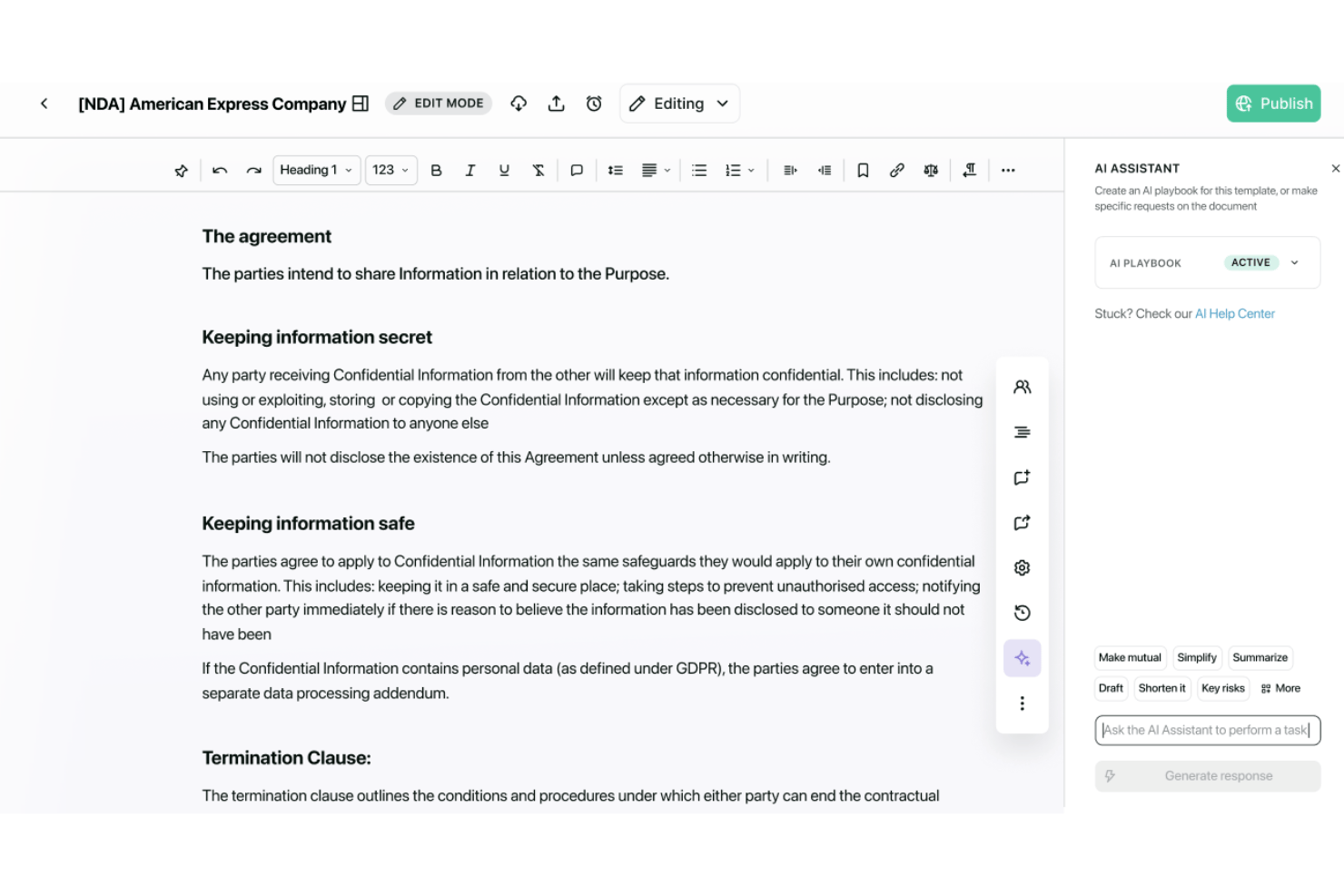
Juro is a browser-native AI contract management platform that combines AI drafting, clause review, metadata extraction, automated approval workflows, and e-signature in one collaborative environment.
Who Is Juro Best For?
Juro is a strong fit for mid-market legal and sales teams that handle high contract volumes and need a shared, browser-based workspace without switching tools.
Why I Picked Juro
Juro earns its spot on my shortlist because the entire contract negotiation happens in the browser, with no Word attachments or email chains to manage. Counterparties can redline, comment, and approve directly inside the platform, keeping the full negotiation trail in one place. I particularly like that AI Review works within that same environment, flagging non-standard clauses against your playbook without pushing anyone into a separate tool.
Juro Key Features
- AI-powered contract drafting: Generate, amend, and redraft contracts using built-in AI tools and customizable contract templates.
- Clause comparison and analysis: Automatically identify and flag deviations from approved clause language across uploaded and in-flight contracts.
- Configurable approval workflows: Route contracts for internal approvals using multi-step, conditional logic directly within the platform.
- Native CRM integrations: Sync contract data and statuses directly with Salesforce, HubSpot, and Pipedrive using pre-built, bi-directional connectors.
Juro Integrations
Juro offers native integrations with Salesforce, HubSpot, DocuSign, Greenhouse, Slack, Google Drive, and more. It also connects with Zapier and provides an API for custom integrations.
Pros and Cons
Pros:
- Counterparty redlining stays inside the platform
- AI clause review flags deviations against playbooks
- Browser-native editor requires no Word attachments
Cons:
- AI drafting less mature than specialist rivals
- Reporting and analytics dashboards are limited

Best for fast implementation and drafting
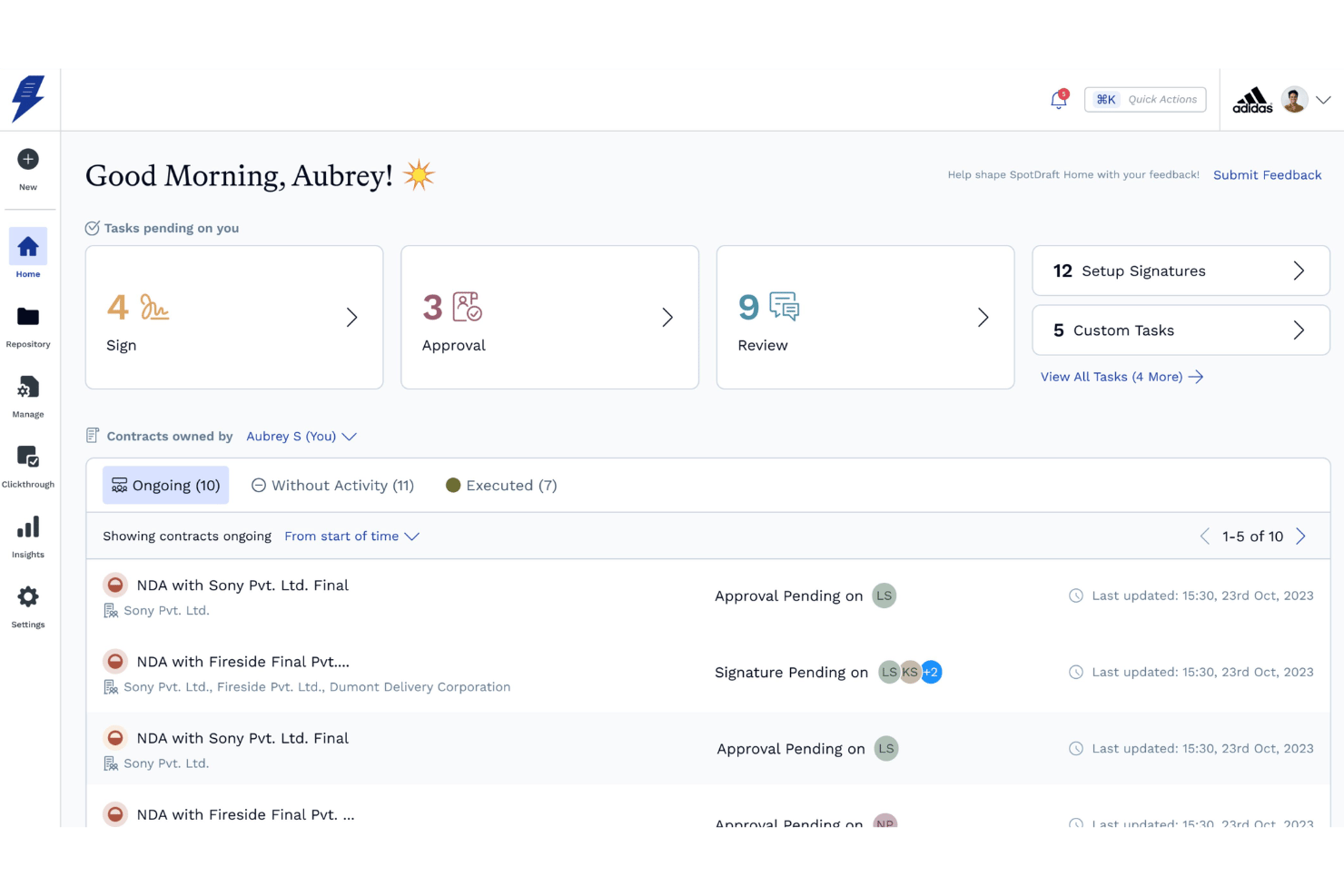
SpotDraft is an AI-native contract lifecycle management platform that handles contract drafting, clause analysis, AI-powered redlining, metadata extraction, workflow automation, and eSignatures across the full contract lifecycle.
Who Is SpotDraft Best For?
SpotDraft is a strong fit for mid-market and enterprise legal and sales operations teams that need a shared contracting environment to close deals faster.
Why I Picked SpotDraft
I've included SpotDraft in my top picks because its implementation model is genuinely different from most CLMs. SpotDraft's own team handles workflow setup, template creation, integration configuration, and data migration at no extra cost and no outsourcing. On the drafting side, VerifAI reviews and redlines contracts inside Microsoft Word against your playbook, so legal teams aren't context-switching to a separate tool when counterparty paper lands.
SpotDraft Key Features
- Clause library intelligence: AI-powered clause suggestions and auto-insertion based on contract type and risk profile.
- Obligation extraction and tracking: Automatically identifies obligations, deadlines, and renewals, triggering alerts and workflow actions.
- Conversational contract Q&A: Lets users query the contract repository in natural language to retrieve key information instantly.
- Centralized contract repository: Consolidates executed and in-flight contracts with advanced search, audit trails, and granular permission controls.
SpotDraft Integrations
SpotDraft offers native integrations with Salesforce, HubSpot, Zoho CRM, Coupa, DocuSign, Slack, Microsoft Teams, Jira, Google Drive, and SharePoint. An API is available for custom integrations.
Pros and Cons
Pros:
- AI clause library auto-inserts pre-approved language
- VerifAI redlines contracts directly inside Microsoft Word
- Fast implementation with dedicated onboarding support
Cons:
- Search within large repositories can be inconsistent
- Analytics dashboards lack depth for portfolio reporting

Best for AI-powered contract portfolio analysis
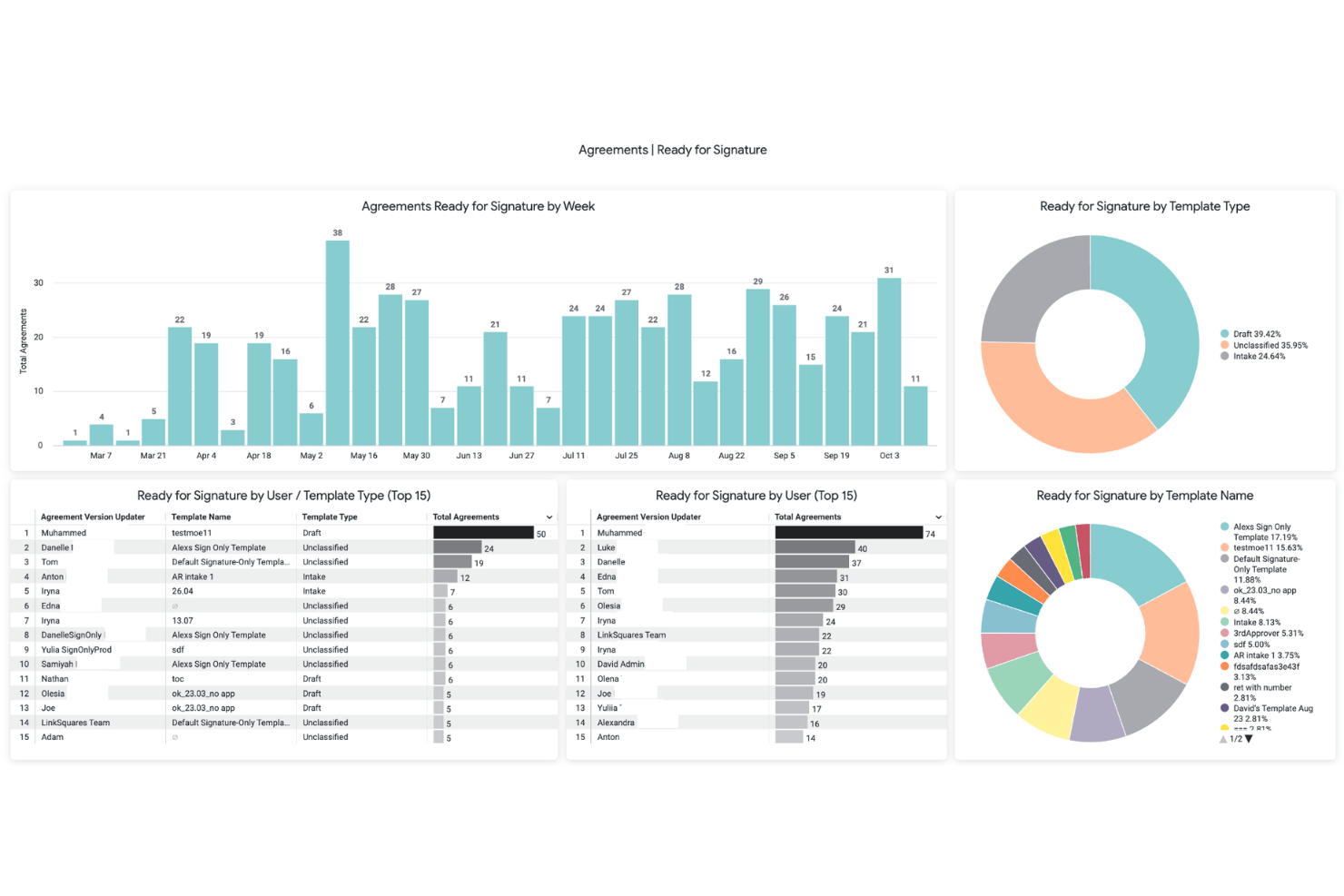
LinkSquares is an AI-powered contract lifecycle management platform that combines contract drafting, clause analysis, AI-driven redlining, metadata extraction, and post-signature analytics across a centralized repository.
Who Is LinkSquares Best For?
LinkSquares fits mid-market to enterprise teams managing high contract volumes across legal, deal desk, and revenue operations functions.
Why I Picked LinkSquares
LinkSquares earns its spot on my shortlist because of how LinkAI handles portfolio-level contract intelligence. I'm particularly impressed that it extracts 120+ structured data points per agreement, from renewal windows to liability clauses, turning a static archive into something you can actually query and act on. The 2025 Risk Scoring Agent and dashboards build on that extraction layer, letting me surface and triage risk across the full contract portfolio at a glance.
LinkSquares Key Features
- Clause library intelligence: Quickly insert pre-approved clauses based on contract type, region, and risk profile.
- Conversational contract Q&A: Query contract repositories in plain language and get instant, contextual answers.
- Obligation extraction and tracking: Surface key deadlines, renewal dates, and commitments with automated alerts.
- Microsoft Word add-in: Draft, review, and revise contracts with AI-powered suggestions directly inside Word.
LinkSquares Integrations
LinkSquares offers native integrations with Salesforce, HubSpot, DocuSign, Adobe Sign, Slack, Microsoft Word, Google Drive, Dropbox, and SharePoint. An API is also available for custom integrations.
Pros and Cons
Pros:
- G2 CLM Leader for five consecutive years
- Salesforce sync keeps contract data current automatically
- AI extraction covers 120+ structured data points
Cons:
- Modular pricing pushes contract-intelligence buyers into full CLM
- Implementation runs 10–12 weeks on average
Concord
Best for collaborative negotiation and editing
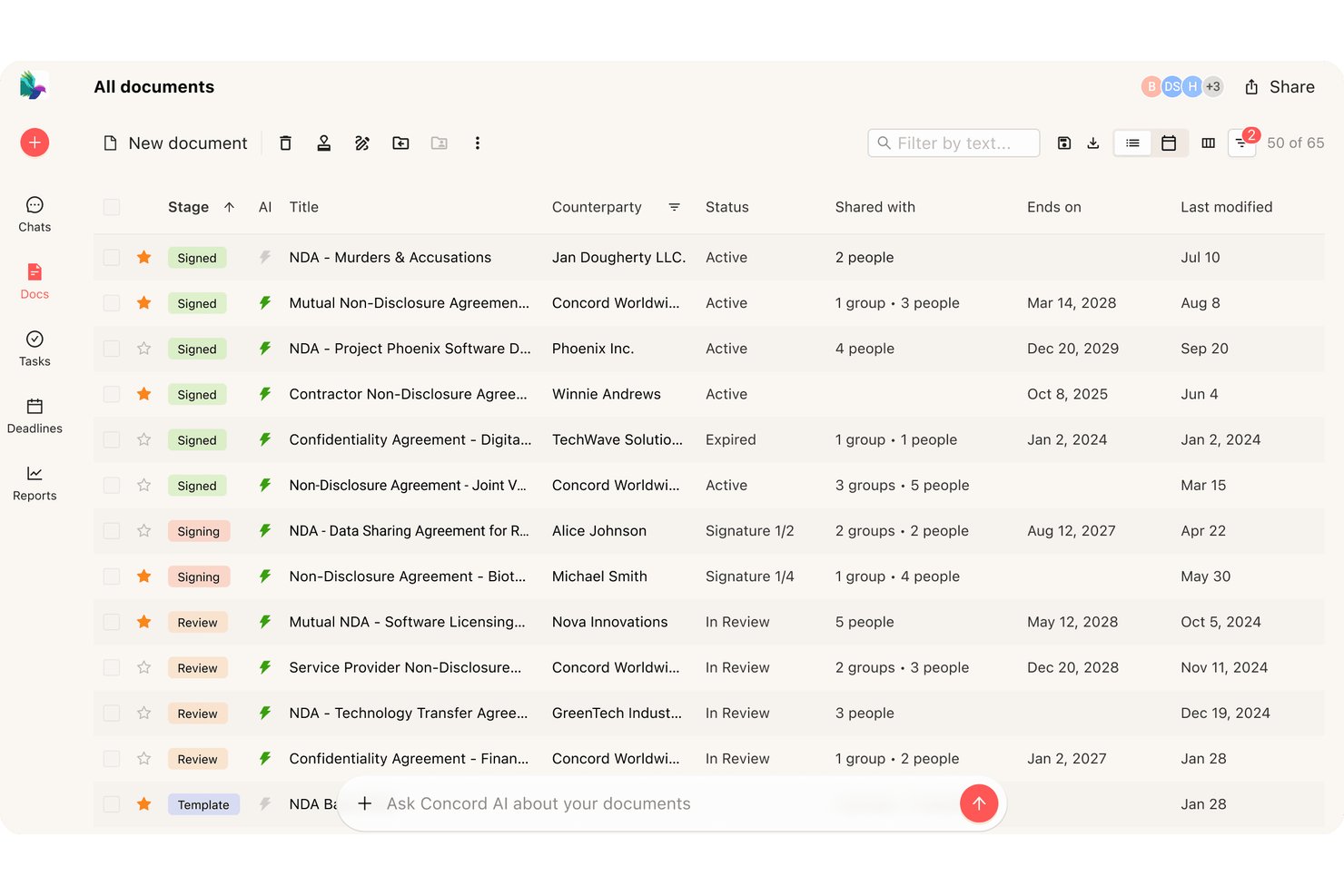
Concord is an AI contract management platform that combines real-time collaborative editing, redlining, e-signature, and automated metadata extraction across the full contract lifecycle.
Who Is Concord Best For?
Concord is a strong fit for SMB and mid-market sales ops and RevOps teams that need fast deployment and cross-functional contract collaboration.
Why I Picked Concord
Concord earns its spot on my shortlist because of how it handles live contract negotiation. Instead of emailing Word documents back and forth, my team redlines, comments, and resolves changes inside a single browser session that both sides edit in real time. On top of that, AI Copilot reviews contract language and flags risks in a few seconds, which keeps legal from becoming a bottleneck mid-deal.
Concord Key Features
- AI metadata extraction: AI/OCR pulls key terms, obligations, and dates into a searchable contract repository.
- Automated approval workflows: Configure multi-step approval routing with dynamic roles and custom team assignments.
- Native Salesforce and HubSpot integrations: Sync contracts, status, and documents directly to CRM records.
- Clause library management: Store, standardize, and quickly insert pre-approved clauses for consistent contract language.
Concord Integrations
Concord offers native integrations with Salesforce, HubSpot, DocuSign, Google Drive, Box, Dropbox, Slack, and Zapier, and also provides an API for custom integrations.
Pros and Cons
Pros:
- Built-in e-signature without third-party tools
- AI risk review completes in seconds
- Real-time collaborative redlining with external parties
Cons:
- Reporting and analytics dashboards are basic
- AI clause analysis less advanced than competitors
Best for integration with finance and HR systems
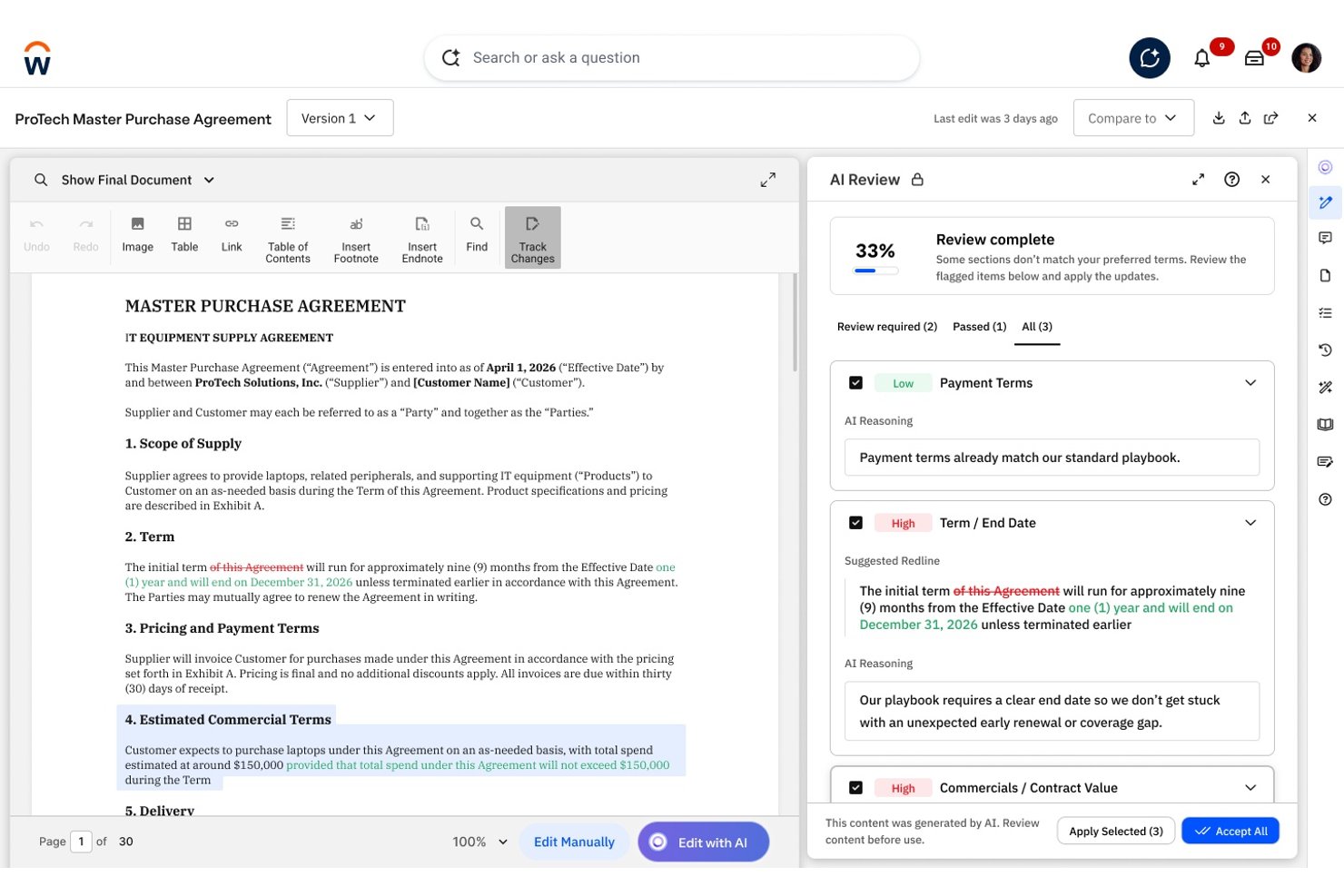
Workday Contract Management is an AI-native CLM platform that combines contract drafting, clause analysis, automated redlining, metadata extraction, and approval workflows—powered by a proprietary LLM fine-tuned specifically for contracts.
Who Is Workday Contract Management Best For?
It's a strong fit for mid-to-large enterprises already running Workday Finance or Workday HCM who want contract intelligence embedded directly in their existing systems.
Why I Picked Workday Contract Management
Workday Contract Management earns its spot on my shortlist because of how deeply it connects contract data to the systems that drive revenue decisions. I particularly like the native Workday Finance and HCM integration, where contract milestones and obligations automatically trigger downstream processes in finance without any manual handoff. The Revenue Contract Agent layers AI on top of that, surfacing structured contract data directly in the dashboards my finance and sales ops teams already use.
Workday Contract Management Key Features
- Clause library intelligence: AI-powered clause libraries suggest and auto-insert pre-approved language matched to contract type and risk profile.
- Conversational AI Q&A: Users can ask contract portfolio questions in natural language and get instant, data-backed answers.
- Portfolio risk analytics: Dashboards surface risks across contracts by flagging non-standard terms, regions, and counterparties.
- Obligation extraction and tracking: The platform automatically pulls out key obligations and deadlines, then triggers alerts for critical dates.
Workday Contract Management Integrations
Workday Contract Management offers native integrations with Workday Finance, Workday HCM, Salesforce, Adobe Sign, DocuSign, SharePoint, Box, and Google Drive. An API is available for custom integrations.
Pros and Cons
Pros:
- Contract data feeds directly into revenue forecasting
- AI obligation tracking built into the platform
- Native tie to Workday Finance and HCM
Cons:
- Implementation typically requires professional services support
- Best value requires existing Workday deployment

Best for seamless e-signature and approval flows
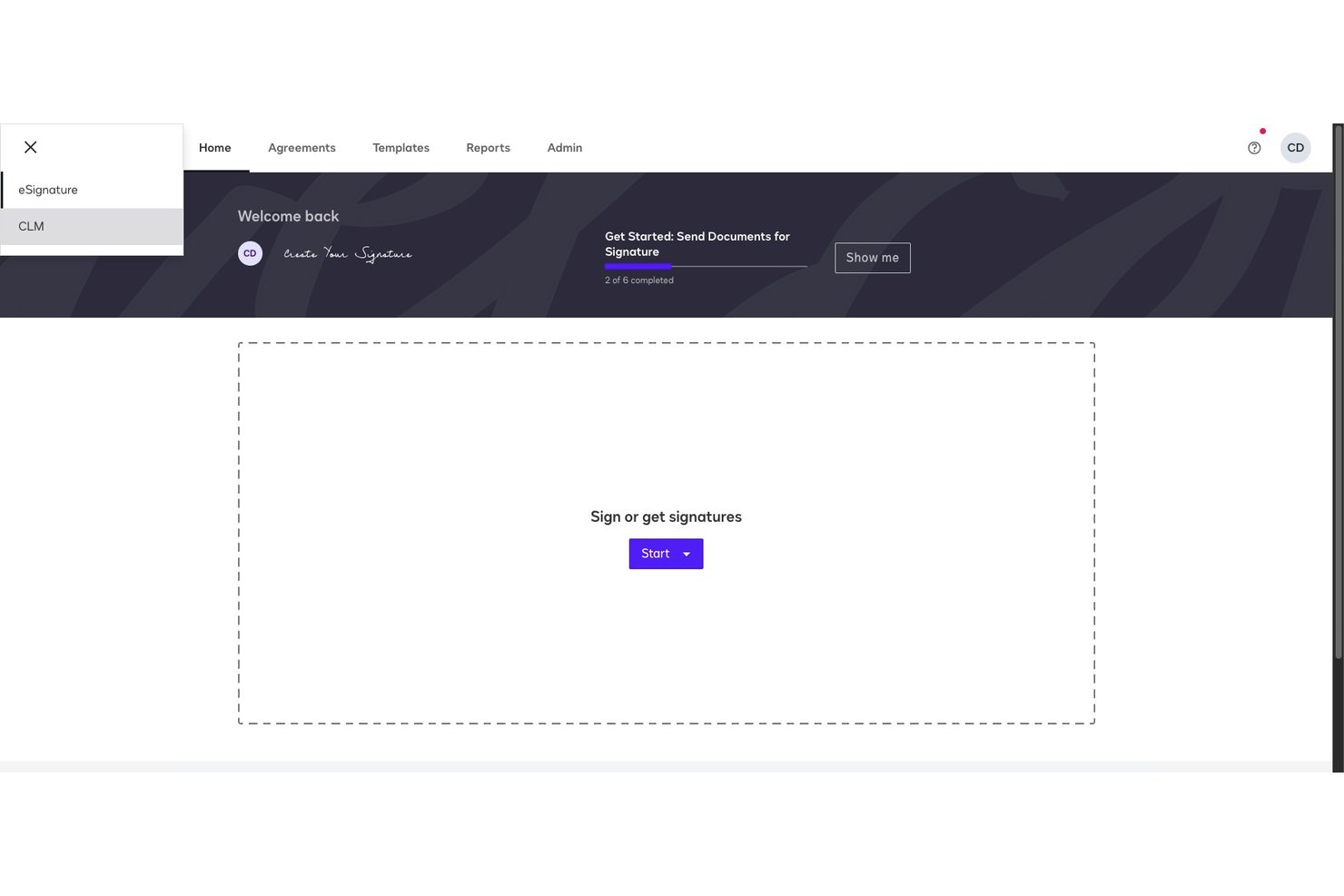
Docusign CLM is an AI-powered contract lifecycle management platform that combines generative contract drafting, AI-assisted clause analysis and redlining, automated approval workflows, and a searchable central repository with deep CRM integration.
Who Is Docusign CLM Best For?
Docusign CLM is a strong fit for mid-market and enterprise revenue and legal teams managing high volumes of complex, multi-stakeholder contracts.
Why I Picked Docusign CLM
Docusign CLM earns its spot on my shortlist because no other tool combines native e-signature with enterprise-grade contract approval automation in a single system. I love the drag-and-drop workflow editor, which handles conditional routing so contracts with non-standard terms automatically escalate to the right approver. The Iris AI engine then triggers approval steps based on extracted contract data, making routing decisions dynamic rather than static.
Docusign CLM Key Features
- Clause library intelligence: AI-powered libraries auto-suggest pre-approved language based on contract type and risk profile.
- Conversational contract Q&A: Natural language chat lets users query contract portfolios and get instant answers sourced from contract data.
- Obligation extraction and tracking: The system detects key obligations and deadlines, then triggers alerts and follow-up tasks.
- Portfolio risk analytics: Dashboards flag risk exposure, compliance drift, and non-standard terms across all managed contracts.
Docusign CLM Integrations
Docusign CLM offers native integrations with Salesforce, SAP Ariba, NetSuite, Coupa, Workday, Oracle, Microsoft 365, Slack, and Google Drive. It also provides an API for custom integrations.
Pros and Cons
Pros:
- Conditional approval routing handles complex escalation logic
- Iris AI extracts metadata from legacy contracts
- Native e-signature removes external handoff steps
Cons:
- AI features lag behind newer CLM competitors
- Implementation requires significant IT and admin resources
Agiloft
Best for customizable contract automation
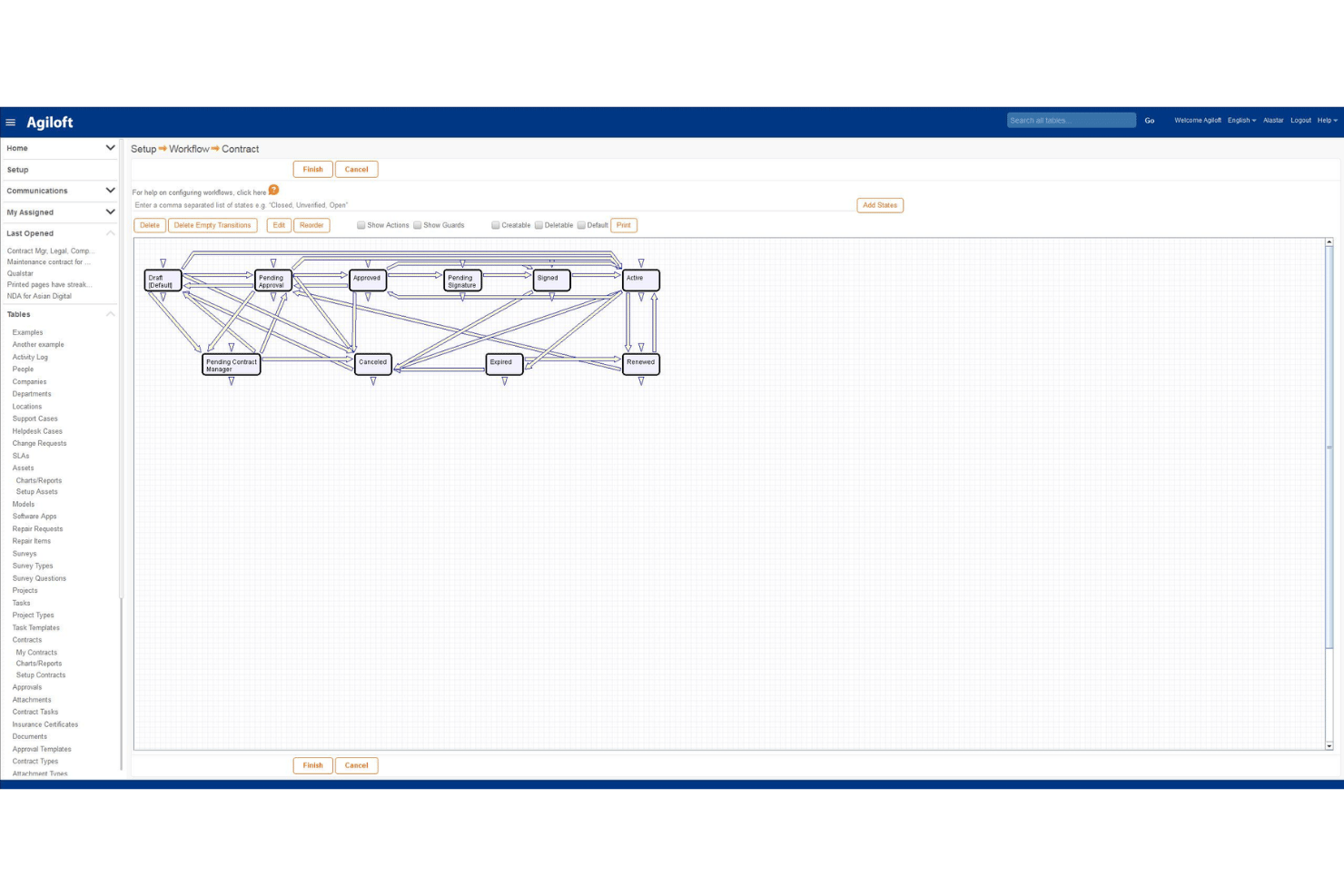
Agiloft is a contract lifecycle management platform with embedded AI for contract drafting, clause analysis, automated redlining, metadata extraction, and no-code workflow configuration across the full contract lifecycle.
Who Is Agiloft Best For?
Agiloft is a strong fit for mid-market and enterprise legal, procurement, and revenue operations teams managing high volumes of complex contracts.
Why I Picked Agiloft
Agiloft earns its spot as one of the best on my shortlist because its no-code architecture lets my team configure approval chains, clause playbooks, and workflow logic to match how deals actually move through our pipeline, without engineering involvement. What I find genuinely impressive is the ability to build custom AI models trained on our own contract data. Astra then turns those past contracts into reusable playbooks that apply our negotiation standards to every new agreement automatically.
Agiloft Key Features
- Clause library intelligence: AI-powered libraries recommend and auto-insert pre-approved language based on contract type and policy.
- Obligation extraction and tracking: The system identifies renewal dates, deadlines, and key deliverables, then triggers reminders and workflows.
- Conversational contract Q&A: Users can search contract portfolios using natural language to surface obligations or compliance details.
- Portfolio risk analytics: Dashboards aggregate and display company-wide contract risk exposure and flag non-standard or high-risk terms.
Agiloft Integrations
Agiloft offers native integrations with Salesforce, DocuSign, Adobe Sign, Microsoft 365, Tableau, Power BI, and supports integrations across the Microsoft ecosystem. An API is available for custom integrations.
Pros and Cons
Pros:
- AI contract drafting adapts to playbooks and past contracts
- No-code customization requires no engineering resources
- Highly configurable approval routing and workflow logic
Cons:
- Native reporting requires external tools like Tableau or Power BI
- Amendment data doesn't consolidate into a single contract record

Ironclad
Best for dynamic workflow automation
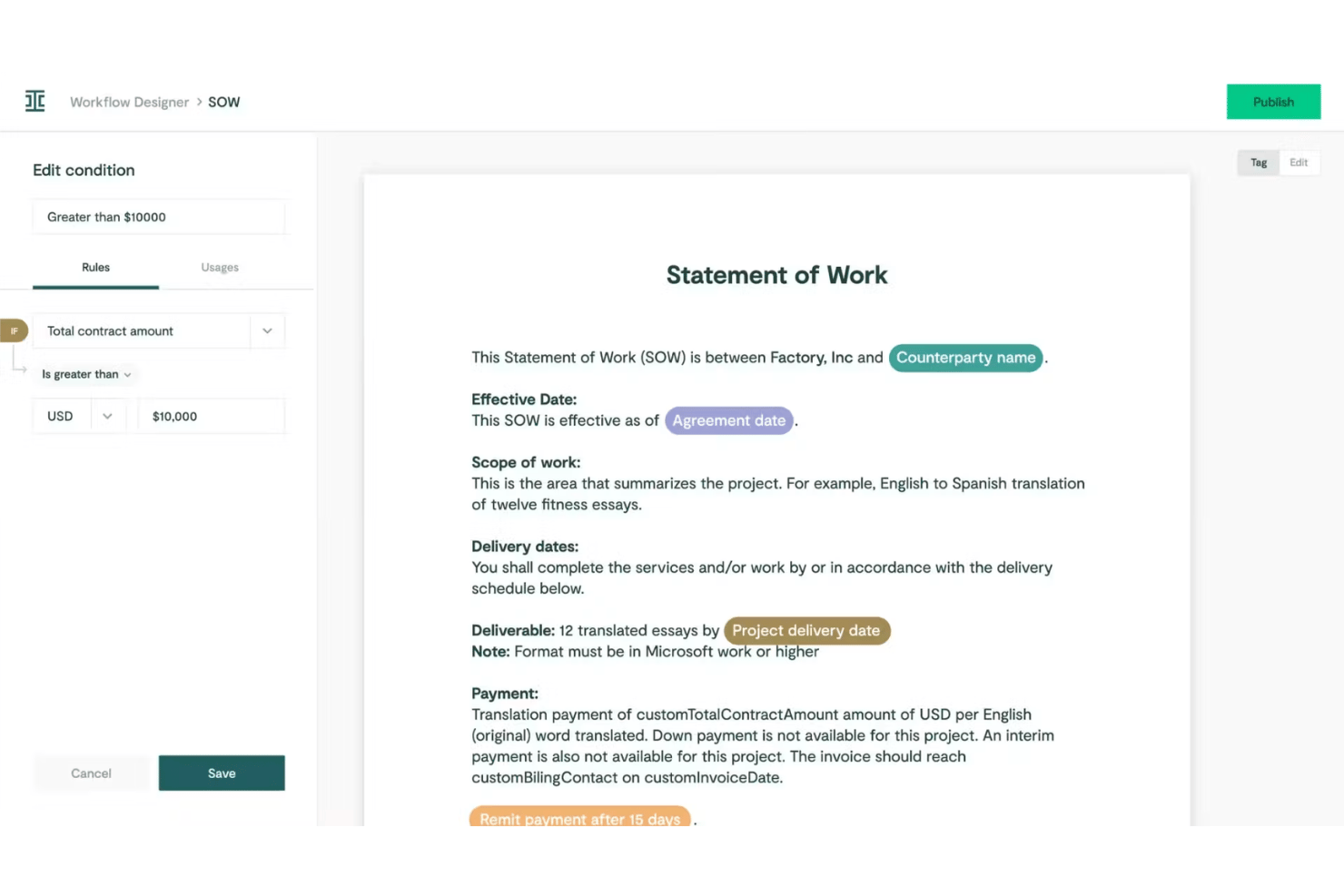
Ironclad is a CLM platform that combines AI-powered contract drafting, redlining, clause analysis, metadata extraction, and no-code workflow automation across the full contract lifecycle.
Who Is Ironclad Best For?
Ironclad suits mid-market and enterprise teams managing high contract volumes with complex, multi-stakeholder approval requirements across legal, sales, and revenue operations.
Why I Picked Ironclad
Ironclad earns its spot on my shortlist because its no-code Workflow Designer is the most configurable approval routing I've worked with in a CLM tool. I can set conditional logic so that any deal above a certain value or with non-standard payment terms automatically branches to a separate legal review queue before the signature workflow resumes. Pair that with AI Playbooks, and policy-based redlines feed directly into those same workflow triggers, keeping the whole process moving without manual handoffs.
Ironclad Key Features
- AI clause library: Maintains a searchable library of approved clauses and automatically suggests relevant language during drafting.
- Smart Import with AI data extraction: Uploads and analyzes legacy contracts, extracting key properties and structuring contract data automatically.
- Salesforce and CPQ integrations: Connects Ironclad directly to CRM and CPQ systems so teams can create, update, and track contracts within their revenue stack.
- AI-powered contract portfolio queries: Lets users ask natural language questions about contract terms, renewals, and risks across the entire contract repository.
Ironclad Integrations
Ironclad offers native integrations with Salesforce, HubSpot, Coupa, DocuSign, Adobe Acrobat Sign, Dropbox Sign, SAP, Ramp, Slack, and Microsoft Teams. An API is available for custom integrations.
Pros and Cons
Pros:
- Strong audit trail across approval stages
- AI Playbooks auto-redline against legal policy
- Highly configurable no-code workflow builder
Cons:
- Reporting customization is limited out of the box
- AI features require significant initial configuration
Icertis
Best for complex enterprise integrations at scale
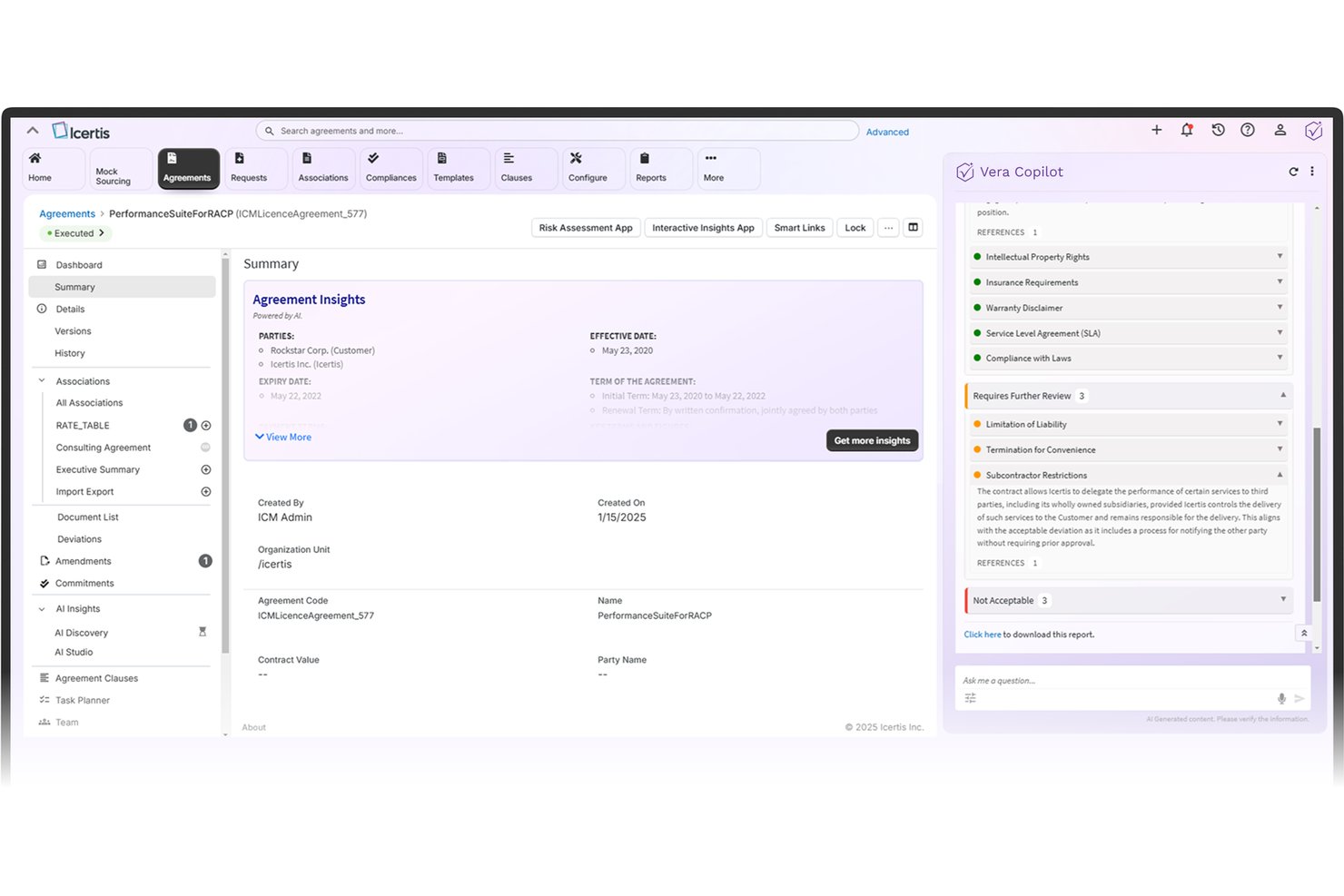
Icertis is an AI-native contract lifecycle management platform that uses agentic AI to handle contract drafting, redlining, clause analysis, metadata extraction, obligation tracking, and analytics across enterprise-scale contract portfolios.
Who Is Icertis Best For?
Icertis is a strong fit for large enterprises managing high contract volumes across multiple business systems, particularly in regulated industries like healthcare, finance, and manufacturing.
Why I Picked Icertis
I've included Icertis in my top picks because of how deeply it embeds into enterprise tech stacks. The pre-built adapters for SAP S/4HANA, Salesforce, and Workday go beyond API connections, syncing contract terms directly into ERP and CRM workflows. I also rate Vera Redline highly, as it handles autonomous AI redlining against playbooks, including third-party paper, which is rare at this scale.
Icertis Key Features
- Clause library intelligence: AI-powered clause suggestions and standardization based on contract type and risk parameters.
- Obligation extraction and tracking: Automatically identifies and monitors contract commitments, renewal dates, and deliverables.
- Conversational contract Q&A: Natural language interface lets you quickly ask questions about your contract portfolio and get instant answers.
- Portfolio risk analytics: Dashboards surface contract risk exposure and flag non-standard terms and compliance gaps across agreements.
Icertis Integrations
Icertis offers native integrations with Salesforce, SAP S/4HANA, SAP Ariba, SAP Fieldglass, Workday, Microsoft 365 and Azure, DocuSign, and Adobe Sign. An API is also available for custom integrations.
Pros and Cons
Pros:
- Natural language Q&A across contract portfolios
- Obligation tracking with automated deadline alerts
- Autonomous AI redlining handles counterparty documents
Cons:
- Reporting dashboards need heavy configuration
- Implementation requires significant IT involvement

Sirion
Best for advanced clause analytics and compliance
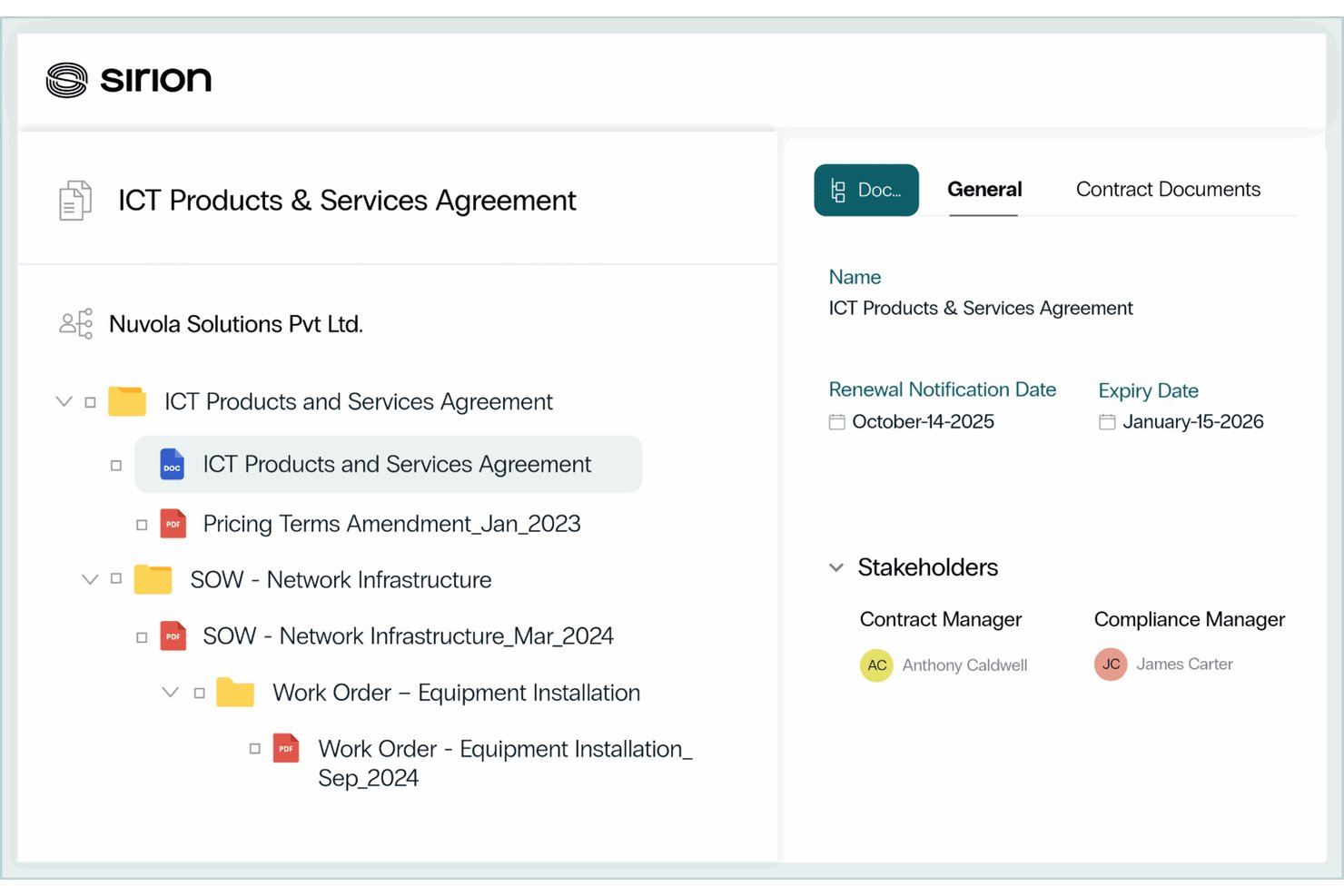
Sirion is an AI-native contract lifecycle management platform built on an agentic architecture, using purpose-built AI agents for contract drafting, clause analysis, automated redlining, metadata extraction, and obligation tracking.
Who Is Sirion Best For?
Sirion is built for large enterprises with high-volume, high-value contracts across legal, procurement, and sales teams that need deep compliance controls.
Why I Picked Sirion
I picked Sirion as one of the best because its clause analytics go deeper than anything else I've seen in this space. The Issue Detection Agent scores clause-level risks against your enterprise playbook, and the Redline Agent revises specific language with policy-backed, explainable changes. The underlying model combines 10+ LLMs with 1,200+ proprietary SLMs purpose-built for contract semantics, so I get precise, source-linked recommendations rather than generic AI output.
Sirion Key Features
- Extraction agent: Pulls structured metadata and obligations from legacy and third-party contracts using multi-model AI.
- Obligation tracking: Monitors contractual commitments and performance triggers across the entire contract lifecycle.
- Salesforce and SAP CPQ integrations: Natively syncs contract and deal data with major CRM and configure-price-quote systems.
- Conversational contract search: Lets users ask questions and instantly search across the contract repository with AI-powered chat.
Sirion Integrations
Sirion offers native integrations with Salesforce, SAP CPQ, Microsoft Dynamics 365, and more. An API is available for custom integrations.
Pros and Cons
Pros:
- Obligation tracking with automated deadline alerts
- Multi-model AI with proprietary legal SLMs
- Deep clause-level risk scoring across portfolios
Cons:
- Steep onboarding for non-legal business users
- Heavy implementation requires significant IT involvement
Other AI Contract Management Software
Here are some additional AI contract management software options that didn’t make it onto my shortlist, but are still worth checking out:
- Conga CLM
For revenue system synchronization
- PandaDoc
For templated contract creation and tracking
- Luminance
For AI-driven contract risk detection
- Contract Logix
For compliance and audit-ready controls
- Leah
For conversational contract analysis
- Malbek
For unified contract data management
- Cobblestone
For obligation management and alerts
- DocJuris
For automated redlining from playbooks
- Lexion
For CRM-connected contract workflows
- HyperStart CLM
For quick-start contract automation


How I Evaluate AI Contract Management Software
Every tool on this list needs to go beyond slapping an AI label on basic template merges—I look for platforms where AI actually accelerates drafting, redlining, and metadata extraction in ways that shave days off deal cycles. I split my evaluation into core functionality every platform must deliver and the differentiating factors that separate good from great.
Core Functionality (Table Stakes For This List)
When I'm selecting tools for my list, I rank each one on a scale from 0 (does not offer the functionality) to 5 (excels in this area) for each core functionality listed below. Then, I calculate the tool's total score into a percentage. Each tool needs to achieve a minimum total score of 65% to be considered for inclusion.
- AI Contract Drafting: I evaluate whether the platform can generate a first draft from CRM deal data and playbooks, not just merge fields into a static template.
- AI Clause Analysis: The tool should identify deviations from approved language and flag risky clauses, like non-standard indemnification or auto-renewal terms.
- AI Redlining & Review: I look for platforms that auto-redline incoming counterparty paper against your playbook rather than requiring line-by-line manual markup.
- AI Metadata Extraction: Extracting dates, pricing, and obligations from executed PDFs into structured, searchable records is a baseline I check across every tool.
- Automated Workflows & Approvals: I evaluate routing logic depth, such as conditional approvals that escalate when discount thresholds are exceeded or deal size triggers legal review.
- CRM & Revenue System Integrations: Native connectors to platforms like Salesforce, HubSpot, or NetSuite matter here—contract data should sync back to your revenue stack without manual exports.
Once I have a list of tools that meet the criteria, I consider what sets each platform apart.
Differentiating Factors (What Sets Vendors Apart)
Here's how I compare and contrast different vendors:
Standout Features
Conversational contract Q&A is a major differentiator—I look for platforms where your team can ask plain-language questions like "Which deals include auto-renewal next quarter?" and get sourced answers instantly. Portfolio risk analytics also matters because it surfaces exposure across counterparties and flags compliance drift before it becomes a problem. I check whether obligation tracking auto-triggers alerts for renewal dates and deliverable deadlines, which directly supports revenue predictability.
Beyond Features
AI trust and explainability is something I weigh heavily—I check whether platforms offer confidence scores on AI suggestions and whether they use domain-specific legal models versus generic LLMs. The integration ecosystem also matters: your contract data needs to flow into Salesforce, HubSpot, or NetSuite without manual CSV exports. Deployment speed is worth evaluating too, especially how quickly you can bulk-ingest a legacy repository and start working from pre-built playbooks.
How to Choose AI Contract Management Software
It’s easy to get bogged down in long feature lists and complex pricing structures. To help you stay focused as you work through your unique software selection process, here’s a checklist of factors to keep in mind:
| Factor | What to Consider |
|---|---|
| Scalability | Can the platform support growing contract volume, entities, and users? Evaluate if it will keep pace with your revenue growth and entity structure over time. |
| Integrations | Does it connect natively to Salesforce, HubSpot, or your billing/ERP stack? Check compatibility with your CRM, CPQ, and e-signature platforms to avoid manual work. |
| Customizability | Will the workflows, templates, and approval rules align with your business processes? Make sure it fits your sales and legal policy requirements. |
| Ease of use | How intuitive is the interface for legal, sales ops, and business users? Consider how much training and ongoing support your team will require. |
| Implementation and onboarding | What resources will you need for initial setup? Ask about migration support and onboarding—especially if you’re moving legacy contracts into the new system. |
| Cost | Are fees per user, per contract, or usage-based? Look for hidden costs tied to advanced AI capabilities or integration add-ons that may impact your budget. |
| Security safeguards | Does it provide encryption, audit trails, and role-based access? Assess compliance certifications and whether it meets your internal and regulatory requirements. |
| Support availability | What service levels are offered for technical issues and contract troubleshooting? Reliable, responsive support can prevent bottlenecks in fast-paced deal cycles. |
What Is AI Contract Management Software?
AI contract management software uses artificial intelligence, machine learning, and natural language processing to automate and optimize end-to-end contract processes, including contract review, drafting, organizing, and tracking business agreements. Many platforms also support AI contract review, clause analysis, redlining, metadata extraction, revisions, and automated notifications, while integrating with your CRM and revenue systems. Their goal is to help in-house legal and revenue operations teams improve decision-making, reduce legal risks, achieve cost savings, and manage contracts through an all-in-one platform that keeps contract data centralized and accessible for forecasting and reporting.
Features of AI Contract Management Software
When selecting AI-powered contract management software, keep an eye out for the following key features:
- AI contract drafting: Uses generative AI to automatically create contract drafts from templates, playbooks, or CRM data with minimal manual effort.
- Clause analysis: Identifies, extracts, and compares key contract clauses to spot risks, compliance gaps, or deviations from approved language.
- Automated redlining: Flags non-standard terms, suggests policy-based edits, and automates the markup process for both internal and third-party contracts.
- Metadata extraction: Uses AI/OCR to pull important contract dates, amounts, obligations, and parties into a structured database to centralize contract information and make it easy to search.
- Approval workflows: Routes contracts through configurable steps for review, legal signoff, and e-signature, supporting parallel and conditional approvals.
- CRM and system integrations: Connects with major CRM, ERP, and e-signature tools so contract data syncs across your revenue operations tech stack.
- Obligation tracking: Monitors contract deadlines, renewal dates, and deliverables, sending automated alerts to prevent missed commitments.
- Reporting and analytics: Surfaces trends in contract cycle times, risk exposure, compliance drift, and revenue impact through tailored dashboards and reports, giving teams actionable insights for a wide range of use cases.
Benefits of AI Contract Management Software
Implementing AI contract management software provides several benefits for your team and your business. Here are a few you can look forward to:
- Faster contract turnaround: AI-driven drafting, redlining, and automated workflows help accelerate negotiation and approval cycles so deals close quicker.
- Improved compliance: Automated clause analysis and policy-based redlining reduce the risk of non-compliant terms slipping through.
- Centralized contract data: All contract documents, metadata, and obligations live in one searchable platform, giving your team reliable access and oversight.
- Revenue forecasting accuracy: Integrated metadata extraction and obligation tracking provide clear, actionable data to inform pipeline visibility and revenue reporting.
- Better risk management: Portfolio analytics and real-time alerts surface non-standard terms, missed renewals, and emerging risks for proactive intervention.
- Seamless system integration: Native connectors sync contract activity with CRM, billing, and analytics platforms to support a unified revenue operations workflow.
Costs and Pricing of AI Contract Management Software
Selecting AI contract management software requires an understanding of the various pricing models and plans available. Costs vary based on features, team size, add-ons, and more. The table below summarizes common plans, their average prices, and typical features included in AI contract management software solutions:
Plan Comparison Table for AI Contract Management Software
| Plan Type | Average Price | Common Features |
|---|---|---|
| Free Plan | $0 | Basic contract storage, manual drafting tools, limited document uploads, and email support. |
| Personal Plan | $20–$50/user/month | Template-based drafting, simple clause search, standard e-signature, and individual contract tracking. |
| Business Plan | $60–$125/user/month | AI-powered drafting, clause analysis, workflow automation, CRM integration, reporting, and advanced user permissions. |
| Enterprise Plan | $150+/user/month | Advanced AI redlining, obligation tracking, portfolio analytics, custom API integrations, SSO, and dedicated customer success management. |
AI Contract Management Software FAQs
Here are some answers to common questions about AI contract management software:
How does AI contract management software help with compliance?
AI contract management software flags risky terms, ensures contract language matches company policies, and alerts your team to renewals or obligations—helping you keep processes compliant without extra manual review.
Can these platforms import and analyze legacy contracts?
Yes, most platforms can bulk upload legacy contracts, use AI to extract clauses and metadata, and then organize your existing documents for search and analysis in the new system.
What integrations should I expect with AI contract management software?
You should expect integrations with sales CRM (like Salesforce or HubSpot), e-signature platforms (DocuSign or Adobe Sign), and revenue systems for seamless data flow between platforms.
Is legal expertise required to use these tools?
No, most AI contract management tools are designed so that sales, operations, and business users can draft, review, and track contracts—with legal teams focused on escalations and exceptions.
How secure is contract data in these systems?
Contract management vendors typically offer role-based access, encryption in transit and at rest, audit trails, and industry-standard compliance certifications such as SOC 2 or GDPR. Always review the vendor’s security documentation to verify these protections.