

HubSpot-recension: Fördelar, nackdelar, funktioner och priser förklarade
HubSpot utmärker sig med sitt användarvänliga CRM-system och kraftfulla marknadsföringsverktyg, men dess verkliga värde beror på vilken tillväxtfas du befinner dig i – idealiskt för team som vill skala upp, men mindre lämpligt för dem som söker avancerade anpassningsmöjligheter.

We review tools independently, and commissions help fund our testing. See our transparency policy, our methodology, or suggest a tool.
HubSpot CRM is a CRM software built for teams that need unified visibility across sales, marketing, and customer success pipelines in one place. I'd consider it if you want a platform that's faster to deploy and easier to maintain than Salesforce, but with enough depth to support a maturing revenue operations function—without needing a dedicated admin just to keep it running.
HubSpot CRM Evaluation Summary
4.4/5
- From $7/user/month
- Free plan available
Varför du kan lita på våra programvarurekommendationer
6,700+
Reviews
20
Industry experts
16+
Evaluation factors
14
Years
Våra recensioner speglar vårt oberoende omdöme — inte ett säljbudskap. Läs mer om hur vi förblir transparenta.
För den här guiden utvärderade vi verktyg genom praktisk testning och oberoende research, och betygsatte verktygen enligt våra urvalskriterier.
Våra recensioner speglar vårt mänskliga redaktionella omdöme, inte ett säljbudskap.
HubSpot CRM Overview
If you’re judging CRM software on ease of use, onboarding, and built-in marketing tools, HubSpot is hard to beat. The interface is intuitive, support is responsive, and integrations cover most needs. Pricing can climb quickly as you add features, and some advanced customization falls short of what power users might expect.
I think HubSpot is best for teams who want fast setup, clear reporting, and a unified platform—especially if you’re scaling or need marketing automation alongside sales. For highly complex workflows, you might find limitations, but most growing teams will find it a strong choice.
Pros
- Fast onboarding with helpful templates and guides.
- AI features for reporting, forecasting, and content generation.
- Built-in marketing automation and sales tools in one platform.
Cons
- Pricing increases quickly as you add premium features.
- Workflow automation can be restrictive for complex processes.
- Advanced reporting features require higher-tier plans.
Is HubSpot CRM Right For Your Needs?
Who Would be a Good Fit for HubSpot CRM?
HubSpot is a strong choice for teams that want a unified CRM with built-in marketing, sales, and customer service tools. It’s especially well-suited for companies that value fast onboarding, need marketing automation, or want to centralize customer data without heavy IT support. HubSpot’s templates, AI features, and guided setup make it a good fit for growing businesses, digital-first teams, and those who want to automate outreach and reporting without building custom solutions.
- SaaS StartupsHubSpot’s automation and lead tracking help SaaS teams scale quickly.
- Marketing AgenciesThe platform’s campaign management and client reporting tools are built-in.
- B2B Sales TeamsPipeline management and deal tracking are easy to set up and use.
- Small BusinessesTemplates and guided onboarding reduce the need for technical resources.
- Customer Success TeamsShared inboxes and ticketing streamline support and follow-up.
- NonprofitsFree and low-cost plans offer core CRM features for limited budgets.
Who Would be a Bad Fit for HubSpot CRM?
HubSpot isn’t ideal for organizations that need deep customization, highly complex workflows, or advanced analytics out of the box. Large enterprises with strict data requirements or companies with legacy systems may find HubSpot’s automation and reporting too limited. If your team relies on niche integrations or needs granular control over every process, you’ll likely run into roadblocks with HubSpot’s structure and pricing.
- Enterprise IT DepartmentsCustom workflow and data controls are limited compared to enterprise CRMs.
- Manufacturing CompaniesComplex inventory and order management aren’t supported natively.
- Financial Services FirmsAdvanced compliance and audit features are not built-in.
- Field Service TeamsMobile features and offline access are less developed than some competitors.
- Healthcare OrganizationsHIPAA compliance and healthcare integrations are not standard.
- Large Retail ChainsMulti-location inventory and POS integrations are not core features.
How We Test & Score Tools
We’ve spent years building, refining, and improving our software testing and scoring system. The rubric is designed to capture the nuances of software selection and what makes a tool effective, focusing on critical aspects of the decision-making process.
Below, you can see exactly how our testing and scoring works across seven criteria. It allows us to provide an unbiased evaluation of the software based on core functionality, standout features, ease of use, onboarding, customer support, integrations, customer reviews, and value for money.
Core Functionality (25% of final scoring)
The starting point of our evaluation is always the core functionality of the tool. Does it have the basic features and functions that a user would expect to see? Are any of those core features locked to higher-tiered pricing plans? At its core, we expect a tool to stand up against the baseline capabilities of its competitors.
Standout Features (25% of final scoring)
Next, we evaluate uncommon standout features that go above and beyond the core functionality typically found in tools of its kind. A high score reflects specialized or unique features that make the product faster, more efficient, or offer additional value to the user.
We also evaluate how easy it is to integrate with other tools typically found in the tech stack to expand the functionality and utility of the software. Tools offering plentiful native integrations, 3rd party connections, and API access to build custom integrations score best.
Ease of Use (10% of final scoring)
We consider how quick and easy it is to execute the tasks defined in the core functionality using the tool. High scoring software is well designed, intuitive to use, offers mobile apps, provides templates, and makes relatively complex tasks seem simple.
Onboarding (10% of final scoring)
We know how important rapid team adoption is for a new platform, so we evaluate how easy it is to learn and use a tool with minimal training. We evaluate how quickly a team member can get set up and start using the tool with no experience. High scoring solutions indicate little or no support is required.
Customer Support (10% of final scoring)
We review how quick and easy it is to get unstuck and find help by phone, live chat, or knowledge base. Tools and companies that provide real-time support score best, while chatbots score worst.
Customer Reviews (10% of final scoring)
Beyond our own testing and evaluation, we consider the net promoter score from current and past customers. We review their likelihood, given the option, to choose the tool again for the core functionality. A high scoring software reflects a high net promoter score from current or past customers.
Value for Money (10% of final scoring)
Lastly, in consideration of all the other criteria, we review the average price of entry level plans against the core features and consider the value of the other evaluation criteria. Software that delivers more, for less, will score higher.
Core Features
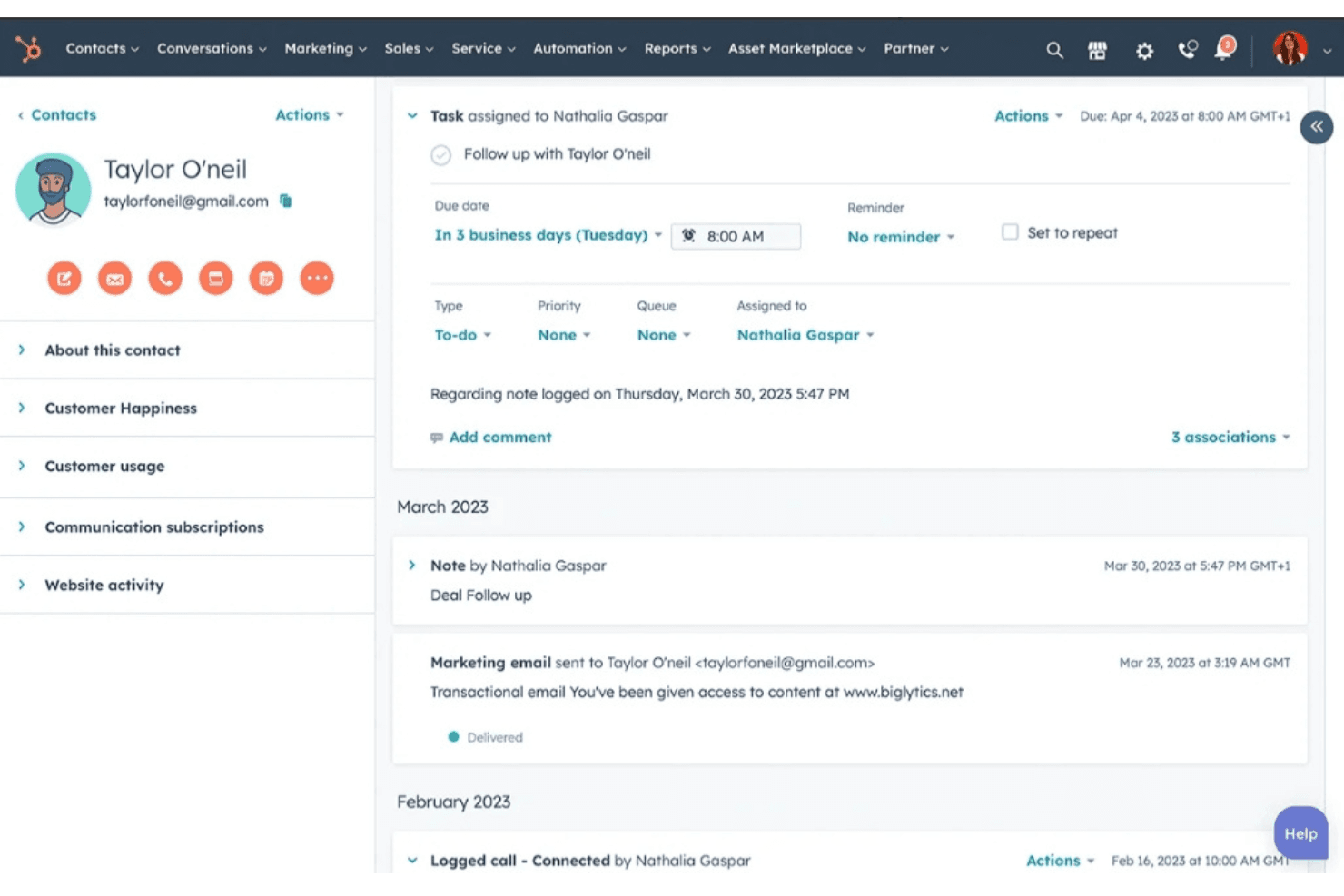
Contact Management
Store, organize, and segment all your contacts with custom fields and activity timelines. You can view every interaction, email, and note in one place.
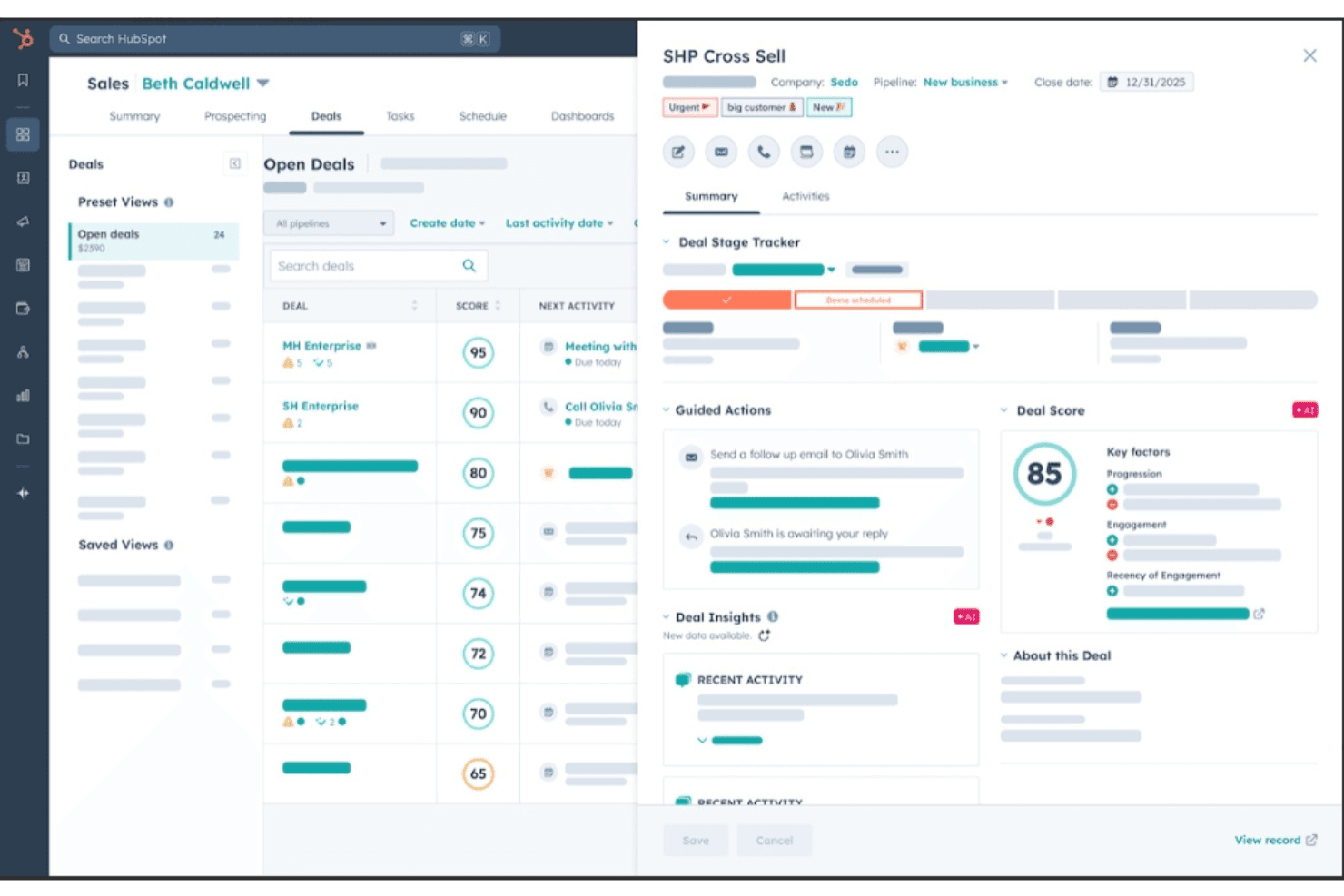
Pipeline Management
Track deals through customizable sales stages with drag-and-drop boards. Visual dashboards make it easy to spot bottlenecks and forecast revenue.
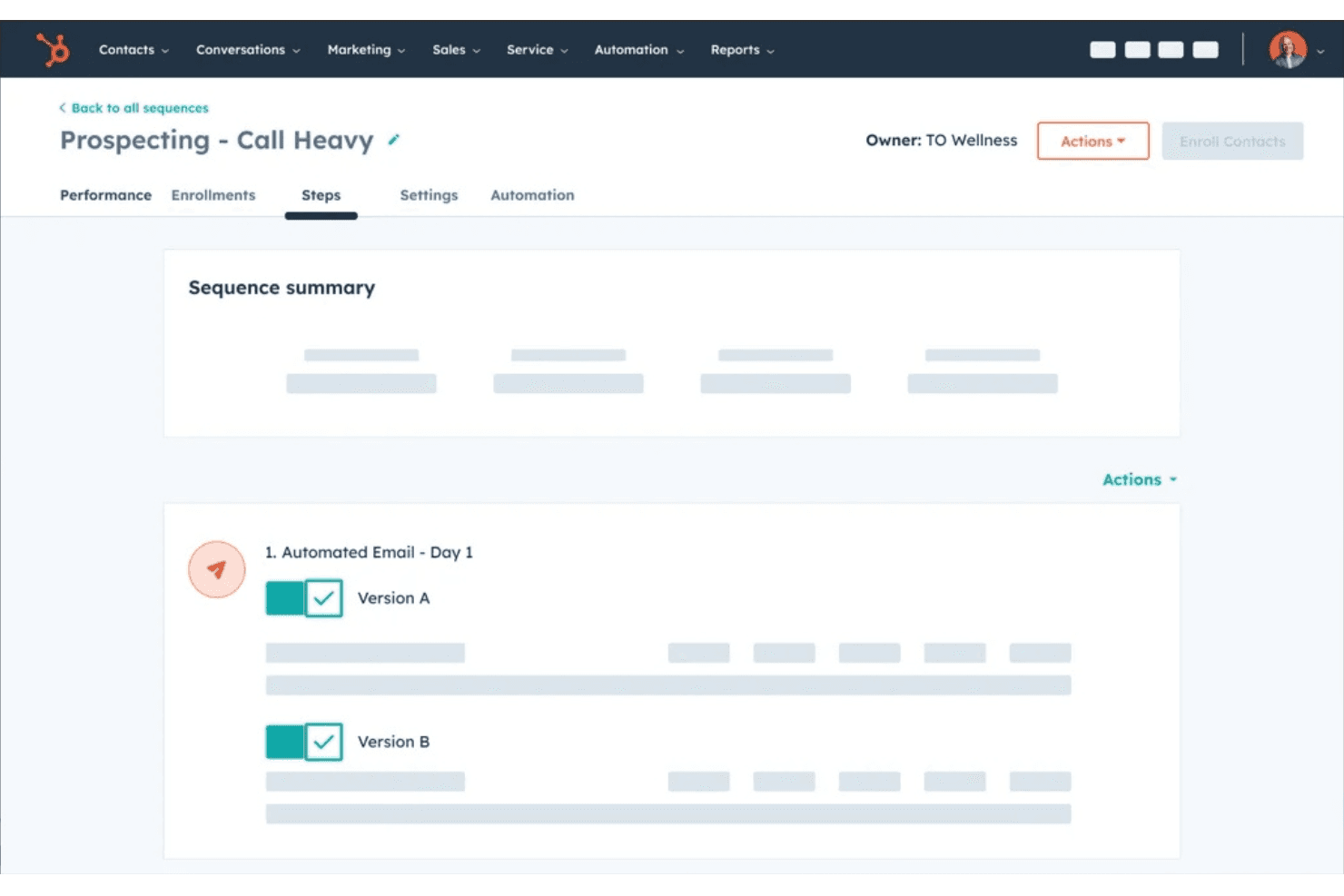
Marketing Automation
Automate email campaigns, lead nurturing, and follow-ups with built-in workflows. Trigger actions based on contact behavior or lifecycle stage.
Reporting and Analytics
Access dashboards for sales, marketing, and service performance with real-time data. Customizable reports let you track KPIs and team activity.
Email Tracking and Templates
Send, track, and log emails directly from HubSpot with notifications for opens and clicks. Save time with reusable templates for outreach and follow-up.
Task and Activity Management
Assign tasks, set reminders, and log calls or meetings from within each contact record. Keep your team organized and accountable with daily to-do lists.
Ease of Use
HubSpot is one of the most user-friendly CRM platforms I’ve used, with a clean interface and intuitive navigation that makes onboarding fast for new users. Drag-and-drop tools, guided setup, and in-app tips help teams get started without IT support.
Many users mention how easy it is to customize pipelines, automate tasks, and access reports. Even as features expand, the platform stays approachable for both technical and non-technical teams.
Integrations
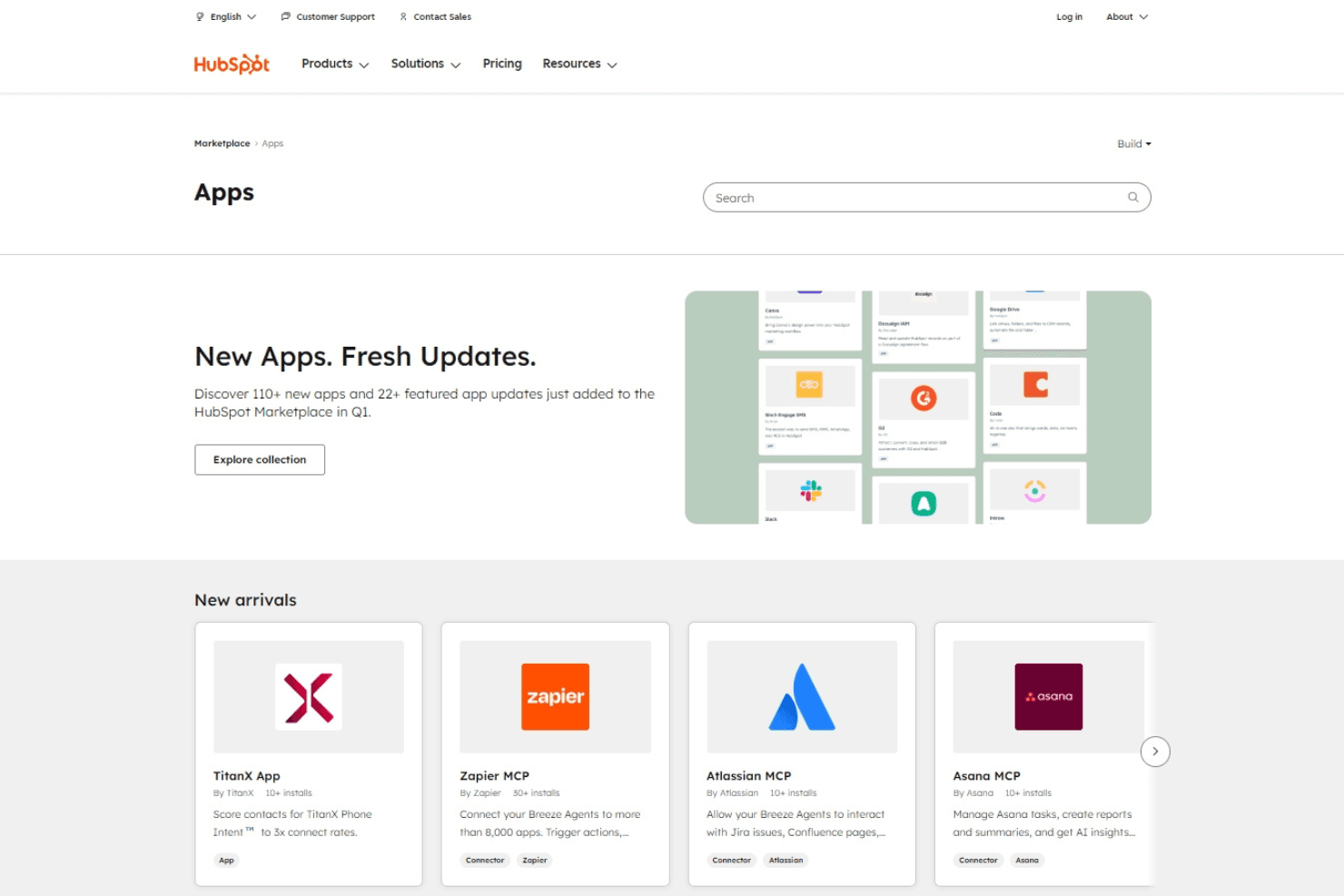
HubSpot integrates with Gmail, Outlook, Slack, TitanX, Shopify, Google Ads, Zoom, Asana, Zapier, and Microsoft Dynamics 365, among others.
HubSpot also offers a robust API and connects with third-party integration tools for even more flexibility.
HubSpot CRM Specs
- 2-Factor Authentication: Yes
- API: Yes
- Calendar Management: Yes
- Call Tracking: Yes
- Campaign Management: Yes
- Click-to-Dial: Yes
- Contact Management: Yes
- Contact Sharing: Yes
- Custom Data Forms: Yes
- Customer Management: Yes
- Dashboard: Yes
- Data Export: Yes
- Data Import: Yes
- Data Visualization: Yes
- Email Integration: Yes
- External Integrations: Yes
- File Sharing: Yes
- File Transfer: Yes
- Google Apps Integration: Yes
- Lead Management: Yes
- Lead Scoring: Yes
- Marketing Automation: Yes
- Mobile App: Yes
- Multi-User: Yes
- Notifications: Yes
- Pipeline Management: Yes
- Sales Automation: Yes
- Scheduling: Yes
- Social-Media Integration: Yes
- Task Scheduling/Tracking: Yes
- Third-Party Plugins/Add-Ons: Yes


