

With so many different sales gamification software available, figuring out which is right for you is tough. You know you want to engage and motivate your sales teams by transforming sales activities into competitive challenges but need to figure out which tool is best.
I've got you! In this post I'll help make your choice easy, sharing my personal experiences using dozens of different sales gamification tools with various teams and accounts, with my picks of the best sales gamification software.
Why Trust Our Software Recommendations
6,700+
Reviews
20
Industry experts
16+
Evaluation factors
14
Years
Our reviews reflect our independent judgment—not a sales pitch. Learn how we stay transparent.
For this guide, we evaluated tools using hands-on testing and independent research, scoring tools using our selection criteria.
Our reviews reflect our human editorial judgment, not a sales pitch.
Best Sales Gamification Software Summary
This comparison chart summarizes pricing details for my top sales gamification software selections to help you find the best one for your budget and business needs.
| Tool | Best For | Trial Info | Price | ||
|---|---|---|---|---|---|
| 1 | Best for a comprehensive enterprise platform to manage brand needs | Free demo available | Pricing upon request | Website | |
| 2 | Best for leveraging psychological drivers to motivate your salespeople | Free demo available | Custom pricing upon request | Website | |
| 3 | Best for sales gamification that focuses on knowledge retention | Free demo available | Custom pricing upon request | Website | |
| 4 | Best for analyzing sales performance to track trends and find room for growth | Free demo available | Custom pricing available | Website | |
| 5 | Best for integrating gamification with sales goals | Free demo available | From $45/user/month (billed annually) | Website | |
| 6 | Best for saving time with turnkey incentives and templates | Free plan + free demo available | From $32/month (billed annually) | Website | |
| 7 | Best for incentivizing both sales and recruiting teams | Free demo available | From $545/month | Website | |
| 8 | Best for sales incentive software for retailers with frontline teams | Website | |||
| 9 | Best for comprehensive sales management solutions | Website | |||
| 10 | Best with AI-powered sales role-play simulations | Free demo available | Pricing upon request | Website |


Best Sales Gamification Software Reviews
Below are my detailed summaries of the best sales gamification software that made it onto my shortlist. My reviews offer a detailed look at the key features, pros & cons, integrations, and ideal use cases of each tool to help you find the best one for you.
 Best for a comprehensive enterprise platform to manage brand needs
- Free demo available
- Pricing upon request
Visit WebsiteCustomer Rating:4.7/5
Raydiant allows you to connect with other apps, like Square, for more variety in your games. Raydiant is an all-in-one platform that can provide everything from video displays, POS-integrated digital menus, self-service kiosks, and sales gamification with rewards to ensure a positive experience for both customers and staff. This tool can provide you with personalized content and content from partner apps that you can display across AI-powered screens.
Why I picked Raydiant: I chose this tool because it does so much more than just sales gamification, while providing some of the most comprehensive incentive experiences possible. Raydiant allows you to connect with Square and Phenium to ensure you have access to top-tier software that helps you craft even more engaging experiences for your employees across multiple locations.
Raydiant Standout Features and Integrations
Standout features include a mobile app that showcases leaderboards and competitions so employees can check their status at any time, design templates that provide you with the tools to create brick-and-mortar experiences for customers and self-service kiosks that optimize employee efficiency.
Integrations include BrightSign, DS Menu, Leyline, MapsPeople, Phenium, Poly, RetailNext, Soundtrack Your Brand, Square, and Toast.
Pros and Cons
Pros:
- Easy-to-navigate user interface
- Knowledgeable and friendly customer support
- Frequently adding new features to the platform
Cons:
- All the data and features can feel overwhelming to learn
- Customer support can be slow
Learn more about Displai: Best for leveraging psychological drivers to motivate your salespeople
- Free demo available
- Custom pricing upon request
Visit WebsiteCustomer Rating:4.8/5
The SalesScreen dashboard visualizes goals and incentives to motivate your team. This sales performance software prioritizes visualization and gamification to help your company build a more productive workplace with less turnover and a more engaged team. By integrating with your CRM, SalesScreen provides real-time updates for competitions, leaderboards, contests, and peer-to-peer recognition.
Why I picked SalesScreen: This gamification software caught my eye because they use psychological metrics to determine what best motivates each team member. They have incentive pathways for various personality types, including Achievers, Socialites, Explorers, and Killers. SalesScreen recommends which pathway you should use with incentives that range from niche badges to social feeds.
SalesScreen Standout Features and Integrations
Standout features include over ten pre-built competition templates with bracket-style tournaments, one-day blitzes, and lotteries, as well as custom awards and badges to reward milestones and achievements.
Integrations include Chorus, Lessonly, HubSpot CRM, Outreach, Pipedrive CRM, Salesforce Sales Cloud, Seismic, Slack, Strava, and SugarCRM.
Pros and Cons
Pros:
- Simplified customization with pre-built templates
- Proactive and knowledgeable customer support team
- Intuitive navigation and user-friendly interface
Cons:
- Limited integration with internal chat platforms
- Limited contest library of images and templates
Learn more about SalesScreen: Best for sales gamification that focuses on knowledge retention
- Free demo available
- Custom pricing upon request
Visit WebsiteCustomer Rating:4.9/5
SmartWinnr offers automated payout calculations on both desktop and mobile. As a web-based platform for sales gamification, SmartWinnr focuses on ensuring uniform messaging for customer communication and keeping your sales team up-to-date on product knowledge while increasing sales. This platform leverages AI-driven quizzes, continuous coaching, gamified KPIs, and reinforcements to drive knowledge.
Why I picked SmartWinnr: This gamification and training platform caught my attention because they focus so much on knowledge retention. Through micro training, personalized learning, and SmartQuizz, your team has frequent contact with learning opportunities to ensure they know what’s going on with your products and services.
SmartWinnr Standout Features and Integrations
Standout features include real-time leaderboards tied to quiz performance that help team members keep track of their successes and structured learning paths based on every individual’s needs, skills, and performance.
Integrations include HubSpot CRM, Microsoft Dynamics, and Salesforce Sales Cloud.
Pros and Cons
Pros:
- Available in multiple European languages
- Backend customer support is knowledgeable
- Agile platform that adapts to your team
Cons:
- Advanced features may require training from customer support
- Customer service needs to create your custom reports
Learn more about SmartWinnr: Best for analyzing sales performance to track trends and find room for growth
- Free demo available
- Custom pricing available
Visit WebsiteCustomer Rating:4.5/5
Spinify allows you to send out regular emails highlighting rep performance. This gamification platform leverages Octalysis techniques and psychological principles to drive motivation for team and individual performance. Spinify also tracks these metrics to spot trends and identify areas of improvement so you and your managers can provide personalized coaching for everyone on your team.
Why I picked Spinify: This platform caught my eye because of its Chat GPT-enabled AI. SpinifyGPT works as a sidekick AI to personalize games and make gamification recommendations based on team performance metrics. Whenever you’re out of ideas, Spinify GPT can step in with answers.
Spinify Standout Features and Integrations
Standout features include custom goal and metric tracking creation with automated recognition messaging and personalized coaching insights for each team and individual to enhance performance.
Integrations include Bullhorn, Google Sheets, JobAdder, Microsoft Excel, Pipedrive CRM, Outreach, Salesforce Sales Cloud, Slack, SQL, and Zapier.
Pros and Cons
Pros:
- Outstanding tracking and analytics tools
- Simple competition and contest creation
- Easy to set up users and channels
Cons:
- Limited branding, missing custom fonts and layouts
- Custom pricing may result in unused tools
Learn more about Spinify: Best for integrating gamification with sales goals
- Free demo available
- From $45/user/month (billed annually)
Visit WebsiteCustomer Rating:4.7/5
Ambition pushes real time sales leaderboards and recognition into Slack, helping teams stay aware of performance where they already communicate. Ambition transforms the dynamics of sales teams by integrating gamification into everyday operations, making it an attractive choice for organizations seeking to boost motivation and performance. Designed for sales managers and teams across various industries, Ambition offers real-time tracking and customizable competitions that align with your company’s KPIs. By fostering a competitive culture and enhancing team accountability, Ambition addresses challenges in sales productivity and engagement, making it a valuable tool for those looking to drive meaningful behaviour change.
Why I Picked Ambition
I picked Ambition for its unique ability to seamlessly integrate gamification with sales performance management, which directly addresses the needs of sales teams aiming to enhance motivation and accountability. Ambition's standout feature is its customizable competitions and leaderboards, which provide real-time visibility into performance metrics. This not only motivates sales representatives but also aligns their efforts with organizational goals. Additionally, the automated goal tracking feature ensures that achievements are recognized promptly, fostering a culture of recognition and continuous improvement.
Ambition Key Features
In addition to its robust gamification elements, I also found several other features that enhance its value as a sales gamification tool.
- Accolades: This feature allows for flexible rewards programs, enabling automatic or manager-discretion recognition of sales achievements.
- Coaching Orchestration: Offers structured coaching programs that integrate seamlessly with gamification, enhancing overall team performance.
- Performance Intelligence: Provides data-driven insights for informed decision-making, crucial for optimizing sales strategies.
- Celebration Alerts: Automatic notifications that highlight achievements and milestones, fostering a culture of recognition and motivation.
Ambition Integrations
Integrations include Salesforce, Slack, Microsoft Teams, Zoom, Gong, Google Calendar, Outreach, Salesloft, HubSpot, and API for custom integrations.
Pros and Cons
Pros:
- Deep Salesforce and CRM integrations
- Real time performance visibility metrics
- Customizable contests motivate sales behaviors
Cons:
- Pricing may limit smaller teams
- Setup complexity for new teams
Learn more about Ambition: Best for saving time with turnkey incentives and templates
- Free plan + free demo available
- From $32/month (billed annually)
Visit WebsiteCustomer Rating:4.5/5
The Arcade Game Center shows salespeople all active games and incentives. This cloud-based employee engagement platform is designed to provide sales managers with a wide variety of gamification techniques in addition to communication and collaboration tools. Motivate employees with contests, leaderboards, and rewards, while providing one-on-one chats, team huddles, social feeds, and surveys.
Why I picked Arcade: I chose this tool for my list because it is purely a gamification platform, instead of a CRM with gamification rolled in. This gamification-first solution focuses on beautiful data visualization, fun sales competitions, and leaderboard standings to keep your team on the ball. With a platform that’s nice to look at and fun to use, your employees will actually want to log on.
Arcade Standout Features and Integrations
Standout features include a native app for iOS and Android that ensures team members can engage from any device, automation for real-time updates that provide your salespeople with exciting graphic notifications, and unique gamification solutions for inside and field sales teams.
Integrations include B2B Soft, Gmail, HubSpot CRM, Pipedrive CRM, Revel Systems, RQ Retail Management, Salesforce Sales Cloud, Slack, Square POS, and Vend.
Pros and Cons
Pros:
- Interface has beautiful graphics and design
- Navigation is intuitive and user-friendly
- Platform is very easy to use
Cons:
- App can be slow on mobile with an outdated OS
- Dashboards aren’t fully customizable
Learn more about Arcade: Best for incentivizing both sales and recruiting teams
- Free demo available
- From $545/month
Visit WebsiteCustomer Rating:5/5
OneUp Sales provides your team with customizable dashboards to tailor their preferences. This sales performance platform is ideal for growing sales teams who also place a heavy focus on recruitment. OneUp Sales collects real-time data from every one of your key systems, including VOIPs and CRMs, to provide managers with clear insights, KPI metrics, and automated reports that ensure visibility across your entire organization.
Why I picked OneUp Sales: This tool made my list because they prioritize recognition that works for every team, including sales and recruiting. Celebrate team or individual successes on TVs and messaging apps (like MS Teams) with data visualization, league tables, videos, images, and rewards.
OneUp Sales Standout Features and Integrations
Standout features include customizable dashboards for every team member to pull the most important metrics front and center, real-time leaderboards that pull live data from your tools to generate automated results, and custom triggers that launch celebrations across all network devices.
Integrations include Access Recruitment CRM, Aircall, Bullhorn CRM, HubSpot CRM, Jobadder, Loxo, Microsoft Dynamics 365, RingCentral, Salesforce Sales Cloud, and Vincere.
Pros and Cons
Pros:
- Provides insight into missed opportunities
- Easy to set up incentives for teams or individuals
- Continual customer support during onboarding
Cons:
- In-depth functionality requires additional training
- “Targets” feature is in beta and still a little clunky
Learn more about OneUp Sales:

The SparkPlug app offers multiple incentive structures, including commissions and leaderboards. Purpose-built for specialty retailers, CPG brands, and restaurants, SparkPlug is ideal for brick-and-mortar businesses with POS systems. Once connected, SparkPlug can automate every aspect of implementing and scaling your new incentive program with managed payouts, trade promotion tools, and vendor-sponsored sales incentives for employees.
Why I picked SparkPlug: This platform made my list because it has features that address the needs of frontline salespeople. SparkPlug is unique for its restaurant-oriented solutions, which encourage the sales of target products, like appetizers, drinks, weekly specials, and other high-margin menu items. SparkPlug also automates payouts and leaderboard tracking.
SparkPlug Standout Features and Integrations
Standout features include payout via virtual wallet that employees can cash out through Venmo, Visa gift card, or ACH, direct integration with your POS system for real-time updates, and purpose-built incentives specifically for retail and restaurant employees.
Integrations include Alleaves, Biotrack, Blaze, Cova, Flowhub, Dutchie, LeafLogix, Meadow, Revel, Square, and Toast. SparkPlug’s API connects you securely to any POS for seamless integration.
Pros and Cons
Pros:
- User-friendly for managers and salespeople
- Friendly and knowledgeable customer support
- Quick and easy implementation
Cons:
- No chat function for customer support
- Vendor-sponsored incentives can be clunky
Learn more about SparkPlug:

SetSail recently launched a leaderboard feature to track performance and metrics. SetSail is a unique sales management solution because it’s built as a signal-based selling platform that interprets and centralizes data across your tools and teams. With all this data, SetSail can detect activities and trends among your top performers to drive those winning behaviors throughout your organization. Driven by AI and behavioral science, SetSail transforms sales data into buying signals.
Why I picked SetSail: I like this tool because it provides your managers with insights that improve your sales team performance, showing you which reps are falling behind to help you address issues early, scorecards with rep performance for real-time feedback, and account health according to custom metrics and milestones. With AI-driven analytics, you can enjoy enhanced visibility across your organization.
SetSail Standout Features and Integrations
Standout features include custom weekly SPIFF creation to incentivize reps to complete high-value activities, public leaderboards to showcase high performers and encourage sales from lower-ranked team members, and guided coaching based on personal sales activities.
Integrations include Chorus, Gmail, Gong, Google Calendar, Microsoft Dynamics, Outreach, Salesforce Sales Cloud, SalesLoft, and Zoom.
Pros and Cons
Pros:
- Dedicated account support team
- Contest timelines are customizable for daily, weekly, and monthly competitions
- Simple and straightforward user interface
Cons:
- KPI and metrics tracking could be more accurate
- Limited self-service customization options
Learn more about SetSail: Best with AI-powered sales role-play simulations
- Free demo available
- Pricing upon request
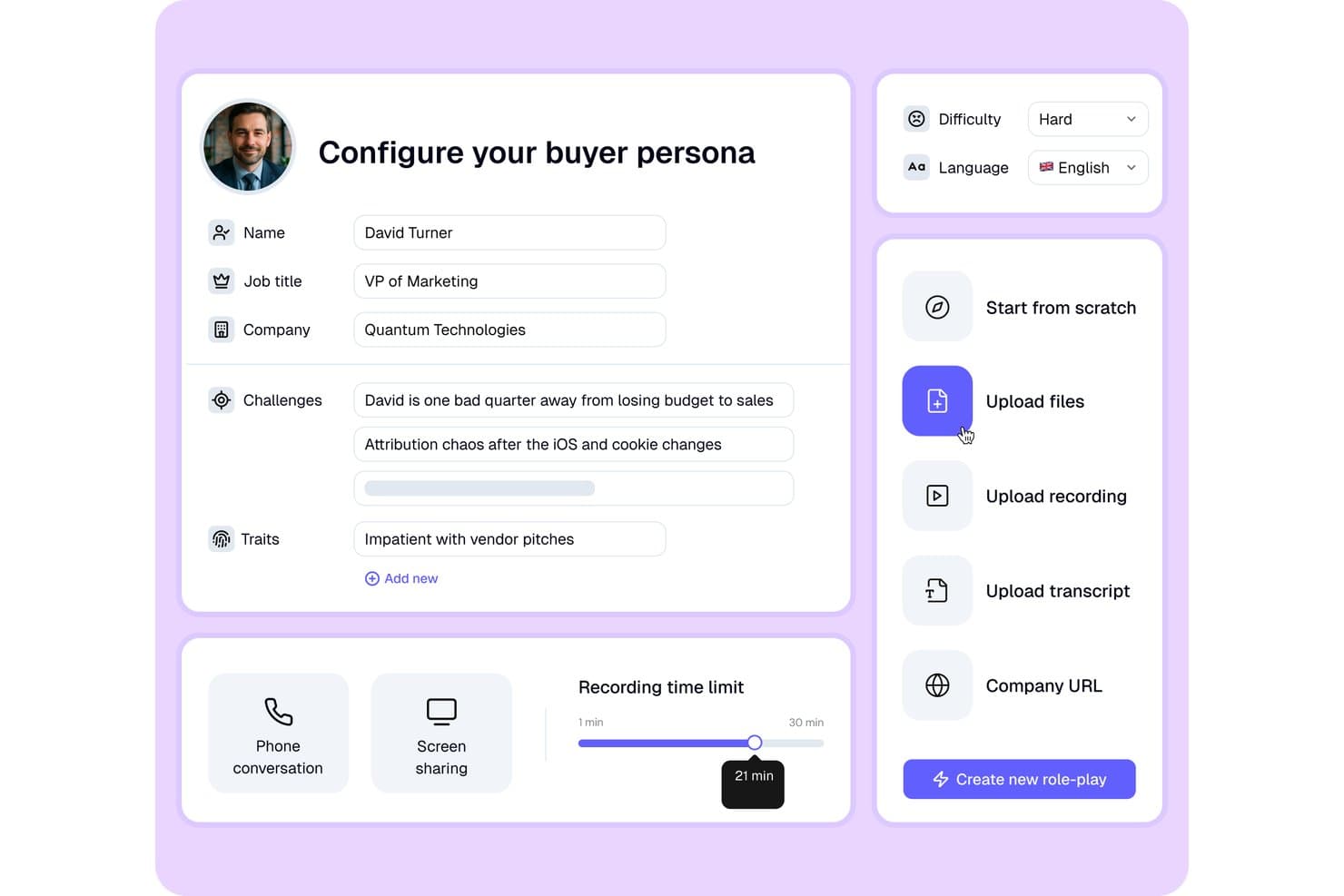
PitchMonster offers a buyer persona configuration interface where sales reps can set up AI role-play scenarios with custom challenges, traits, difficulty, and recording time limits. PitchMonster is an AI sales role-play platform that gamifies rep training through simulated buyer conversations, customizable scorecards, performance leaderboards, and scenario-based practice competitions.
Who Is PitchMonster Best For?
Sales enablement leaders and training managers at mid-to-large organizations who want to gamify rep onboarding and ongoing skill development through structured, scenario-based practice.
Why I Picked PitchMonster
I picked PitchMonster as one of the best because its AI role-play engine does something most gamification tools can't: it recreates specific buyer objections and conversation flows, not just abstract KPI contests. I like that you can build scorecards aligned to methodologies like MEDDPICC, so reps are scored on what actually matters in your sales process. The leaderboards then rank performance on those scorecards, making practice genuinely competitive.
PitchMonster Key Features
- Self-coaching mode: Reps can independently practice sales conversations and receive AI feedback without manager involvement.
- Peer review tools: Managers and reps can use shared scorecards to facilitate structured peer-to-peer feedback on role-play sessions.
- Scenario library: Offers 48 ready-to-use sales role-play scenarios covering common customer conversations and objection handling.
- Skill gap analytics: Provides dashboards that track individual and team skill improvements and highlight areas for targeted coaching.
PitchMonster Integrations
Native integrations are not clearly documented. PitchMonster primarily operates as a standalone platform and does not offer built-in CRM or sales tool integrations.
Pros and Cons
Pros:
- Scenario library for diverse practice topics
- Custom scorecards for methodology alignment
- AI-driven sales conversation simulations
Cons:
- Lacks live sales KPIs on leaderboards
- No CRM or sales tool integrations
Learn more about PitchMonster:
Other Sales Gamification Software
Here are some additional sales gamification software options that didn’t make it onto my shortlist, but are still worth checking out:
- 11Master-OBest for micro-learning, behavioral nudges, and virtual training
- 12PlectoBest for real-time dashboards and instant notifications of ranking changes
- 13Zoho CRMBest for strategizing team success through KPIs in a comprehensive CRM
- 14CaptivateIQBest for improving team performance through commission transparency
- 15AmbitionBest for driving personalized development with Coaching Cadences
- 16EverstageBest for customized incentive plan designing with templates
- 17CentricalBest gamification platform with automated coaching and feedback
- 18Bunchball NitroBest cloud-based tool for enterprise
- 19Cloudapps Revenue IntelligenceBest for AI-driven motivational gamification
- 20Level ElevenBest for simple contest creation in just a few clicks
How I Evaluate Sales Gamification Software
I split my evaluation into two layers: core non-negotiables like real-time leaderboards and CRM sync, and the differentiators that separate a basic contest tool from one built for a scaling sales org.
Core Functionality (Table Stakes For This List)
When I'm selecting tools for my list, I rank each one on a scale from 0 (does not offer the functionality) to 5 (excels in this area) for each core functionality listed below. Then, I calculate the tool's total score into a percentage. Each tool needs to achieve a minimum total score of 65% to be considered for inclusion.
- Leaderboards & Rankings: I look for real-time leaderboards that can be filtered by KPIs like calls booked, deals closed, or pipeline generated across individuals and teams.
- Contests & Competitions: Whether it's a week-long SPIF or a head-to-head deal challenge, I evaluate how many contest formats a tool supports and how easy they are to set up.
- Rewards & Recognition: I check whether reps earn points, badges, or tangible rewards when they hit milestones, and how automated the distribution process is.
- CRM & Data Integration: The tool should pull live data from your CRM (Salesforce, HubSpot, Dynamics, etc.) so leaderboards and contests update without manual data entry.
- Performance Dashboards: I evaluate whether dashboards give managers and reps a clear view of progress, with options to display on office TVs or share in team channels.
- Goal & KPI Tracking: Admins should be able to define and assign custom quotas or activity targets at the rep, team, or org level and track pacing against them.
Once I have a list of tools that meet this criteria, I consider what sets each platform apart.
Differentiating Factors (What Sets Vendors Apart)
Here's how I compare and contrast different vendors:
Standout Features
Behavioral analytics is a major differentiator. I look for tools that correlate gamified activities with revenue outcomes, showing whether a contest actually moved pipeline or just inflated vanity metrics. A native mobile app also matters for field sales teams who need to check standings and receive contest alerts away from their desks. Peer-to-peer recognition adds another dimension—reps celebrating each other's wins drives engagement in ways that top-down leaderboards alone can't replicate.
Beyond Features
Integration depth matters a lot here. I evaluate whether a tool connects natively with your CRM, Slack or Teams, and sales engagement platforms so contest updates and recognition flow where reps already work. Implementation speed is another factor I weigh—pre-built contest templates and onboarding resources help RevOps teams launch programs in days, not months. I also check how well a platform scales across multiple teams, territories, or business units, since a tool that works for 20 reps but buckles at 500 creates problems you'll inherit later.
How to Choose Sales Gamification Software
It’s easy to get bogged down in long feature lists and complex pricing structures. To help you stay focused as you work through your unique software selection process, here’s a checklist of factors to keep in mind:
| Factor | What to Consider |
|---|---|
| FactorScalability | What to ConsiderCan the software grow with your team? Consider if it can handle more users or data as your sales grow. Look for flexible plans that cater to different team sizes. |
| FactorIntegrations | What to ConsiderDoes it work with your existing tools? Check if it integrates with your CRM, communication tools, and analytics platforms for seamless workflow integration. |
| FactorCustomizability | What to ConsiderCan you tailor it to fit your needs? Evaluate if you can customize dashboards, reports, and user roles to match your team's workflow and goals. |
| FactorEase of use | What to ConsiderWill your team adopt it easily? Look for intuitive interfaces and straightforward navigation. A steep learning curve can hinder adoption. |
| FactorImplementation and onboarding | What to ConsiderHow quickly can you get started? Assess the support for onboarding, such as training videos, product tours, and live demos to ensure a smooth transition. |
| FactorCost | What to ConsiderIs it within your budget? Compare pricing plans and check for hidden fees. Consider the cost against the features offered and your team's needs. |
| FactorSecurity safeguards | What to ConsiderAre data protections in place? Ensure the software complies with data protection standards and offers encryption, access controls, and regular security updates. |
| FactorSupport availability | What to ConsiderWill help be there when you need it? Look into the availability of customer support, including hours of operation and channels like chat, email, or phone. |
Trends In Sales Gamification Software For 2026
Sales gamification software have become integral in motivating sales teams, driving productivity, and fostering a competitive yet collaborative work environment. Here's what the latest trends reveal about the sales gamification software landscape:
- Integration with Advanced Technologies: The incorporation of AI and machine learning for personalized challenges and rewards indicates a shift towards more intelligent and adaptive gamification strategies. This approach enhances user engagement by tailoring experiences to individual preferences and performance history.
- Emphasis on Analytics and Reporting: There's a growing trend towards robust analytics features that provide deeper insights into team performance and engagement metrics. Such data-driven functionalities help managers fine-tune strategies and recognize areas needing improvement or acknowledgment.
- Enhanced Customization and Flexibility: The demand for customizable gamification platforms is on the rise, allowing organizations to align the software with their specific sales processes, goals, and cultures. This flexibility ensures that gamification strategies resonate well with team members, fostering greater buy-in and participation.
- Increased Focus on Mobile Experience: With remote and on-the-go sales roles expanding, gamification solutions are emphasizing mobile-friendly designs and functionalities. This trend caters to the need for anytime, anywhere access to gamification tools, ensuring continuous engagement and participation.
- Integration with Sales and CRM Platforms: Seamless integration with existing sales and CRM tools remains a critical feature. It ensures that gamification efforts are deeply woven into the daily activities and workflows of sales teams, providing a cohesive and frictionless experience.
For revenue operation leaders exploring sales gamification software, these trends underscore the importance of selecting a solution that not only motivates and engages but also integrates seamlessly with existing workflows and provides actionable insights. The right gamification software should adapt to the unique dynamics of your sales team, ensuring sustained engagement and improved performance.
What Is Sales Gamification Software?
Sales gamification software is a digital tool that incorporates game-like elements into the sales process to motivate sales teams. It transforms sales tasks and goals into competitive activities, using features like points, leaderboards, badges, and rewards.
This software integrates with sales and CRM systems, applying gaming strategies to real-world sales objectives and activities, thereby making the sales environment more interactive and enjoyable.
Features
When selecting sales gamification software, keep an eye out for the following key features:
- Leaderboards: Display team rankings to foster healthy competition and motivate sales reps to improve their performance.
- Reward systems: Offer incentives and recognition for achieving sales targets, boosting team morale and engagement.
- Performance tracking: Monitor individual and team progress to identify strengths and areas for improvement.
- CRM integration: Seamlessly connect with existing CRM systems to streamline data flow and enhance reporting accuracy.
- Customizable challenges: Tailor challenges and goals to fit your team's specific needs and objectives, keeping them aligned and focused.
- Real-time analytics: Provide up-to-date insights into sales activities and outcomes, enabling quick decision-making.
- Mobile app availability: Allow access on-the-go, ensuring that sales reps can stay engaged and informed wherever they are.
- AI-driven insights: Use artificial intelligence to identify trends and opportunities, helping teams optimize their strategies.
- Interactive product tours: Facilitate onboarding and training with guided tours that quickly familiarize users with the platform.
- Social media integration: Leverage social platforms to share achievements and foster a sense of community among team members.
Benefits
Implementing sales gamification software provides several benefits for your team and your business. Here are a few you can look forward to:
- Increased motivation: By using leaderboards and reward systems, teams stay motivated and driven to reach their sales goals.
- Enhanced engagement: Interactive challenges and real-time feedback keep team members actively involved and committed to their tasks.
- Improved performance: Performance tracking identifies areas for improvement, helping sales reps focus on strengthening their skills.
- Better collaboration: Social media integration fosters a sense of community, encouraging team members to share achievements and support each other.
- Quicker onboarding: Interactive product tours and training resources make it easier for new hires to get up to speed and contribute quickly.
- Data-driven insights: AI-driven analytics offer valuable insights, enabling teams to make informed decisions and optimize their strategies.
- Flexibility and access: Mobile app availability ensures that team members can stay connected and productive, no matter where they are.
Costs & Pricing
Selecting sales gamification software requires an understanding of the various pricing models and plans available. Costs vary based on features, team size, add-ons, and more. The table below summarizes common plans, their average prices, and typical features included in sales gamification software solutions:
Plan Comparison Table for Sales Gamification Software
| Plan Type | Average Price | Common Features |
|---|---|---|
| Plan TypeFree Plan | Average Price$0 | Common FeaturesBasic leaderboards, limited reward systems, and essential analytics. |
| Plan TypePersonal Plan | Average Price$10-$30/user/month | Common FeaturesAdvanced leaderboards, customizable challenges, and basic CRM integration. |
| Plan TypeBusiness Plan | Average Price$40-$70/user/month | Common FeaturesComprehensive analytics, full CRM integration, and mobile app access. |
| Plan TypeEnterprise Plan | Average Price$80-$150/user/month | Common FeaturesAI-driven insights, dedicated support, and extensive customization options. |
Sales Gamification Software FAQs
Here are some answers to common questions about sales gamification software:
What are the types of sales gamification software?
Sales gamification software comes in various types, each designed to engage and motivate sales teams in unique ways. Understanding these types can help organizations choose the most suitable solution to enhance their sales processes and team dynamics. Here are the primary types of sales gamification software:
- Points-Based Systems: These platforms allow sales teams to earn points for completing certain activities or achieving goals. The accumulation of points often leads to rewards or recognition, driving competition and motivation.
- Leaderboard Systems: These systems rank participants based on their performance metrics, displaying rankings in a visible, often real-time leaderboard. This fosters a competitive environment, encouraging team members to outperform their peers.
- Badge and Achievement Systems: Similar to video game achievements, these systems reward sales reps with badges for specific accomplishments or milestones. Badges serve as a tangible recognition of a rep’s skills, achievements, and progress.
- Mission-Based Systems: These platforms create specific missions or challenges that reps need to complete within a given timeframe. Missions can vary in complexity and reward, adding variety and excitement to the sales process.
- Progress Bars and Milestone Tracking: Utilizing visual progress indicators, these systems show sales reps their progress toward individual or team goals, providing a clear sense of advancement and encouraging continued effort.
- Fantasy Sports Models: Some gamification platforms adopt a fantasy sports approach, where sales reps form teams and compete in sales “games” or “seasons” based on their performance metrics, adding a team-based competitive element.
- Training and Educational Gamification: These platforms focus on using gamification to enhance learning and development. They engage reps in training modules or educational content, rewarding them for completing lessons or demonstrating knowledge retention.
- Integrated CRM Gamification: This type integrates directly with a company’s CRM system, allowing for real-time tracking and gamification of sales activities. It ensures that all data is centralized and that gamification efforts align closely with daily sales operations.
By selecting the right type of sales gamification software, organizations can inject energy and enthusiasm into their sales processes, improving engagement, morale, and ultimately, sales performance.
Can sales gamification software be used for remote teams?
Yes, sales gamification software is great for remote teams. It keeps everyone connected and engaged, no matter where they are. Features like leaderboards and real-time updates help remote workers feel part of the team. Choose a tool with a mobile app or cloud-based access so everyone can participate.
How do you measure the success of sales gamification software?
You measure success by tracking key performance indicators (KPIs) like sales growth, employee engagement, and task completion rates. Set clear goals before implementation. Regularly review performance data provided by the software to see what’s working and where improvements are needed. Adjust your strategies based on these insights.
Is sales gamification software suitable for small businesses?
Yes, sales gamification software can be a good fit for small businesses. It helps improve team motivation and sales performance without needing large budgets. Look for solutions with flexible pricing plans that scale with your team size. Even basic features can add value by fostering engagement and teamwork.
What’s Next:
If you're in the process of researching sales gamification software, connect with a SoftwareSelect advisor for free recommendations.
You fill out a form and have a quick chat where they get into the specifics of your needs. Then you'll get a shortlist of software to review. They'll even support you through the entire buying process, including price negotiations.