

Sejamos realistas — analisar ferramentas de vendas e marketing que prometem fazer tudo não é tarefa fácil. Uma promete melhorar o acompanhamento de potenciais clientes, enquanto outra garante que fará disparar o retorno do investimento das suas campanhas. Entretanto, fica a tentar gerir tudo — acompanhar potenciais clientes, executar campanhas e manter-se atento às receitas. Parece-lhe familiar? A ferramenta certa pode poupar-lhe horas, mas a errada pode simplesmente aumentar o caos. Então, como decidir qual resolverá realmente os seus problemas?
É aqui que entro eu. Passei tempo suficiente a configurar, explorar e testar software para saber o que merece o seu tempo (e o que não merece).
Neste artigo, vou analisar as principais soluções de software para enfrentar os seus desafios de vendas e marketing. Pense em informações claras, melhores casos de utilização e comparações de preços para o ajudar a tomar a decisão certa. Estas são as minhas principais escolhas das melhores soluções de software de vendas e marketing.
Why Trust Our Software Recommendations
6,700+
Reviews
20
Industry experts
16+
Evaluation factors
14
Years
Our reviews reflect our independent judgment—not a sales pitch. Learn how we stay transparent.
For this guide, we evaluated tools using hands-on testing and independent research, scoring tools using our selection criteria.
Our reviews reflect our human editorial judgment, not a sales pitch.
Tabela comparativa de software de vendas e marketing
Esta tabela comparativa resume os detalhes de preços das minhas principais escolhas de software de vendas e marketing:
| Tool | Best For | Trial Info | Price | ||
|---|---|---|---|---|---|
| 1 | Best for real-time B2B data enrichment | Free plan + 14-day free trial + free demo available | From $49/user/month (billed annually) | Website | |
| 2 | Best for AI-driven sales outreach | Free plan + 14-day trial + free demo available | From $25/user/month (billed annually) | Website | |
| 3 | Best for small business affordability | Free plan + free demo available | From $11.04/user/month (billed annually) | Website | |
| 4 | Best for go-to-market strategies | Free demo available | Pricing upon request | Website | |
| 5 | Best for automating customer journeys | Free plan available | Pricing upon request | Website | |
| 6 | Best for email marketing automation | 14-day free trial + free demo available | From $15/month (billed annually) | Website | |
| 7 | Best for event marketing tools | 14-day free trial + free demo available | From $12/month | Website | |
| 8 | Best for project management integration | 14-day free trial | From $29/user/month (billed annually) | Website | |
| 9 | Best for large enterprise teams | 30-day free trial | From $25/user/month | Website | |
| 10 | Best for advanced analytics | Free demo available | Pricing upon request | Website |


Análises do melhor software de vendas e marketing
Seguem-se os meus resumos detalhados das melhores ferramentas de marketing e vendas que entraram na minha seleção. As minhas análises apresentam uma visão detalhada das principais funcionalidades, vantagens \u0026 desvantagens, integrações e casos de utilização ideais de cada ferramenta, para o ajudar a encontrar a melhor opção para si.
 Best for real-time B2B data enrichment
- Free plan + 14-day free trial + free demo available
- From $49/user/month (billed annually)
Visit WebsiteCustomer Rating:4.5/5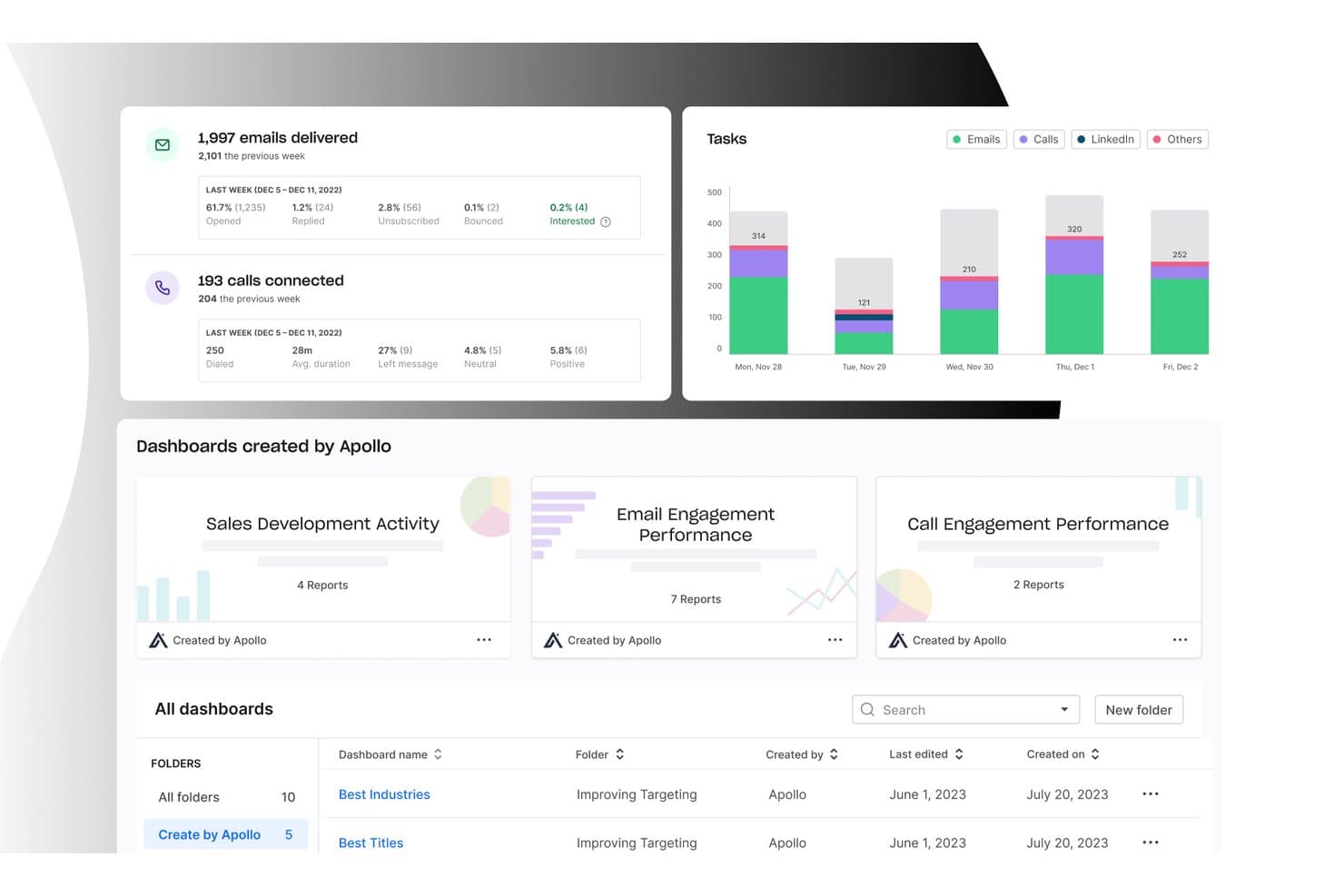
Apollo.io offers a detailed analytics dashboard displaying email delivery stats, call connection metrics, task breakdowns by channel, and pre-built sales and marketing performance dashboards. Apollo.io is an AI-powered sales platform that combines a 265M+ contact B2B database with sales engagement sequencing, data enrichment, lead routing, and a built-in dialer.
Who Is Apollo.io Best For?
Apollo.io suits small-to-mid-sized sales teams and SDR-heavy organizations that run high-volume outbound prospecting from a single platform.
Why I Picked Apollo.io
Apollo.io earns its spot on my shortlist because its waterfall enrichment pulls from multiple data providers in sequence, filling gaps that a single-source tool would miss. I like that enrichment runs on a schedule, so my CRM contact records update automatically without manual exports or CSV uploads. The AI Research feature lets me define custom fields, like whether a company uses a specific technology, and Apollo populates them across thousands of records at once.
Apollo.io Key Features
- Bi-directional CRM sync: Keep contacts and activity updated between Apollo, Salesforce, and HubSpot with field mapping and auto-sync.
- Multi-channel sales sequences: Automate outreach using email, calls, LinkedIn tasks, and manual steps in custom workflows.
- Deal and pipeline management: Track deals, stages, and progress with customizable pipeline dashboards and opportunity records.
- Account-based prospecting tools: Build dynamic account lists, identify buying committees, and organize outbound by account.
Apollo.io Integrations
Apollo.io offers native integrations with Salesforce, HubSpot, Outreach, Airtable, Amplitude, Asana, and Gmail, and provides an API for custom integrations.
Pros and Cons
Pros:
- AI scoring surfaces in-market accounts automatically
- Dialer, sequencing, and enrichment in one platform
- Large, continuously refreshed B2B contact database
Cons:
- Email sending limits frustrate high-volume teams
- Data accuracy drops for non-US contacts
Learn more about Apollo.io: Best for AI-driven sales outreach
- Free plan + 14-day trial + free demo available
- From $25/user/month (billed annually)
Visit WebsiteCustomer Rating:4.2/5
CloudTalk dashboard displaying real-time call metrics and performance analytics for sales teams. For businesses seeking to elevate their sales and marketing efforts, CloudTalk offers a sophisticated cloud call center solution that stands out by enhancing communication and operational efficiency. Tailored for industries that rely on robust customer interactions, CloudTalk is ideal for teams looking to overcome challenges related to call management and customer engagement. With features designed to streamline processes and improve customer experiences, it addresses the needs of organizations aiming to optimize their sales and marketing workflows.
Why I Picked CloudTalk
I picked CloudTalk because of its AI-driven tools that significantly enhance sales outreach and customer engagement. The platform's AI Dialer not only automates dialing but also incorporates voicemail drop and answering machine detection, which helps your team maximize productive call time. Furthermore, its AI Conversation Intelligence provides automatic call summaries and sentiment analysis, enabling your team to gain insights and improve interactions with clients. These features address the core needs of sales and marketing teams by providing actionable data and enhancing communication capabilities.
CloudTalk Key Features
In addition to its AI-driven functionalities, I also found CloudTalk offers several other valuable features:
- Local Numbers: Provides access to local numbers in over 160 countries, allowing your business to maintain a local presence globally.
- Real-Time Monitoring: Enables live call listening and performance analytics, giving you the tools to monitor and improve your team's effectiveness.
- Customizable Call Routing: Allows you to tailor call flows to suit your specific business needs, ensuring that calls are directed to the right agents.
- WhatsApp Messaging: Supports communication through WhatsApp, expanding your team's ability to engage with customers on their preferred platform.
CloudTalk Integrations
Integrations include HubSpot, Salesforce, Zoho, Freshdesk, Pipedrive, Zendesk, Microsoft Dynamics 365, Intercom, Slack, and Shopify.
Pros and Cons
Pros:
- AI-powered conversation intelligence tools
- Multiple outbound dialer modes
- Extensive CRM integration options
Cons:
- Parallel dialer stability issues
- International number availability can be inconsistent
Learn more about CloudTalk: Best for small business affordability
- Free plan + free demo available
- From $11.04/user/month (billed annually)
Visit WebsiteCustomer Rating:4.6/5
EngageBay simplifies customer management, marketing automation, and sales. EngageBay is an all-in-one marketing, sales, and service platform targeting small businesses. It helps manage customer interactions, automate marketing campaigns, and streamline sales processes.
Why I picked EngageBay: It's ideal for small businesses due to its affordability and comprehensive feature set. EngageBay combines CRM, marketing automation, and helpdesk tools in one package, providing excellent value. You can automate your marketing campaigns with ease, saving time and effort. The platform's capability to manage customer interactions makes it a practical choice for small teams.
Standout features & integrations:
Features include a landing page builder that lets you create and customize pages without coding. The CRM component offers contact management and deal tracking to keep your sales organized. Its marketing automation tools allow you to nurture leads through email sequences.
Integrations include Mailchimp, Zapier, Xero, Shopify, QuickBooks, Stripe, Twilio, Mandrill, SendGrid, and Docusign.
Pros and Cons
Pros:
- Affordable for small businesses
- Effective deal tracking
- Customizable landing pages
Cons:
- Steeper learning curve for new users
- Limited advanced features
Learn more about EngageBay: Best for go-to-market strategies
- Free demo available
- Pricing upon request
Visit WebsiteCustomer Rating:4.7/5
HockeyStack’s Odin AI dashboard visualizing full-funnel performance and sales-qualified leads by channel. For businesses aiming to refine their sales and marketing strategies, HockeyStack offers a unique blend of AI-driven insights and analytics designed to enhance go-to-market efforts. Whether you're a sales professional seeking to resurrect closed deals or a marketer focused on optimizing budgets, HockeyStack provides the tools you need to improve customer acquisition and retention. Its seamless integration with various sales and marketing software makes it an appealing choice for teams looking to unify their data and drive actionable insights.
Why I Picked HockeyStack
I picked HockeyStack because it provides a distinctive approach to sales and marketing challenges by offering AI-driven analytics that cater specifically to improving go-to-market strategies. With features like customizable attribution reporting and buyer journey tracking, you can gain comprehensive insights into customer interactions, empowering your team to make informed decisions. Additionally, account scoring helps prioritize efforts on the most promising leads, ensuring your resources are directed where they can have the most impact.
HockeyStack Key Features
In addition to its standout analytics capabilities, I also found several other features that enhance its utility for sales and marketing teams.
- Full-Funnel Visibility: This feature provides a comprehensive view of the entire customer journey, allowing your team to identify and address potential bottlenecks in the sales process.
- Deal Resurrection: Helps your sales team revisit and potentially recover lost deals by analyzing past interactions and suggesting actionable steps.
- Marketing Budget Optimization: Offers insights into budget allocation to maximize return on investment and improve campaign performance.
- Next Best Step Generators: Provides actionable recommendations for progressing open deals, ensuring your sales pipeline remains active and productive.
HockeyStack Integrations
Integrations include Salesforce, HubSpot, Marketo, Google Analytics, Slack, Microsoft Teams, Intercom, Drift, Pendo, and Zendesk.
Pros and Cons
Pros:
- Unifies marketing, product, and sales data
- Customizable attribution reporting across buyer journeys
- AI-driven insights support go-to-market decision-making
Cons:
- Advanced features may require onboarding time
- Pricing not publicly available
Learn more about HockeyStack: Best for automating customer journeys
- Free plan available
- Pricing upon request
Visit WebsiteCustomer Rating:4.5/5
Ortto automates customer engagement, personalizes journeys, and integrates data. Ortto is a marketing automation tool designed for businesses looking to automate customer engagement. Its main user base includes marketers and sales teams focused on creating personalized customer journeys. The platform excels at integrating customer data and automating marketing processes.
Why I picked Ortto: Ortto specializes in automating customer journeys with features like personalized messaging and notifications. Its customer data platform enables you to integrate and segment customer data efficiently. AI-powered tools assist in creating optimized messages and emails. The platform's analytics provide insights to visualize data, supporting marketers in decision-making.
Standout features & integrations:
Features include customer data integration, personalized messaging, and AI-driven email creation. Ortto's analytics help visualize customer data, making it easier to understand trends and behaviors. The platform supports no-code integrations, enhancing its usability across various applications.
Integrations include Shopify, Salesforce, HubSpot, Mailchimp, Zapier, Google Analytics, Slack, WordPress, Zendesk, and Intercom.
Pros and Cons
Pros:
- Strong customer support
- Scales well with growth
- Easy to set up
Cons:
- Integration with existing tech stack can be tricky
- Limited customization options
Learn more about Ortto: Best for email marketing automation
- 14-day free trial + free demo available
- From $15/month (billed annually)
Visit WebsiteCustomer Rating:4.4/5
ActiveCampaign supports email marketing, automation, and customer tracking. ActiveCampaign is an email marketing and automation sales software platform designed for small to medium businesses. It helps your team manage email campaigns, track customer interactions, and automate various marketing tasks.
Why I picked ActiveCampaign: It excels in email marketing automation, making it ideal for businesses that rely heavily on email engagement. Its automation workflows allow you to send targeted messages based on customer behavior. You can create personalized campaigns without coding skills. The platform's segmentation features help tailor communications to specific audience segments, enhancing your email marketing efforts.
Standout features & integrations:
Features include a visual automation builder, which simplifies creating complex workflows. Its CRM capabilities let you manage customer relationships right alongside your marketing efforts. The email design tools make it easy to create professional-looking emails without any design experience.
Integrations include Shopify, Salesforce, WordPress, Zapier, WooCommerce, Facebook, Stripe, PayPal, Google Analytics, and Eventbrite.
Pros and Cons
Pros:
- Advanced email tracking
- Effective customer segmentation
- Flexible automation workflows
Cons:
- Requires time to master features
- Can be overwhelming at first
Learn more about ActiveCampaign: Best for event marketing tools
- 14-day free trial + free demo available
- From $12/month
Visit WebsiteCustomer Rating:4.2/5
ConstantContact is an email platform for managing campaigns and event marketing. ConstantContact is an email marketing platform primarily used by small businesses and nonprofits. It offers tools to create and manage email campaigns and event marketing.
Why I picked ConstantContact: It's ideal for businesses focused on event marketing. The tool provides features to create and promote events, track registrations, and manage attendees. You can easily design custom emails with its drag-and-drop editor. The reporting features give insights into campaign performance, helping you refine your strategies.
Standout features & integrations:
Features include a drag-and-drop email editor for easy customization. The event management tools let you create, promote, and track events. You also get access to social media posting and monitoring from within the platform.
Integrations include Shopify, WooCommerce, Eventbrite, Facebook, Salesforce, WordPress, QuickBooks, Zapier, Google Analytics, and Outlook.
Pros and Cons
Pros:
- Social media tools included
- Easy email customization
- Strong focus on event marketing
Cons:
- Can be pricey at scale
- Limited advanced features
Learn more about Constant Contact: Best for project management integration
- 14-day free trial
- From $29/user/month (billed annually)
Visit WebsiteCustomer Rating:4.2/5
Insightly integrates CRM, sales tracking, and project management into one platform for SMBs. Insightly is a CRM and project management tool designed for small and mid-sized businesses. It helps teams manage customer relationships, track sales, and oversee projects from start to finish.
Why I picked Insightly: It combines CRM with project management, making it ideal for businesses needing both functionalities in one platform. You can track sales opportunities and manage detailed project timelines effectively. The tool provides deep reporting features to analyze business performance. Its pipeline management helps prioritize tasks and improve workflow efficiency.
Standout features & integrations:
Features include a customizable dashboard that allows your team to focus on important metrics. The workflow automation tool helps automate repetitive tasks, saving you time. Insightly also offers email templates to streamline communication with clients.
Integrations include QuickBooks, Mailchimp, Microsoft Outlook, Google Workspace, Slack, Dropbox, Evernote, Xero, Zapier, and PieSync.
Pros and Cons
Pros:
- Workflow automation capabilities
- Detailed project timelines
- Combines CRM and project management
Cons:
- Steep learning curve initially
- Requires technical setup
 Best for large enterprise teams
- 30-day free trial
- From $25/user/month
Visit WebsiteCustomer Rating:4.4/5
Salesforce is a CRM tool for managing relationships, automating tasks, and analytics. Salesforce is a comprehensive CRM and marketing tool designed for large enterprises. It helps salespeople manage customer relationships, automate marketing tasks, and analyze data for better forecasting.
Why I picked Salesforce: Its vast suite of tools caters to large enterprise teams, offering unparalleled scalability and customization. Salesforce provides detailed customer insights, enabling you to tailor marketing strategies effectively. You can automate complex workflows, reducing manual tasks and increasing efficiency. Its extensive analytics offer deep insights into customer behavior, making it ideal for large teams looking for more ways to close deals.
Standout features & integrations:
Features include advanced reporting tools, customizable dashboards, and AI-driven insights. Salesforce's marketing automation capabilities allow you to create personalized journeys for customers. The platform's collaboration tools support teams to work together.
Integrations include Slack, Tableau, Mailchimp, Marketo, LinkedIn, Zoom, Google Workspace, QuickBooks, Docusign, and Dropbox.
Pros and Cons
Pros:
- Frequent updates and improvements
- Scales with large data sets
- Highly customizable workflows
Cons:
- Can be overwhelming for small teams
- Steep learning curve
Learn more about Salesforce : Best for advanced analytics
- Free demo available
- Pricing upon request
Visit WebsiteCustomer Rating:4.1/5
Adobe Marketo Engage is a platform for B2B marketers to manage leads and analytics. Adobe Marketo Engage is a marketing automation platform designed for large enterprises and B2B marketers. It helps manage customer engagement, lead nurturing, and analytics for effective marketing strategies.
Why I picked Adobe Marketo Engage: It's tailored for those needing advanced analytics to drive marketing decisions. The platform offers detailed reporting and insights to optimize your campaigns. Its lead nurturing capabilities allow for personalized customer journeys. You can analyze customer behavior deeply to refine your marketing strategies continuously.
Standout features & integrations:
Features include a powerful email marketing tool that helps you deliver personalized campaigns. The platform's lead management system ensures that you can score and prioritize leads effectively. You also have access to a robust event marketing tool to manage webinars and in-person events.
Integrations include Salesforce, Microsoft Dynamics 365, LinkedIn, Facebook, Zoom, GoToWebinar, Slack, Eventbrite, Optimizely, and ON24.
Pros and Cons
Pros:
- Scales well with enterprise needs
- Detailed analytics and reporting
- Extensive lead management options
Cons:
- Requires technical expertise
- Steep learning curve
Learn more about Adobe Marketo Engage:
Outro software de vendas e marketing
Eis algumas opções adicionais de software de vendas e marketing que não entraram na minha seleção, mas que ainda vale a pena conhecer:
- 11BrevoBest for multi-channel messaging
- 12NutshellBest for ease of use
- 13PitchMonsterBest for accelerating new rep onboarding
- 14Bitrix24Best for team collaboration features
- 15FreshsalesBest for AI-driven sales insights
- 16SugarAIBest for customization options
- 17Zoho CampaignsBest for email marketing analytics
- 18Zoho CRMBest for multichannel communication
- 19Close CRMBest for inside sales teams
- 20HubSpot Sales HubBest for inbound sales teams
How I Evaluate Sales and Marketing Software
I split my evaluation into baseline requirements—like CRM sync, lead scoring, and pipeline reporting—and differentiators that set one platform apart from another.
Core Functionality (Table Stakes For This List)
When I'm selecting tools for my list, I rank each one on a scale from 0 (does not offer the functionality) to 5 (excels in this area) for each core functionality listed below. Then, I calculate the tool's total score into a percentage. Each tool needs to achieve a minimum total score of 75% to be considered for inclusion.
- CRM Integration & Data Sync: I check whether the platform syncs contacts, accounts, and opportunities bi-directionally with major CRMs or functions as one natively.
- Lead Management & Scoring: How leads are captured, scored, and routed matters—I look for configurable rules that reflect real MQL-to-SQL handoff workflows.
- Campaign & Outreach Automation: Multi-channel automation with behavioral triggers is key, like enrolling a prospect in a sales sequence after they attend a webinar.
- Pipeline & Revenue Analytics: I evaluate whether dashboards cover conversion rates, stage velocity, and forecasting rather than just surface-level activity counts.
- Segmentation & Audience Targeting: Dynamic lists that update based on firmographic and engagement data help teams target the right accounts at the right time.
- Sales & Marketing Alignment Tools: Shared workflows, unified account views, or coordinated plays between teams show whether the platform bridges the GTM gap.
Once I have a list of tools that meet the criteria, I consider what sets each platform apart.
Differentiating Factors (What Sets Vendors Apart)
Here's how I compare and contrast different vendors:
Standout Features
I look for AI-powered insights that go beyond dashboards—deal risk alerts, next-best-action recommendations, and conversation intelligence that flags buyer sentiment shifts. Intent and enrichment data is another differentiator; platforms that surface which accounts are actively researching your category help teams prioritize outreach. Account-based orchestration also matters when it coordinates plays across teams, like triggering a rep task when a target account crosses an engagement threshold.
Beyond Features
Integration ecosystem is one of the first things I evaluate. A sales and marketing platform that can't connect to your CRM, data warehouse, or BI tools creates the exact silos RevOps teams are hired to eliminate. Scalability matters too—I check whether the platform supports multi-brand setups, complex team hierarchies, and high-volume data as your GTM org grows. Pricing transparency rounds out my evaluation; I look at how costs scale with contacts, seats, or usage tiers so there are no surprises at renewal.
Como escolher software de vendas e marketing
É fácil perder-se em longas listas de funcionalidades e estruturas de preços complexas. Para o ajudar a manter-se concentrado enquanto percorre o seu processo único de seleção de software, apresentamos uma lista de verificação dos fatores a ter em conta:
| Fator | O que considerar |
| Escalabilidade | Certifique-se de que o software consegue crescer com a sua empresa. Procure ferramentas capazes de lidar com um aumento de dados e utilizadores sem problemas de desempenho. |
| Integrações | Verifique se integra as ferramentas que já utiliza, como CRM, e-mail e plataformas de análise, para garantir um fluxo de dados e uma eficiência sem problemas. |
| Personalização | Procure software que lhe permita adaptar as funcionalidades aos seus processos empresariais. Os painéis e relatórios personalizados são uma vantagem. |
| Facilidade de utilização | Escolha uma interface fácil de utilizar que a sua equipa consiga adotar rapidamente, sem necessidade de formação extensa. |
| Orçamento | Considere tanto os custos iniciais como as despesas contínuas. Certifique-se de que o software se enquadra no seu orçamento sem eliminar funcionalidades essenciais. |
| Medidas de segurança | Dê prioridade a ferramentas com medidas sólidas de proteção de dados, especialmente se lidar com informações sensíveis dos clientes. |
Tendências no software de vendas e marketing
Durante a minha pesquisa, consultei inúmeras atualizações de produtos, comunicados de imprensa e registos de lançamentos de diferentes fornecedores de software de vendas e marketing. Eis algumas das tendências emergentes que estou a acompanhar:
- Personalização orientada por IA: Mais ferramentas estão a utilizar IA para adaptar as mensagens de marketing com base no comportamento dos utilizadores. Isto torna as campanhas mais eficazes, ao alcançar o público certo com a mensagem certa.
- Otimização para pesquisa por voz: À medida que os dispositivos ativados por voz se tornam comuns, otimizar o conteúdo para a pesquisa por voz tornou-se uma tática cada vez mais comum. Esta tendência ajuda as empresas a captar potenciais clientes através de consultas de voz. Alguns sistemas de CRM estão a começar a incorporar funcionalidades que suportam a introdução e a obtenção de dados por voz.
- Reforço da privacidade dos dados: Com regulamentações mais rigorosas em todo o mundo, os fornecedores estão a melhorar as funcionalidades de privacidade dos dados. Isto assegura a conformidade e cria confiança junto dos utilizadores. Muitas empresas estão agora a disponibilizar opções seguras de tratamento de dados e políticas de privacidade transparentes.
- Perfis de clientes unificados: A combinação de dados de diferentes canais num único perfil está a ganhar força. Esta tendência ajuda as empresas a obter uma visão holística das interações com os clientes. Fornecedores como a HubSpot estão a trabalhar na criação de perfis mais integrados para melhorar a experiência do utilizador.
- Integração do marketing de vídeo: À medida que o conteúdo de vídeo se torna mais popular, incorporar vídeo nas estratégias de marketing é fundamental. Os softwares de vendas e marketing estão a adicionar funcionalidades de criação e gestão de vídeo.
O que é o software de vendas e marketing?
O software de vendas e marketing é um conjunto de ferramentas que ajudam as empresas a gerir as relações com os clientes, as campanhas de marketing e os processos de vendas. Estas ferramentas são geralmente utilizadas por equipas de vendas, profissionais de marketing e profissionais de apoio ao cliente para aumentar a eficiência e melhorar as interações com os clientes. Funcionalidades como a gestão de potenciais clientes, o marketing por e-mail e a análise de dados ajudam a criar relações com os clientes e a executar campanhas eficazes. De um modo geral, estas ferramentas ajudam as empresas a crescer, otimizando os esforços de vendas e marketing.
Funcionalidades do software de vendas e marketing
Ao selecionar um software de vendas e marketing, procure as seguintes funcionalidades essenciais:
- Gestão de potenciais clientes: Acompanha e organiza potenciais clientes para garantir ações de acompanhamento atempadas e eficazes, apoiando simultaneamente a geração eficiente de potenciais clientes e a nutrição dos contactos de maior qualidade.
- Marketing por e-mail: Automatiza o envio de e-mails personalizados para interagir com os clientes em várias fases do funil de vendas, melhorando a experiência geral do cliente.
- Análise de dados e relatórios: Fornece informações baseadas em dados através de ferramentas avançadas de análise para monitorizar as atividades de vendas e marketing, assegurando uma tomada de decisões informada e a otimização do ciclo de vendas.
- Integração com CRM: Liga-se eficazmente ao software de CRM para manter uma base de dados de clientes centralizada e unificada, simplificando os fluxos de trabalho e o acesso aos dados.
- Gestão de projetos: Ajuda a gerir tarefas e cronogramas para executar campanhas de marketing sem problemas, assegurando o alinhamento com os objetivos mais amplos da equipa.
- Comunicação multicanal: Permite interagir com os clientes em várias plataformas para melhorar o envolvimento ao longo do funil de vendas.
- Painéis de controlo personalizáveis: Permite aos utilizadores adaptar a sua interface para se concentrarem nas métricas e nos dados mais relevantes, melhorando a visibilidade e a usabilidade.
- Automatização de fluxos de trabalho: Simplifica os processos através de software de automatização, reduzindo as tarefas manuais e aumentando a produtividade da equipa com uma automatização eficaz das vendas.
- Ferramentas de gestão de eventos: Apoia o planeamento e a execução de webinários e de eventos presenciais, melhorando o alcance e a coordenação das campanhas.
- Funcionalidades de colaboração: Facilita a comunicação e a coordenação da equipa, assegurando que todas as partes interessadas estão alinhadas para obter maior eficiência e melhores resultados.
Benefícios do software de vendas e marketing
A implementação de um software de vendas e marketing proporciona vários benefícios à sua equipa e à sua empresa. Eis alguns dos benefícios que pode esperar:
- Maior envolvimento dos clientes: As funcionalidades de comunicação multicanal ajudam a alcançar os clientes onde quer que estejam, promovendo relações mais fortes.
- Maior eficiência: A automatização dos fluxos de trabalho reduz as tarefas manuais, libertando tempo para esforços mais estratégicos.
- Melhor tomada de decisões: A análise de dados e os relatórios fornecem informações para orientar as estratégias de marketing e os esforços de vendas.
- Colaboração melhorada: As ferramentas de colaboração em equipa mantêm todos alinhados e a trabalhar para objetivos comuns.
- Marketing personalizado: O marketing por e-mail e a gestão de potenciais clientes permitem uma comunicação adaptada, aumentando as taxas de conversão.
- Processos simplificados: A integração com CRM assegura que os dados dos clientes estão organizados e acessíveis, melhorando as operações em geral.
- Planeamento eficaz de eventos: As ferramentas de gestão de eventos simplificam a organização e a execução de eventos de marketing, tanto em linha como fora de linha.
Custos e preços do software de vendas e marketing
A seleção de software de vendas e marketing requer uma compreensão dos vários modelos de preços e planos disponíveis. Os custos variam consoante as funcionalidades, o tamanho da equipa, os complementos e outros fatores. A tabela abaixo resume os planos comuns, os respetivos preços médios e as funcionalidades normalmente incluídas nas soluções de software de vendas e marketing:
Tabela de comparação de planos de software de vendas e marketing
| Tipo de plano | Preço médio | Funcionalidades comuns |
|---|---|---|
| Tipo de planoPlano gratuito | Preço médio$0 | Funcionalidades comunsMarketing por e-mail básico, CRM limitado e análise básica. |
| Tipo de planoPlano pessoal | Preço médio$10-$30/por utilizador/mês | Funcionalidades comunsAutomatização de e-mails, gestão de contactos e relatórios básicos. |
| Tipo de planoPlano empresarial | Preço médio$50-$100/por utilizador/mês | Funcionalidades comunsComunicação multicanal, relatórios avançados e gestão de projetos. |
| Tipo de planoPlano empresarial de grande escala | Preço médio$100-$300/por utilizador/mês | Funcionalidades comunsPainéis de controlo personalizáveis, automatização de fluxos de trabalho e suporte dedicado. |
Perguntas frequentes sobre software de vendas e marketing
Eis algumas respostas a perguntas comuns sobre software de vendas e marketing:
O que exige um SLA de vendas e marketing à equipa de vendas?
Um SLA de vendas e marketing, ou acordo de nível de serviço, exige que a sua equipa de vendas siga orientações específicas definidas pelo marketing. Normalmente, isto significa contactar os potenciais clientes gerados pelo marketing dentro de um determinado período de tempo. Também pode exigir o fecho de um número definido de negócios provenientes desses potenciais clientes. Isto garante o alinhamento entre as suas equipas de vendas e marketing, otimizando o processo de conversão de potenciais clientes.
Que sistema é utilizado para apoiar as atividades de vendas e marketing?
Os sistemas de gestão de relações com clientes (CRM) são normalmente utilizados para apoiar as atividades de vendas e marketing. Estes sistemas gerem as interações comerciais e o funil de vendas dos clientes atuais e futuros. Os CRM ajudam a sua equipa a acompanhar os dados e as interações dos clientes, garantindo um processo de vendas mais personalizado e eficiente.
Como impulsionam os sistemas de vendas e marketing o crescimento dos rendimentos?
Os sistemas de vendas e marketing impulsionam o crescimento dos rendimentos ao criarem um processo repetível para alcançar, envolver e angariar clientes. Estes sistemas são concebidos para produzir resultados específicos alinhados com os objetivos da sua empresa. Ao manterem as restrições financeiras e operacionais, ajudam a sua equipa a aumentar as receitas de forma eficiente.
Que aspetos importantes devem ser considerados ao escolher software de vendas e marketing?
Ao escolher software de vendas e marketing, tenha em consideração fatores como as capacidades de integração, a facilidade de utilização e a escalabilidade. Procure ferramentas alinhadas com os processos da sua empresa e que possam acompanhar o crescimento da sua equipa. Avalie o apoio ao cliente e os recursos de formação para garantir uma transição tranquila e um sucesso contínuo.
Como pode o software de vendas e marketing melhorar a colaboração da equipa?
O software de vendas e marketing pode melhorar a colaboração da equipa ao proporcionar acesso partilhado aos dados dos clientes e às ferramentas de comunicação. Funcionalidades como painéis de controlo partilhados e gestão de tarefas promovem a transparência e a responsabilização. Isto ajuda a sua equipa a trabalhar em conjunto de forma eficiente, garantindo mensagens e acompanhamentos consistentes.
Que papel desempenha a privacidade dos dados no software de vendas e marketing?
A privacidade dos dados é crucial no software de vendas e marketing, uma vez que ajuda a proteger as informações dos clientes e a manter a confiança. O cumprimento de regulamentos como o RGPD garante que as suas práticas de tratamento de dados são seguras. Isto protege a sua empresa e transmite aos seus clientes a segurança de que as respetivas informações estão protegidas.