

What Is CLM Software? Benefits, Features & Examples

CLM Software Defined: What is CLM software? It centralizes drafting, negotiation, approvals, and renewals across sales, legal, and finance teams.
Core Benefits: CLM platforms reduce delays, improve compliance, and help teams manage obligations, renewal alerts, and recurring revenue.
Implementation Considerations: Implementation of CLM software can introduce risks if data migration, integrations, or workflows are mishandled.
Real-World Results: Case studies show CLM software drastically cuts contract turnaround times and improves cross-functional visibility for revenue operations.
Who Needs CLM: Teams handling recurring, complex agreements or high volumes—such as sales, legal, and procurement—benefit most from CLM software.
Contract lifecycle management software (CLM) gives revenue teams a single, controlled process for every contract—from first draft to renewal. Without it, deals stall in email threads, renewal dates get missed, and compliance risks go unnoticed until they become problems.
I've seen those gaps cost teams real revenue. This guide covers the key benefits, must-have features, and real-world examples to help you evaluate your options. Whether you're buying your first CLM tool or replacing a broken process, you'll leave with a clear picture of what to look for and why it matters.
What Is Contract Lifecycle Management Software?
Contract lifecycle management software (CLM) is a platform that manages contracts from drafting and negotiation through approval, execution, renewal, and expiration. It gives revenue teams a shared place to create templates, route reviews, track obligations, store signed agreements, and monitor key dates.

By connecting contract data with sales, legal, finance, and customer success workflows, CLM software helps teams maintain visibility and control throughout each agreement’s lifecycle.
Examples of Contract Lifecycle Management Software
These interface examples show how CLM software organizes contract drafting, approvals, signed agreements, and renewal dates:

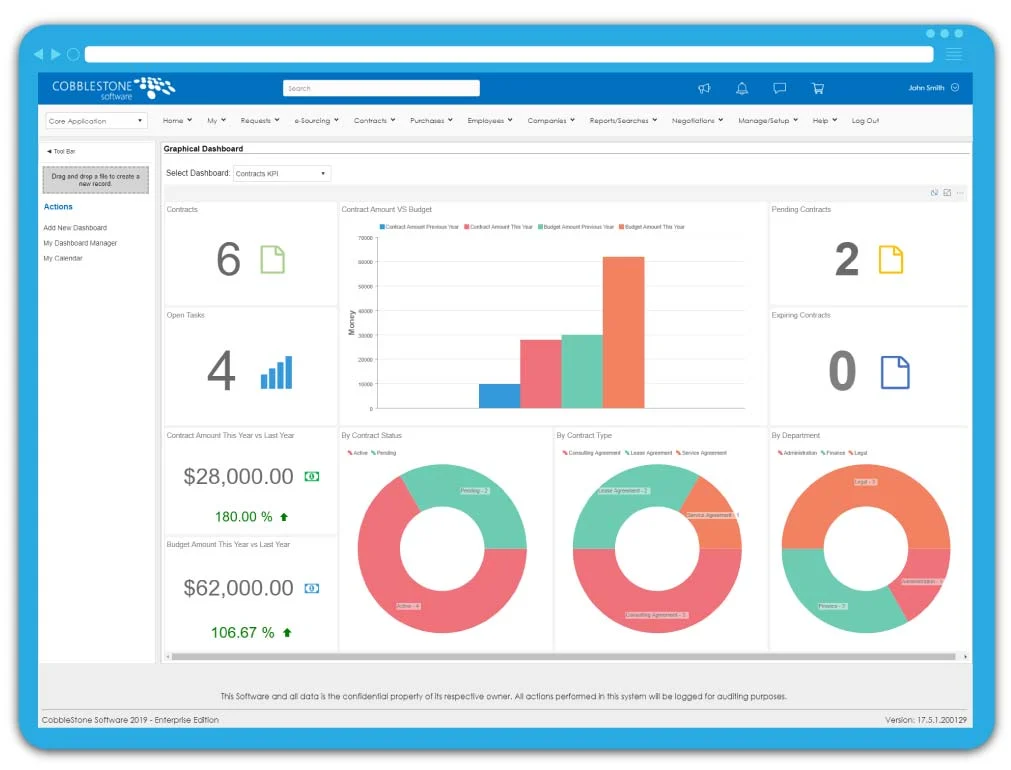

Top Contract Lifecycle Management Software to Consider
Here's my shortlist of the best contract lifecycle management software solutions:
Clicks on the links below may earn a commission, which supports our independent testing and review of software and services. Learn more about how we stay transparent.


Who Uses Contract Lifecycle Management Software?
CLM software fits teams that manage recurring agreements, multiple reviewers, or revenue-impacting deadlines:
- Revenue Operations Teams: Use CLM to connect contract data with CRM records, approval workflows, forecasting, and renewal reporting.
- Sales Organizations: Use templates, clause libraries, approval routing, and electronic signatures to manage complex deals without losing status visibility.
- Legal and Contract Operations: Use centralized repositories, version control, playbooks, and obligation tracking to review agreements and monitor policy compliance.
- Finance Teams: Use executed contract data, billing terms, renewal dates, and obligation records to support invoicing, forecasting, and revenue reporting.
- Customer Success Teams: Use searchable agreements and renewal alerts to verify entitlements, commitments, pricing, and upcoming customer conversations.
- High-Volume B2B Companies: Use CLM when contracts involve frequent amendments, multiple approval steps, recurring revenue, or many active customers and suppliers.
Key Contract Lifecycle Management Software Benefits and Business Impacts
Contract lifecycle management software centralizes drafting, approvals, obligations, and renewal alerts to reduce delays, limit compliance risks, and protect recurring revenue.
However, these platforms can cost more than shared drives or manual workflows, and poor implementation, integration gaps, or inaccurate contract data can create new operational risks.
Use this table to compare the operational benefits and implementation risks of contract lifecycle management software:
| Benefits | Risks |
|---|---|
| Centralized contract repository improves agreement visibility across sales, legal, finance, and customer success. | Poor data migration can create missing, duplicated, or inaccurate contract records. |
| Approval workflows route agreements to the right reviewers and reduce delays caused by email-based handoffs. | Complicated approval rules can slow deals when workflows don’t match actual sales processes. |
| CRM integrations connect contract status, terms, and renewal dates with pipeline and revenue reporting. | Integration gaps can create inconsistent data between the CLM platform, CRM, billing, and finance systems. |
| Template and clause libraries support consistent agreement creation and reduce manual drafting work. | Outdated templates or clauses can spread incorrect terms across new agreements. |
| Obligation tracking helps teams monitor pricing, service commitments, deliverables, and renewal conditions. | Incomplete obligation data can cause missed commitments, disputes, or unexpected revenue leakage. |
| Renewal alerts give revenue teams earlier visibility into upcoming customer and supplier decisions. | Poorly configured alerts can create notification overload or cause teams to miss important deadlines. |
| Audit trails, permissions, and version control support governance and contract review. | Broad permissions, weak access controls, or poor adoption can expose sensitive commercial information. |
Contract Lifecycle Management Software Case Studies
These case studies show how teams handled contract work before and after implementing contract lifecycle management software. You’ll see how centralized records, approval workflows, and renewal tracking changed everyday revenue operations.
Case Study: Hormel's Implementation of Ironclad
Hormel Foods was managing business contract workflows in Excel and running negotiations over email before adopting Ironclad as its CLM platform. The legal team built 47 automated contract workflows within a few months of implementation, consolidating all contract activity into a single system accessible to procurement, sales, and IT.
Here are the results of Hormel's implementation of contract lifecycle management software:
- 75% reduction in contracting time: Replacing manual processes and email-based negotiations with automated workflows drove a significant drop in overall time spent per contract.
- Contract turnaround cut from 12 weeks to 3 weeks: Automated approval routing and a single source of truth for contract status reduced bottlenecks across reviewing teams.
- 47 automated workflows deployed: High-volume contract types like NDAs and complex multi-variation agreements were the first to be automated, giving the team a repeatable build pattern for future workflows.
- Improved cross-functional visibility: Procurement, sales, and IT could collaborate directly within Ironclad, reducing handoff delays and making contract status visible without chasing updates over email.
Case Study: Redwood Logistics's Implementation of Gatekeeper
Redwood Logistics, a Chicago-based 4PL provider managing roughly 1,200 vendors and over $90 million in contracts, was spending up to one hour per renewal manually gathering pricing, terms, vendor performance, and spend data ahead of each review.
The team deployed Gatekeeper's Contract Renewal Agent to automate the preparation of structured renewal briefs before any contract hit the procurement desk for review.
Here are the results of Redwood Logistics's implementation of contract lifecycle management software:
- 95% faster renewal context-gathering: The Renewal Agent reads contract data and produces structured briefs automatically, replacing what previously required manual research across multiple sources.
- 300 senior procurement hours returned annually: Across approximately 300 contract renewals per year, automating the preparation phase freed that time for higher-value sourcing and negotiation work.
- Same-day first live renewal processed: The agent was configured and produced its first full renewal analysis with a renew, renegotiate, or terminate recommendation on the day it went live.
- Full audit trail for renewal decisions: Every agent recommendation and the underlying data used to generate it is logged, supporting governance and accountability across the procurement function.
- Informed negotiation from the start: Procurement now enters renewal conversations with pre-prepared analysis rather than reactive, last-minute contract reviews.
Core Features & Capabilities of Contract Lifecycle Management Software
Revenue operations teams should expect these features to connect contract work with pipeline, forecasting, billing, and renewals:
- Centralized repository: Store executed and active agreements in one searchable location, with metadata for account, owner, contract value, term, and status.
- Templates and clause libraries: Give teams approved starting points and fallback language for recurring agreements, while limiting edits that require legal review.
- Approval workflows: Route contracts to sales, legal, finance, and security reviewers based on deal value, terms, region, or risk level.
- CRM and business system integrations: Sync contract status, key terms, renewal dates, and customer or vendor data with systems such as Salesforce, HubSpot, ERP platforms, billing tools, and finance software.
- Electronic signature: Send approved agreements for signing, track signer activity, and return completed documents to the contract record.
- Renewal and obligation tracking: Monitor notice periods, price changes, service commitments, usage limits, and other terms that affect retention and revenue forecasts.
- Version control and audit trails: Preserve document history, comments, approvals, and executed versions so teams can verify how an agreement changed.
- AI and contract intelligence: Use artificial intelligence to extract contract data, summarize agreements, identify key clauses and obligations, flag risky language, and surface insights across the contract repository. These capabilities can help teams review agreements faster and find important information without manually reading every document.
- Reporting and analytics: Give RevOps teams dashboards for contract volume, cycle times, approval bottlenecks, upcoming renewals, and revenue-related terms.
How Contract Lifecycle Management Software Works
CLM software connects each stage of the contract lifecycle in one workflow, from request and drafting through negotiation, approval, signature, storage, and renewal. Instead of managing those steps across email, documents, and disconnected systems, teams can track contract status, ownership, terms, and deadlines in one place.
Use this table to compare revenue operations processes with the contract lifecycle management features that support them:
| Process | Description | How Software Helps |
|---|---|---|
| Contract Intake and Drafting | Capture requests for new agreements, amendments, and renewals. Create documents that follow approved business and legal requirements. | Intake forms collect deal details before drafting begins. Templates and clause libraries produce consistent agreements while reducing manual document preparation. |
| Contract Negotiation and Redlining | Review proposed terms, compare edits, resolve comments, and move the agreed version toward approval. | Redlining tools, clause libraries, and version control help teams compare changes, collaborate on terms, and route exceptions for review while maintaining a clear history of edits. |
| Approval Routing | Send contracts to sales, legal, finance, security, or leadership for review. Apply approval rules based on contract value, region, terms, or risk. | Workflow automation routes each agreement to the correct reviewers. Status tracking shows where approvals are delayed and records each decision. |
| Contract Execution | Coordinate final edits, approval completion, electronic signatures, and executed-document storage. Keep the agreement tied to the correct customer or supplier record. | Electronic signature tools track signer activity and completion. The signed document returns to a searchable contract record with its final terms and audit history. |
| Revenue Data Synchronization | Keep contract status, values, billing terms, renewal dates, and account details consistent across revenue systems. Use accurate contract data for forecasting and reporting. | CRM and business system integrations sync key contract fields with platforms such as Salesforce, HubSpot, billing tools, and finance systems. Field mappings and status updates reduce duplicate data entry. |
| Renewal and Obligation Management | Monitor renewal windows, notice periods, price changes, service commitments, and usage limits. Give account teams enough time to prepare customer or supplier decisions. | Renewal alerts notify owners before key deadlines. Obligation records connect contract terms with account ownership, task assignments, and renewal reporting. |
Types of Contract Lifecycle Management Software & Similar Tools
Contract management software and CLM software are often used interchangeably, but CLM usually refers to a broader, end-to-end process.
A basic contract management tool may focus on storing agreements and tracking key dates, while a CLM platform can support contract requests, contract templates, contract negotiation, approvals, e-signature, contract execution, obligation tracking, and renewals across customer and vendor agreements.
CLM software also overlaps with several adjacent tools, and the category itself includes different approaches for sales, procurement, and legal teams.
Use this table to see how each option differs from a full CLM platform:
| Type | Differentiator |
|---|---|
| Sales CLM | Built around CRM workflows; prioritizes sales contract creation, approval routing, and deal-stage integration over legal review or procurement use cases |
| Procurement CLM | Focused on vendor and supplier agreements; emphasizes spend visibility, vendor performance tracking, and sourcing workflows rather than revenue contracts |
| Legal CLM | Designed for legal teams; centers on redlining, playbook enforcement, clause-level review, and compliance tracking rather than sales or procurement workflows |
| Electronic signature software | Handles document signing and signer tracking only; doesn't manage drafting, approvals, obligation tracking, or renewal alerts |
| CPQ software | Generates quotes, pricing, and product configurations; stops at the proposal stage without managing post-signature obligations or contract terms |
| Document management software | Stores and organizes files without contract-specific metadata, approval workflows, obligation records, or renewal monitoring |
The Bottom Line on CLM Software
If you want to go deeper on what CLM can do for your day-to-day operations, the benefits of contract management software extend well beyond faster turnaround times—from compliance risk reduction to measurable gains in team productivity.


