
Every CRO has the same goals. They need to grow revenue, hit targets faster, and shorten the sales cycle. All while maintaining or improving profitability and without increasing the company headcount. Most proposed strategies address hiring, go-to-market strategies, and process optimization. But there is an underlying issue that could undermine it all.
The level of effort your sales and marketing teams put in is not the issue. And, more often than not, neither is the strategy. The real problem usually results from a lack of cohesion between sales and marketing tools. When your CRM and marketing automation tools aren’t properly integrated, your revenue engine pays an invisible tax that shows up through misalignment, slow or no follow-up, stalled deals, and unexplained gaps in your revenue.
This is what we call “integration tax.” It’s the cost your business pays as a direct result of fragmented sales and marketing tools. Most leaders don’t realize the cost until they see the outcomes when integration tax is eliminated.
This article explains what integration tax is and its impact on revenue velocity and sales and marketing alignment. It also highlights how revenue teams that utilize {{deeplink:151956:[Nutshell’s integrated CRM and email marketing]}} eliminate this tax, with an example of a team that increased close rates by 45% with zero headcount adjustment. By the end, you will know for sure if your revenue engine is paying this tax, and see specific examples of workflows that eliminate it.
What is integration tax? (And how does it undermine revenue growth)
Integration tax is the extra cumulative cost (in time and lost revenue) that your go-to-market (GTM) strategy has to bear when there's a disconnect between your customer relationship management (CRM) system and marketing automation tools. This cost doesn't display as a line item in your profits and losses (P&L) statement, but you can see it in lost deals, missed opportunities, and revenue objectives that remain unachieved even after putting in extra effort.
What integration tax looks like in your revenue engine
Sales and marketing are misaligned: Marketing sends campaigns with no knowledge of the prospects' status in the sales pipeline, while sales is in the dark about the marketing interactions and contact engagement. Follow-up becomes a challenge. Leads receive generic messages that are irrelevant to the opportunity’s stage in the buying process.
Manual work slows velocity: Sales development representatives (SDRs) and marketers extract and import contact lists from the CRM to the email system. Account executives have to intervene and manually send follow-up emails since automated email marketing campaigns aren’t connected to pipeline data. Marketing operations (MOPs) is forced to waste hours instead of minutes on segmenting audiences. Revenue operations (RevOps) has to create bridging spreadsheets to align sales and marketing data.
Lost context that kills conversions: A prospect opens a proposal, but because your system isn’t automated, the next communication you send them is a generic nurture email instead of a more appropriate follow-up. You have a stalled deal at the negotiation stage of a closed deal, but marketing is unable to send a re-engagement sequence because there is no connection between your pipeline stages and email platform. Your best opportunities and cold leads receive the same messaging, because sales context segmentation takes too much time.
Delayed reactions that cost deals: There’s a significant gap between a sales event and a response from marketing. Marketing finds out about a deal that’s moved to the next stage or stalled too late for meaningful engagement. Real-time sales and marketing triggers don’t fire when systems are left disconnected.
Why revenue teams keep paying it
Many teams believe that exporting data manually and delays in data synchronization are inevitable. But teams don’t experience integration tax as one dramatic event. It’s simply a collection of inefficiencies compounding over time. Time lost to manual work or deals slowed through alignment doesn’t show up as a line item. As the pipeline expands, integration tax grows exponentially.
The real cost to revenue
Integration tax limits revenue growth. The need for manual work at each stage of the customer journey means your conversions take a hit and your best sales opportunities are lost due to missed buying signals. Sales and marketing also remain misaligned due to the fragmented systems they are forced to operate within.
The evidence is clear. Research done by Bain in 2025 showed that 70% of companies could not integrate their sales processes into their technology systems. According to Salesforce, only 56% of sales and marketing teams are fully aligned to the same target accounts.
Research also shows that strong sales-marketing alignment in a B2B context led to more than 20% in annual revenue growth. Furthermore, in 2023, Salesforce found that sales teams spent 72% of their working hours entering data manually and completing other administrative tasks.
Integration tax is the greatest obstacle to overcoming your revenue growth challenges. By removing this tax, your company will have the capacity to initiate GTM motions that previously required twice the number of employees.
How revenue teams use Nutshell to eliminate integration tax
Nutshell helps sales and marketing teams eliminate integration tax. It combines CRM and email marketing in a single platform.
Here’s how Nutshell provides the necessary tools and resources to enhance alignment between sales and marketing teams, improve deal velocity, and achieve greater scalability.
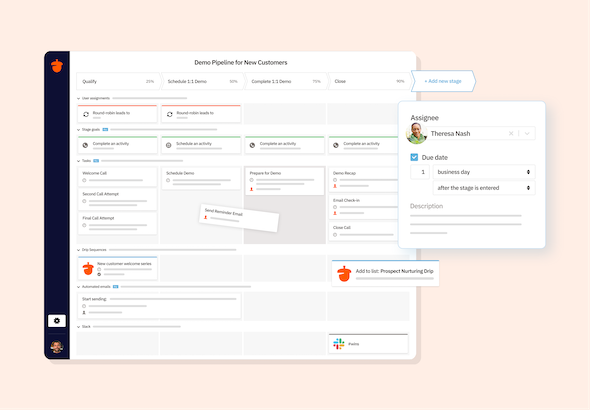
Pipeline-based email automation: Sales context powers marketing execution
Nutshell takes email automation a step further and tracks where your contacts sit in your sales pipeline to trigger email sequences.
Here's an example of a pipeline-based email automation sequence you could set up in Nutshell. When an SDR creates a new opportunity, you can have Nutshell automatically place the contact in an email nurture sequence aligned to that pipeline’s stage. Then, when a deal moves to the “Proposal Sent” stage, a sequence is triggered to follow up at 3, 7, and 14 days if no response is received from the contact, with no manual reminders required.
When an opportunity sits in the “Negotiation” stage with no contact for over 30 days, you can have Nutshell send a re-engagement email with a calendar link to start the conversation again. Once the opportunity closes, Nutshell can initiate an email sequence for the next steps in the onboarding process.
Email automation directly linked to your sales pipeline means contextually relevant emails are sent to your leads. With Nutshell, deals move along the sales pipeline with consistent, automated contact. It improves sales rep productivity because they no longer need to waste time manually following up on dozens of deals. Overall, sales and marketing tool alignment in Nutshell encourages a healthy sales pipeline and positively affects your revenue.
One-click segmentation: Precision targeting without the RevOps bottleneck
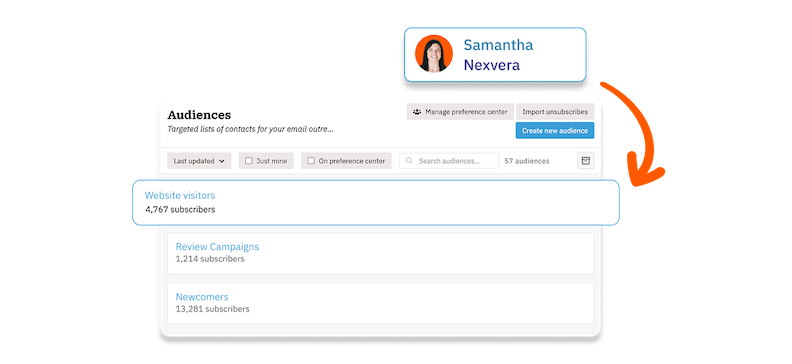
Because Nutshell's CRM integrates directly with its email marketing, segmentation can be done by CRM field in mere seconds. Filter your contacts for more targeted segmentation and campaigns (e.g., “Industry” is “SaaS” AND “Deal Value” is greater than “$50K” AND “Pipeline Stage” is “Qualified” AND “Last Contact” is more than “45 days”).
Save your segment to use again later (“High-Value Stalled Deals” or “Post-Demo Nurture”). Create segments that automatically update based on your audience criteria, and run campaigns to the exact audience without needing to upload anything to your marketing database.
When you target people based on their likely buying behavior instead of their demographics, you can create messages that relate more to that particular person. This typically leads to greater sales conversion rates. Also, because the process is automated, you don't have to wait for slow data reports to keep the campaign moving.
Unified reporting: Connect marketing activity to revenue, not just engagement
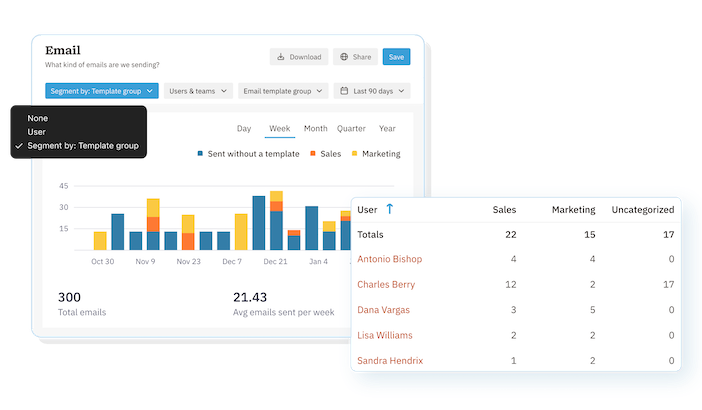
Since pipeline and email marketing data are in a unified system, Nutshell reports on which marketing campaigns resulted in pipeline movement, closed deals, and increased revenue as opposed to just email opens and clicks.
Monitor which email campaigns generated the most value in the sales pipeline. Attribute revenue to specific marketing touchpoints. Determine which automated marketing campaigns resulted in an increased rate of closed deals and an improved deal cycle. And evaluate the ROI of marketing campaigns based on actual revenue.
This leads to the improved allocation of company resources (focusing on revenue-driving campaigns), total marketing and sales team alignment (both teams are focused on revenue as opposed to activities), and revenue growth based on a clear understanding of the most significant business drivers.
Real results with Nutshell: The Reuse Network (case study)
A small team with ambitious revenue goals
{{deeplink:151956:[The Reuse Network]:reuse_network}} links schools and universities planning to upgrade or clear out buildings with charities that need furniture for disaster relief and development work around the world. Its six-person team was managing over 200 complex reuse projects per year, involving various client organizations, movers, and recipient charities, plus many different deal stages (e.g., proposal, logistics, billing, documentation).
Mark Lennon, founder of The Reuse Network, said that without a proper system, its team would either miss projects or “go crazy” trying to keep up. To stay top of mind long term, the company has to deploy consistent marketing, as its clients often only need furniture reuse services once every 15 to 20 years. The problem was that their small team couldn’t really afford to spend hours on manual outreach.
Integration tax was capping the team’s capacity
Before Nutshell, the Reuse Network experienced many of the classic symptoms of integration tax. Managing so many moving parts with such a small team resulted in the team often losing track of clients and projects. Staying connected to the hundreds of contacts in a meaningful way became challenging because marketing and sales data were stored in completely separate silos. Due to a lack of clear visibility, prepping for weekly project reviews resulted in sorting through scattered notes and searching through emails to find relevant information.
During the company’s peak seasons, which are spring and summer, the risk of failing to address a need or contact would be high. The team found it difficult to reach their audience of several thousand contacts without adding to the team or spending many hours manually sending out emails.
Eliminating integration tax with Nutshell
The Reuse Network has two primary uses for Nutshell’s integrated system. Their first major use is the end-to-end tracking of projects. This involves tracking the client organization, the related movers, recipient charities (which may include multiple charities for any given project), and all the communications pertaining to the listed parties. This allows the team to create a standard and repeatable process with the ability to access all the information they need from a single source.
Mark’s Monday morning routine is a great example of the efficiency the system provides. It eliminates information being dispersed and the need for manual reporting. Mark explains, “It’s literally I touch a button on Monday mornings, and a report pops up that lists every project that’s active for us and where it stands.”
The other use case Nutshell serves for The Reuse Network is the ability to market to thousands of people without needing to add staff. Mark describes Nutshell’s built-in email marketing tool as “...absolutely huge for us in that it allows us to reach several thousand contacts with the touch of a few buttons.” Within the past few months, his team has been leaning into personal email sequences, sending emails that come directly from one of their staff members with a couple of clicks.
This has shown the true power of eliminating integration tax. It allows marketing and sales to work with the same database and scale outreach.
What eliminating integration tax unlocked
The results have validated the framework. The usage statistics show a 45% increase in close rate for The Reuse Network since implementing Nutshell’s integrated platform. This reinforces the importance of tighter follow-through and complete project visibility in converting more opportunities.
They stopped dropping projects even when they were in their busiest season. The team now has the ability to review what’s in progress, what’s on deck, and what requires focus without losing the critical information necessary to manage complex coordination.
The company increased its reach without having to hire additional team members. Managing about 400 leads a year with just 6 team members is only possible if the whole company is working from the same unified system. For customers who may only use their services every 15-20 years, ongoing broadcasts and tailored communication to maintain the connection make The Reuse Network easy to remember and contact.
Mark put it plainly, saying, "We certainly wouldn't be where we are now without a CRM as good as Nutshell."
The Reuse Network didn’t have to have every high-end automation feature to rid itself of integration tax. What it needed was sales and marketing data combined in one place to provide visibility into what was active without manual reporting, and the capacity to efficiently contact thousands. That’s exactly what Nutshell’s integrated platform provided, and the 45% increase in their close rate is proof that it worked.
How to identify if integration tax is slowing your revenue engine
Do the following quick checks and see if you are losing revenue due to integration tax. If you answered "no" to any of the following questions, you are likely paying integration tax due to sales and marketing misalignment.
The sales-marketing alignment test: Can your email platform access contact data in your sales pipeline? Can your marketing team trigger campaigns in response to CRM changes? Does marketing see sales updates in real time? If you answered “no” to any of these questions, you are losing conversions due to integration tax.
The deal velocity test: Can you set up automated responses based on contact interactions, like when they reach a certain sales pipeline stage, view a proposal, or visit your pricing page? Is there a gap of days or weeks between sales events and marketing follow-ups? If your follow-up process is manual or delayed, the velocity of your deals is suffering due to integration tax.
The segmentation test: How long does it take to create a segmented mailing list related to sales pipeline stage, deal value, or account owner? How easy is it to create and send different messages to clusters of contacts, depending on their buyer journey stage? If segmentation takes longer than a few minutes, you’re losing conversions due to integration tax, because the messages you send will likely be irrelevant to your recipients.
The revenue attribution test: Can you do more than just measure opens and clicks to show which email campaigns build the revenue pipeline and why? Can you show the connection between marketing touchpoints and the opportunities that close? If you can’t prove that your marketing activities create revenue, you’re paying integration tax due to a lack of insight.
If even one of these examples has a negative outcome in your revenue system, integration tax is likely putting the brakes on your revenue growth. The good news is that recognizing the integration tax is the first step toward a solution. Once you realize what it’s costing you in lost deals, slower deal closing, and potential revenue, you can work toward fixing the problem. Teams that use Nutshell usually see a measurable impact on revenue within 30 days.
Your 30-day roadmap to eliminating integration tax with Nutshell
Week 1: Diagnose and quantify the revenue impact. Conduct the revenue engine audit mentioned above. Within this week, assess the amount of time your GTM team spends completing manual tasks and identify your top three revenue blockers. Consider the value of better alignment. If it improved your close rate by just 10%, what would that mean for your annual revenue? Book a Nutshell demo to discover how other revenue teams overcame these blockers.
Week 2: See Nutshell in action. Ask for a Nutshell demo based on your particular GTM workflows. That way, you get to see how Nutshell lets you segment audiences in one click, automate pipeline workflows, and set up custom reports. If integration tax is removed and Nutshell improves conversion rates by 10 to 20% and accelerates deal velocity by 15 to 30%, what do you think the impact on ARR would be?
Week 3: Migrate and set up your first high-impact workflow. Move your existing CRM data over to Nutshell (most teams do this in 1 to 2 days with Nutshell’s onboarding support). Create your first audience segment focused on revenue. Set up a workflow that is automated based on your pipeline data, and run a small test segment before executing a full rollout.
Week 4: Launch, measure revenue impact, and scale. Create your first Nutshell campaign and see the impact on your revenue and time compared to previous marketing efforts. Nutshell allows you to measure pipeline and revenue impact through its unified reporting. The goal is to create one workflow that shows a positive revenue impact and then use it to scale.
Beyond 30 days, you’ll remove the blockers one workflow at a time, allowing your small team to operate with the efficiency and scale of a larger organization.
Stop paying integration tax, start accelerating revenue
If your team is missing its targets, it’s not due to a lack of effort, strategy, or ability. It’s more likely that the team is struggling because their tools are siloed. Revenue teams without sales and marketing alignment experience integration tax, which reduces deal velocity, and forces them to hire more team members to increase revenue.
You don't have to deal with integration tax. By using Nutshell, which has a fully integrated CRM and marketing automation system, you eliminate the disconnect, unnecessary admin, and lost opportunities to boost your revenue.
The Reuse Network is an example of this. Its small team of six managing over 200 projects employed Nutshell’s CRM with built-in email marketing. This allowed them to maintain contact with thousands of people and improve their close rate by 45%. No one was added to the team. Nutshell gave them the tools to stop paying integration tax and gain revenue engine speed.
Running the revenue engine audit will give you the insight you need. If your GTM team spends a significant chunk of their day on manual data admin, if your deals are getting stuck due to insufficient follow-up, and if your sales and marketing teams are working with different sets of data and not accessing real-time data, then you’re definitely paying integration tax.
Are you ready to eliminate integration tax and accelerate your revenue engine? Find out how Nutshell’s fully integrated CRM and email marketing platform helps teams save 10 or more hours per week, increase close rates, and scale revenue efficiently. Schedule a free demo today to learn more, or {{deeplink:151956:[start your free 14-day trial]:article_signup}} (no credit card required).