
CROs give CRM companies millions to improve efficiency. But they often get an overly complicated system in return, which requires constant maintenance, often costing more than the price of the CRM.
At {{deeplink:151956:[Nutshell]}}, we've spent 15 years helping revenue teams steer clear of that complexity. We built our CRM around the principle that sophistication means solving problems efficiently, not accumulating features. The result is that teams can onboard new reps in days, achieve 90%+ adoption rates, and close deals 14.9% faster while growing new sales revenue by 26.4%.
According to Metrigy's 2025 CX MetriCast study, 67.9% of companies use a CRM, which means that the use of these systems is nearly universal. However, there's an unfortunate reality attached: A 2018 study published in the Harvard Business Review notes that CRM systems fail to achieve their intended goals between 18% and 69% of the time. The average failure rate is 43.5%.
In other words, an average of almost 50% of CRM systems fail to achieve their objective, and it has little to do with the functionality of the system. More often than not, it's the extreme complexity of the system that ultimately sinks proper implementation and adoption.
This article shares the complexity debt framework we recommend for revenue teams, illustrates exactly how Nutshell solves each complexity problem at the architectural level, and provides real outcomes from companies that chose simplicity over an excess of features.
Complexity tax in action
CRM systems become more and more complicated with each customization. As a result, sales processes see an increase in complexity, and teams spend more time and effort keeping the highly complicated system operational, instead of working on driving sales.
Here's what this complexity tax looks like in practice.
Integration debt
Every time a new software tool is released, companies claim that it integrates seamlessly with CRMs. The truth is that with every new tool bolted on, CRMs become more fragmented. APIs break, middleware changes, fields stop syncing, and teams are left with a backlog of duplicate records and closed and lost deals.
The true story is in the data. According to a 2024 report by Validity on the State of CRM Data Management, 24% of CRM administrators say that less than half their data is accurate and complete. That's one in four teams.
Beyond the data being inaccurate, it also creates a huge loss in finances. The same report notes that 31% of administrators say poor data quality costs them a minimum of 20% of their organization's annual revenue. That's not an insignificant loss. It's an issue the company's executives should be made aware of.
How Nutshell eliminates integration debt
We built CRM and email marketing into one platform. When a sales team updates a contact, marketing sees it instantly. When a lead engages with an email, the CRM logs it automatically. That gives sales and marketing teams one database and, therefore, one source of truth with zero integration tax.
Decision latency
The greater the complexity, the greater the loss of productivity. Whether it's an excess of fields, steps, or clicks, the end result is that it slows reps down.
When a rep has to complete numerous data fields before they can open or close an opportunity, there's a strong likelihood that they won't do it. And if they do complete those fields, they'll often do it as fast as possible, not paying much attention to the data input. Regardless, data is either lost or it's inaccurate, leading to no one trusting the report your VP of Sales spent three hours on.
The more steps you place between a rep and the progression of a deal, the greater the overall team latency. Lack of speed is detrimental to sales success.
How Nutshell eliminates decision latency
With minimal required fields, drag-and-drop pipeline management, and critical information accessible in under three clicks, reps see deal status, contact history, and next actions on one screen. This way, they spend their time selling instead of clicking through complex workflows.
Capacity drain
This is probably where the most concerning damage is reflected. According to Salesforce's 2023 study, sales reps perform actual selling activities 28% of the time. The remaining 72% is spent on administrative tasks, research, and coordination.
That means that your sales reps spend only a third of their time actually meeting and talking to prospects. This is a serious pitfall of admin-heavy systems.
And training adds fuel to the fire. According to research done by Optifai in 2026, new sales reps take an average of 3.5 months (or 105 days) to be onboarded and reach full productivity. This means that for 3.5 months, a significant chunk of which is spent on CRM training, the company won't receive a return on that hire.
At the same time, RevOps teams often spend too many hours on integration maintenance, data cleaning, and fixing workflows that no longer work. RevOps teams are forced to take on the role of firefighter, instead of the strategists they're meant to be. And all the while, the complexity debt continues to grow.
How Nutshell eliminates capacity drain
New reps are productive in under a week because Nutshell matches how revenue teams already work. The interface is intuitive, and workflows are logical. There's also no time-consuming certification process or complex customization to master. In addition, rather than wasting time on data entry and maintenance, RevOps teams spend 60%+ of their time on strategy.
The complexity debt audit framework
Many teams are unaware that they have a complexity problem until they reach a point where it's ingrained in their processes and tricky to remove. This framework will help teams identify complexity debt before it expands.
Diagnostic questions
Answer these questions truthfully. If you're not sure of the answer, your reps should be able to help you.
1. How long does it take to train a new rep to basic proficiency?
If it stretches beyond days into weeks, you have a problem. With any of the best CRMs, reps should be up and running in less than five days. If it takes three weeks, the system is likely too complex.
Most Nutshell customers onboard new reps in 3–5 days. That's because the interface is easy to use with workflows that match real sales processes, and no complex customizations to learn before reps can start working. They log in, see their pipeline, and start moving deals forward, because the system requires little to no training.
2. What percentage of your team actively uses all the "essential" features you're paying for?
Way too many companies routinely pay for a comprehensive plan, while the team utilizes less than 50% of the features. When reps disregard features, more often than not, it's because the features aren't aligned to their workflows.
We built Nutshell with a focus on the 20% of features that drive 80% of results. Every feature serves a clear purpose in moving deals forward. That's why adoption rates consistently exceed 90% across our customer base. Reps actually use what they're paying for because it aligns with how they work.
3. How much RevOps or admin capacity goes to maintenance versus strategic projects?
If more than 40% of your RevOps team spends their time dealing with data integrity, managing system integrations, solving system issues, or similar, complexity is consuming your operational capacity.
With Nutshell's consolidated platform and native automation, RevOps teams spend 60%+ of their time on strategy instead of putting out fires. In other words, they focus on revenue operations, not CRM operations.
4. Can reps get the information they need in under three clicks?
This is your usability test. If team members have to perform an Olympic navigation routine to get access to important information or tasks, the CRM is a productivity hindrance.
Nutshell's visual pipeline puts deal status, contact history, communication timeline, and next actions on one screen. Reps see what they need instantly without the need for custom report building, filter configuration, or clicking through six tabs to find last week's conversation.
5. When was the last time you removed a tool or field versus added one?
Companies typically only add to their systems and processes and seldom remove things from them. This approach is what results in a team ending up with eight different tools that claim to "manage leads" and 73 custom fields for reps to complete.
Nutshell combines sales, marketing, and engagement features in one platform, eliminating the need for separate systems and the integrations that connect them. That means you're essentially replacing three tools with one. Most companies start working immediately without adding a single custom field because the defaults match how revenue teams actually operate.
The time-to-value versus time-to-maintain ratio
Use this simple mental model to determine if the value provided by your CRM is more than the cost.
Equation: Hours spent getting value from your CRM / Hours spent maintaining your CRM
| Ratio | Meaning |
| 4:1 or more | Ideal range. 4 hours of productive work for every hour of maintenance. |
| 2:1 or below | Warning zone. You're spending 50% of your CRM time making it work. |
| 1:1 | Crisis zone. You're doing more maintenance than work, simplifying to survive. |
Self-assessment scorecard
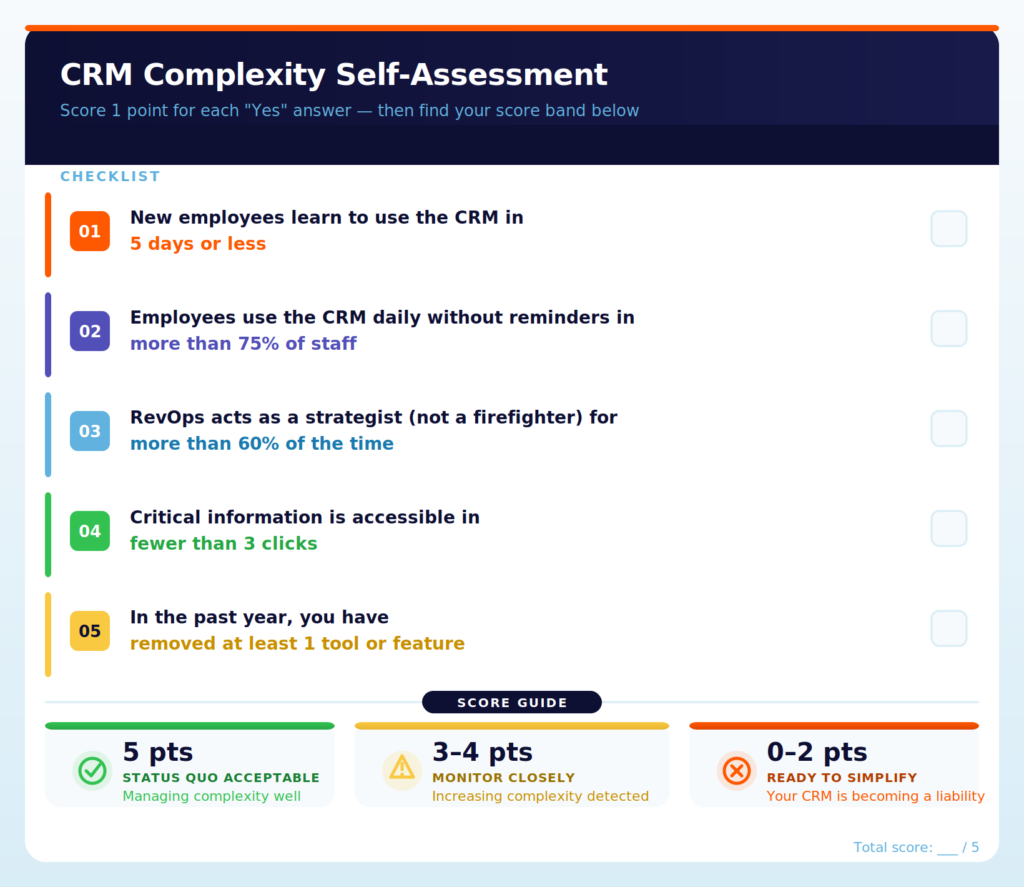
The next complexity debt audit step is to give your CRM and team a complexity score. Here's how to score yourself:
Your employees earn 1 point for every "yes":
- New employees learn to use the CRM in 5 days or less
- Your employees use the CRM daily without the need for reminders in more than 75% of your employees
- RevOps is more of a strategist and less of a firefighter for more than 60% of the time
- Less than 3 clicks is the time it takes to find critical information
- In the past year, you have removed at least 1 tool or feature
- 5 points: Status quo acceptable. You're managing complexity well.
- 3 to 4 points: Monitor closely. Increasing complexity.
- 0 to 2 points: Ready to simplify. Your CRM is becoming a liability.
What strategic simplification looks like in practice
Strategic simplification may conjure visions of reducing your CRM to a glorified spreadsheet. Instead, it means streamlining your CRM to only the features that move your deals forward. At Nutshell, we designed our platform around this exact principle.
The features that actually drive deal velocity
Essentially, revenue teams need four key things from a CRM:
- Clear pipeline visibility: Your team should be able to view the sales pipeline immediately without having to run a report. Sales team members should know where they need to take their next action to move a deal along the sales process, simply by looking at the pipeline.
- Fast data entry: If your CRM has multiple mandatory fields for reps to input data before saving a lead, most team members will avoid using the software.
- Immediate performance tracking against goals: Team members should easily be able to track where they are in terms of meeting their quota without the need for a special report.
- Built-in communication tools: When team members constantly have to switch between the CRM and their email or personal calendar, it reduces both the efficiency and the effectiveness of the entire sales process.
According to DemandSage, research shows that organizations that use their CRM system properly gain, on average, a 17% increase in won leads, a 27% better customer retention rate, and a 21% increase in the productivity of their agents. In addition, businesses earn $3.10 for every $1 CRM costs, when used properly, as per a study conducted by Nucleus Research.
Nutshell's simplicity-by-design approach
Nutshell is built on the idea that solving problems efficiently is where true sophistication lies, not having a ton of features.
Here's what that looks like in practice:
- Consolidated platform: Nutshell combines key sales, marketing, and engagement features in one tool. Most teams need to use multiple tools integrated and synced to move data between tools. With Nutshell, there is one tool, which means fewer systems to maintain.
- Streamlined data model: We don't believe in a complex data maze. Easily keep track of the essentials, including people, companies, deals, notes, and history. Most companies can hit the ground running without customizing a single field. For the rest, customization has never been more hassle-free.
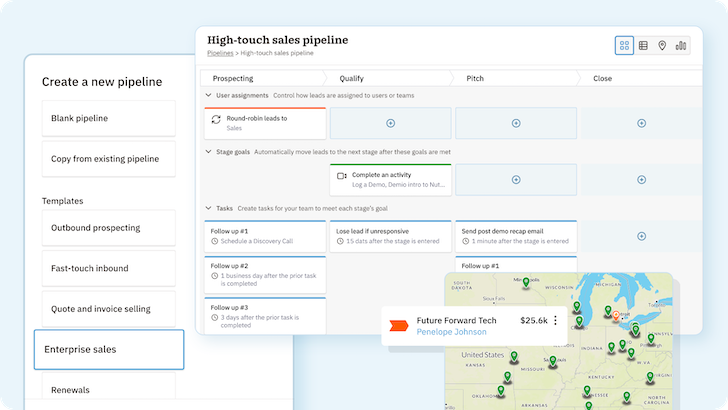
- Visual pipeline management: Reps see the lead status instantly without needing to build a report, drag and drop to move opportunities forward, and view pipelines in list, board, chart, and map views.
- Native automation: With Nutshell, you don't need middleware or special technical know-how to automate workflows, including follow-ups, task assignments, and lead routing.
- Fast onboarding: Nutshell's interface is intuitive, with workflows that match actual revenue team processes. So, training and onboarding happen over a few days.
Real-world CRM simplification outcomes
Theory is great. Proof is better. Here are two teams that chose simplicity and saw measurable improvements in close rates, visibility, and adoption.
Connected Sales & Marketing: Choosing value over enterprise features
Connected Sales & Marketing is a firm that manages consumer electronics brands in the Pacific Northwest. They experience long sales cycles that span from 8 to 24 months, with an extensive sales territory. The team needed a sales tool that they would actually use.
The team analyzed the largest "enterprise" systems and selected Nutshell. Lengthy feature lists were not the deciding factor here, as they placed more emphasis on clarity, usability, and value.
The visual layout of the platform provided sales reps with an immediate understanding of their workload. Management now had the ability to view activities and results on a single screen. Teams were able to navigate complex, multi-year projects, and system adoption continued to grow due to the usability of the platform.
HR Company: Adoption through simplicity
A small HR firm in the Boston area needed to move its entire company from spreadsheets to a CRM. One of the most important characteristics they required from a CRM was that it was easy to use, especially for their "less tech-savvy" team members.
The team explored several solutions but found that the complicated process of migrating to these CRMs would cause them to lose data and historical context.
Nutshell was their next step, and they have not moved from it since. The adoption training period decreased drastically, reporting was now simplified, and a trusted system was established. They also found that they could keep the historical data they needed. Due to Nutshell's simplicity and intuitive nature, HR Company was able to retain a significant user base.
Your simplification roadmap
This five-step roadmap makes moving from complexity to clarity easy for revenue teams.
Step 1: Run the complexity debt audit
Work through the diagnostic questions and scorecard detailed before. Be completely honest and gather input from the sales team as well, rather than only including management in the process. Determine your time to value/benefit versus the time to support/maintain. If you know you are in the warning or crisis zone, you'll have a clearer picture of what to do next.
Step 2: Identify simplification opportunities
Consider these questions:
- What features do only 20% or fewer of your team members use that you're still paying for? These don't provide valuable functionality and should be removed.
- At which points is data entry slowing your team down? Identify the fields that aren't adding value and eliminate them.
- Which tool integrations require time-consuming maintenance? Where possible, consolidate and simplify.
- What tools can you combine into a single solution? Consolidating your system means fewer platforms to manage, promoting simplicity and ease of use.
Step 3: Make the case to stakeholders
To stakeholders, "simplification" often sounds like a "downgrade," which is why you need to pitch it differently.
- For CFOs: Give them the total cost of ownership, including licenses, admin time, training costs, and integration fees. Then, show the savings that come with consolidation.
- For boards: Your positioning here should be, "We are optimizing for outcomes and not features." It's less about having a more functional CRM and more about having the ability to close deals faster and forecast accurately.
- For executives: Present it to them as the ability to free up RevOps for more strategic work, and not for more CRM maintenance. When RevOps stops firefighting, they can then focus on work that generates more revenue.
Step 4: The implementation sequence
It's best to avoid finding a solution for everything at once. Prioritize a specific area of focus to help you strategize.
Start by tackling the highest maintenance and lowest value tools. These tools don't produce value, but consume significant time. Focus on replacing or eliminating these first.
Consolidate your tech stack as much as possible by investing in systems that bring all or most of the tools you need into one, unified solution.
With fewer integrations to manage, faster adoption rates, and less time spent on training, your RevOps should have the bandwidth for more strategic work.
Step 5: What success looks like
Focus on tracking these metrics:
- Training time for new reps: The target is less than five days to reach basic productivity. If you're at more than two weeks, it is too complex.
- Team adoption rate: The target is to have more than 90% of the team using the CRM on a daily basis with a high number of active sessions. If team members are avoiding it, then you need to reassess.
- RevOps capacity freed for strategic work: The goal is for your RevOps team to spend at least 60% of their time on strategy and 40% or less on maintenance.
- Deal velocity and forecast accuracy improvements: This will be evident after simplification, and should result in greater trust in forecasts and faster deal cycles.
From feature excess to outcome-focused
The most significant yet most straightforward change for a CRO to make is to stop measuring the success of a CRM by features and integrations, and instead, start measuring it by the velocity of deals, accuracy of forecasts, and user adoption.
It's vital to recognize the weight of every tool, field, or integration added, instead of viewing complexity as an advantage. If your CRM is slowing down your team, you have a complexity problem.
Ready to simplify? Use the self-assessment scorecard and the diagnostic questions above to evaluate your system and team's attitude toward simplification. Then {{deeplink:151956:[discover how Nutshell resourcefully applies simplicity]:signup_url}} to help solve your complexity challenge.
The best CRM is the one your team actually utilizes to strengthen relationships and close more deals.