
Reseña de Concord: Ventajas, Desventajas, Características y Precios
Concord destaca por su gestión de contratos intuitiva, ofreciendo funciones completas a precios competitivos, lo que la hace ideal para empresas en crecimiento.

Analizamos las herramientas de forma independiente, y las comisiones ayudan a financiar nuestras pruebas. Consulta nuestra política de transparencia, nuestra metodología, o sugiere una herramienta.
Concord is a cloud based contract management software for teams that need to draft, negotiate, sign, and store contracts in one place. It's worth a close look if your team manages a high volume of contracts but doesn't want the setup complexity of an enterprise tool like Ironclad. Concord covers the full contract lifecycle without requiring a dedicated legal ops team to get it running.
Concord Evaluation Summary
4.5/5
- From $499/month (billed annually)
- Free demo available
Por qué confiar en nuestras recomendaciones de software
6,700+
Reviews
20
Industry experts
16+
Evaluation factors
14
Years
Nuestras reseñas reflejan nuestro criterio independiente, no un discurso de ventas. Descubra cómo mantenemos la transparencia.
Para esta guía, evaluamos las herramientas mediante pruebas prácticas e investigación independiente, puntuando las herramientas según nuestros criterios de selección.
Nuestras reseñas reflejan nuestro criterio editorial humano, no un discurso de ventas.
Concord Overview
In my opinion, Concord is a solid choice for cloud-based contract management, especially if your team values intuitive design and reliable support. It excels in delivering a user-friendly interface and key features like automation, which can simplify your contract workflow. However, the pricing might not be the best fit for smaller teams or startups, as some competitors offer more budget-friendly options. Onboarding could be smoother, as some users find the initial setup a tad complex. If your organization requires robust features and is willing to invest, Concord is worth considering. It's best suited for mid-sized to large enterprises looking for comprehensive contract management capabilities.
Pros
- You can easily collaborate with your team using Concord's user-friendly interface.
- Your document management is simplified with Concord's automated version tracking.
- You gain control with Concord's customizable approval workflows.
Cons
- You might find its search functionality lacking compared to competitors.
- Your team could experience a learning curve with its complex features.
- You may notice occasional performance lags with large document volumes.
Is Concord Right For Your Needs?
Who Would be a Good Fit for Concord?
If your team often juggles numerous contracts and needs to manage them efficiently, Concord is a solid choice. It's perfect for departments like legal, procurement, finance, and sales that need to handle high-priority contracts without the hassle of manual tasks. With AI-assisted reviews and proactive alerts, your team can focus on critical work and save time.
- Legal DepartmentsConcord helps your in-house legal team focus on essential tasks by automating contract reviews.
- Procurement TeamsYour procurement team will benefit from seamless contract creation and management, streamlining supplier relationships.
- Finance DepartmentsConcord aids in managing financial agreements efficiently, ensuring compliance and accurate tracking.
- Sales TeamsSales teams can quickly generate contracts and track them, which speeds up the sales cycle and closes deals faster.
- Small to Medium Enterprises (SMEs)For SMEs, Concord offers a cost-effective solution to manage contracts without needing a large legal team.
- Large EnterprisesLarge enterprises benefit from Concord's scalability and integration capabilities, managing vast numbers of contracts efficiently.
Who Would be a Bad Fit for Concord?
If you're in a highly specialized industry needing advanced customization, Concord might not be your best choice. It lacks extensive customization options, making it less suitable for businesses requiring tailored contract workflows. Teams needing complex integrations could find Concord limiting, as it doesn’t support a wide array of third-party applications. If your work demands intricate reporting or analytics, Concord's capabilities might fall short, as it focuses more on basic contract management functions rather than deep data insights.
- Highly Regulated IndustriesIf your industry requires stringent compliance and audit trails, Concord may not provide the necessary features or flexibility.
- Large EnterprisesLarge enterprises with complex, multi-departmental needs might find Concord's feature set too limited for comprehensive contract management.
- Tech-Heavy StartupsTech startups needing robust API integrations and custom solutions may find Concord's integration options lacking.
- Financial ServicesFinancial services needing advanced analytics and reporting features may not benefit from Concord's basic data capabilities.
- Manufacturing CompaniesManufacturing firms that rely on complex supply chain contracts might find Concord’s functionality too simplistic for their needs.
Cómo Probamos y Evaluamos Herramientas
Hemos pasado años construyendo, refinando y mejorando nuestro sistema de pruebas y evaluación de software. La rúbrica está diseñada para capturar las complejidades de la selección de software y lo que hace que una herramienta sea efectiva, centrándose en aspectos críticos del proceso de toma de decisiones. A continuación, puede ver exactamente cómo funcionan nuestras pruebas y evaluación a través de siete criterios. Esto nos permite ofrecer una evaluación imparcial del software basada en la funcionalidad principal, características destacadas, facilidad de uso, incorporación, soporte al cliente, integraciones, opiniones de los clientes y relación calidad-precio.
Funcionalidad Principal (25% de la puntuación final)
El punto de partida de nuestra evaluación es siempre la funcionalidad principal de la herramienta. ¿Tiene las características y funciones básicas que un usuario esperaría ver? ¿Alguna de esas funciones principales está restringida a planes de precios superiores? En esencia, esperamos que una herramienta cumpla con las capacidades básicas de sus competidores.
Características Destacadas (25% de la puntuación final)
A continuación, evaluamos características poco comunes que van más allá de la funcionalidad principal que suelen ofrecer herramientas similares. Una puntuación alta refleja funciones especializadas o únicas que hacen que el producto sea más rápido, eficiente o aporte un valor adicional al usuario. También evaluamos lo fácil que es integrar la herramienta con las demás del stack tecnológico para ampliar la utilidad y el alcance del software. Las herramientas que ofrecen integraciones nativas, conexiones de terceros y acceso API para crear integraciones personalizadas reciben las mejores puntuaciones.
Facilidad de Uso (10% de la puntuación final)
Consideramos qué tan rápido y fácil es realizar las tareas definidas en la funcionalidad principal usando la herramienta. El software que obtiene una alta puntuación está bien diseñado, es intuitivo de usar, ofrece aplicaciones móviles, proporciona plantillas y hace que tareas relativamente complejas parezcan sencillas.
Incorporación (10% de la puntuación final)
Sabemos lo importante que es la rápida adopción por parte del equipo de una nueva plataforma, por lo que evaluamos lo fácil que es aprender y utilizar una herramienta con una formación mínima. Evaluamos qué tan rápido un miembro del equipo puede configurarse y empezar a usar la herramienta sin experiencia previa. Las soluciones con puntuación alta indican que se requiere poco o ningún soporte.
Soporte al Cliente (10% de la puntuación final)
Revisamos cuán rápido y sencillo es encontrar ayuda y resolver problemas a través de teléfono, chat en vivo o base de conocimientos. Las herramientas y compañías que brindan soporte en tiempo real obtienen las mejores puntuaciones, mientras que los chatbots reciben las peores.
Opiniones de Clientes (10% de la puntuación final)
Además de nuestras propias pruebas y evaluaciones, consideramos el puntaje neto de promotores de los clientes actuales y anteriores. Revisamos su probabilidad, si tuvieran la opción, de volver a elegir la herramienta para la funcionalidad principal. Un software con puntuación alta refleja un puntaje neto de promotores elevado por parte de clientes actuales o anteriores.
Relación Calidad-Precio (10% de la puntuación final)
Por último, considerando todos los demás criterios, revisamos el precio promedio de los planes de nivel inicial frente a las funciones principales y consideramos el valor de los otros criterios de evaluación. El software que ofrece más, por menos, obtendrá una puntuación más alta.
Core Features
Document Management
Concord lets you store and manage contracts in a centralized digital repository, and set user permissions. You can quickly retrieve contracts, helping your team stay organized and efficient.
Collaboration Tools
With Concord, you and your team can collaborate in real-time on contracts, using features like comments and chat. This ensures everyone stays on the same page and can make timely decisions without endless email threads.
E-Signature
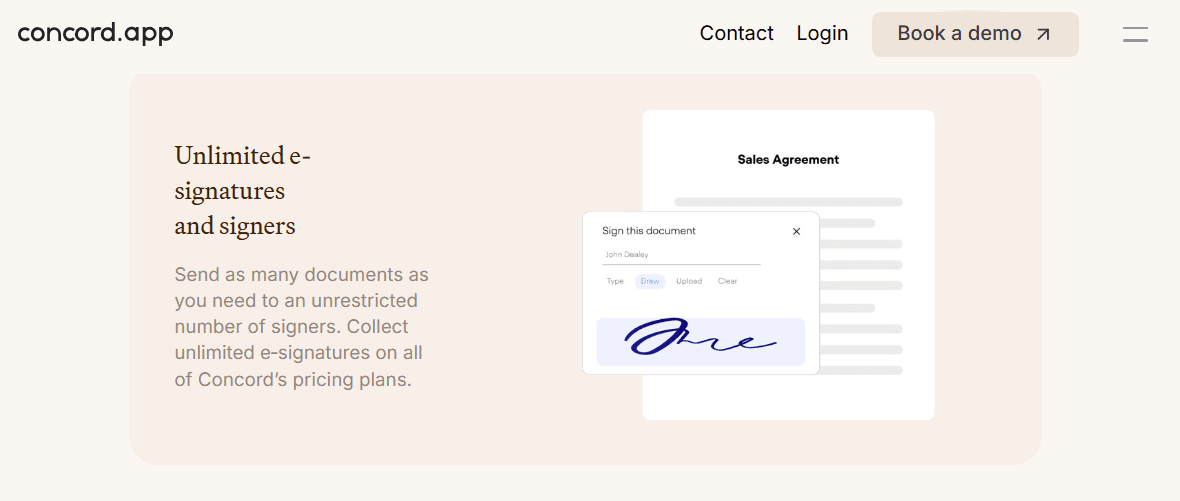
Concord offers a built-in e-signature feature, allowing you to sign contracts digitally without leaving the platform. This speeds up the approval process and eliminates the need for physical paperwork.
Template Library
Concord provides a collection of pre-approved contract templates that you can customize to fit your needs. This saves you time and ensures consistent formatting across all your contracts.
Version Control
You can track changes and maintain a history of all contract versions within Concord. This feature ensures you always have access to the most recent document and can easily review past modifications.
Automated Alerts and Notifications
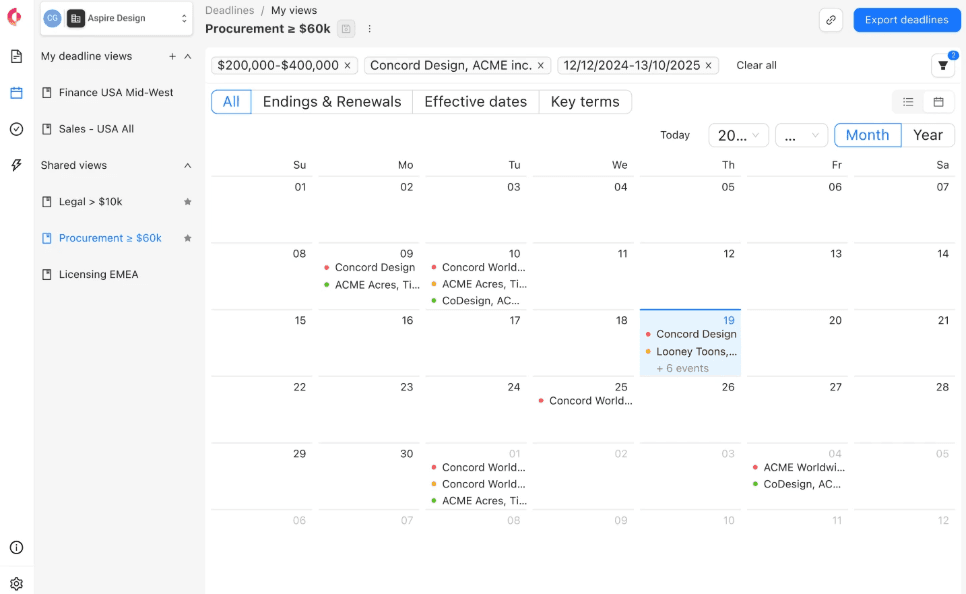
Concord sends automatic reminders and notifications about contract deadlines and renewals. This helps you avoid missed deadlines and ensures timely contract management.
Ease of Use
Concord’s user interface is intuitive with easy navigation, making it user-friendly for your team. You can quickly move between features using the left navigation menu, and the clear layout ensures you won't get lost. The interface is straightforward, allowing you to focus on your work rather than figuring out how to use the tool. The simple design helps you and your team save time, making it a solid choice for those who value ease of use.
Integrations
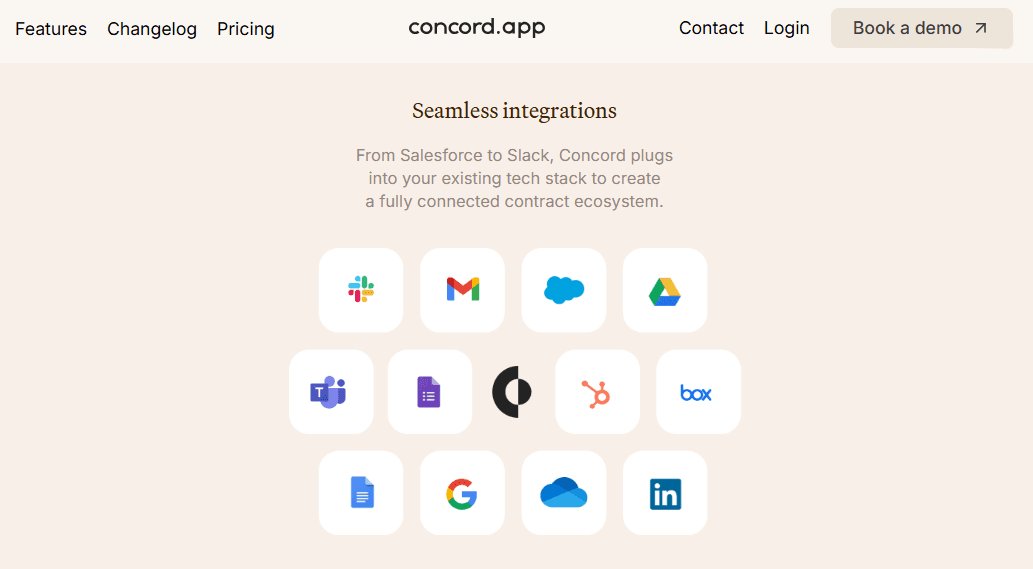
Concord integrates with Salesforce, HubSpot, Zapier, Single Sign-On (SSO), Dropbox, Box, Google Drive, and Azure Active Directory.
Concord also offers an open API that allows users to extend its functionalities for their software and applications.
Concord Specs
- 2-Factor Authentication: Yes
- API: Yes
- Approval Workflows: No
- Audit Trail: No
- Batch Permissions & Access: No
- Calendar Management: No
- Compliance Tracking: No
- Contact Management: No
- Dashboards: No
- Database: No
- Design Templates: No
- Document Comparison: Yes
- Document Management: No
- Electronic Signature: Yes
- External Integrations: Yes
- File Sharing: Yes
- File Transfer: Yes
- History/Version Control: No
- Multi-User: Yes
- NDA Management: No
- Notifications: Yes
- Reports: No
- Scheduling: No
- Task Scheduling/Tracking: No
- Third-Party Plugins/Add-Ons: No
- Workflow Management: No


