

O software CRM é uma ferramenta essencial para instituições de ensino superior. O software certo pode eliminar estrangulamentos e simplificar o processo de admissão, ao mesmo tempo que permite criar relações sólidas com os estudantes. No entanto, com tantas opções, encontrar o melhor CRM pode ser um desafio.
Com base na minha experiência com software de operações de receitas, testei e comparei várias soluções CRM líderes para o ensino superior. Elaborei análises detalhadas para o ajudar a encontrar o melhor software para as suas necessidades específicas. Estou confiante de que encontrará o seu próximo software CRM para o ensino superior na lista abaixo.
Why Trust Our Software Recommendations
6,700+
Reviews
20
Industry experts
16+
Evaluation factors
14
Years
Our reviews reflect our independent judgment—not a sales pitch. Learn how we stay transparent.
For this guide, we evaluated tools using hands-on testing and independent research, scoring tools using our selection criteria.
Our reviews reflect our human editorial judgment, not a sales pitch.
Tabela comparativa de software CRM para o ensino superior
A tabela abaixo compara os detalhes de preços das minhas principais escolhas de software CRM para o ensino superior.
| Tool | Best For | Trial Info | Price | ||
|---|---|---|---|---|---|
| 1 | Best for pre-built SIS and LMS integrations | Free demo available | Pricing upon request | Website | |
| 2 | Best for AI-powered student engagement | Not available | From $40/user/month | Website | |
| 3 | Best for AI-powered admissions and outreach automation | Free demo available | From $119/user/month (billed annually) | Website | |
| 4 | Best CRM for ready-made data import solutions | Free demo available | Pricing upon request | Website | |
| 5 | Best for scalability and customization | Free demo available | From $81.25/user/month (billed annually) | Website | |
| 6 | Best for personalized student support | Free demo available | Pricing upon request | Website | |
| 7 | Best for enrollment automation | Free demo available | From $107/month (billed annually) | Website | |
| 8 | Best for AI-driven student engagement | Free demo available | Pricing upon request | Website | |
| 9 | Best for detailed admissions tracking | Free demo available | Pricing upon request | Website | |
| 10 | Best for application management | Free demo available | Pricing upon request | Website |


Análises do melhor software CRM para o ensino superior
Abaixo encontrará os meus resumos detalhados do melhor software CRM para o ensino superior que incluí na minha lista restrita. As minhas análises apresentam uma visão detalhada das principais funcionalidades, vantagens e desvantagens, integrações e casos de utilização ideais de cada ferramenta, para o ajudar a encontrar a melhor opção para si.
 Best for pre-built SIS and LMS integrations
- Free demo available
- Pricing upon request

Navigate360 is a higher education CRM that supports the full student journey from enrollment to retention to advancement. Navigate360 is a higher education CRM platform designed to support student success, advising workflows, and campus-wide engagement. It connects student lifecycle management tools with communication features and integrations for institutional systems, helping colleges coordinate retention, advancement, and support efforts.
Who Is Navigate360 Best For?
Higher education institutions seeking a CRM tailored to student engagement, enrollment, retention, and alumni engagement across departments.
Why I Picked Navigate360
I picked Navigate360 for its pre-built integrations with major student information systems and learning management platforms. My team can connect directly with systems like Ellucian Banner, payment platforms, the CommonApp, and learning management systems, which reduces implementation complexity and improves data visibility.
Navigate360 Key Features
- Reporting and analytics: Monitor enrollment, student success, giving progress, and retention risk indicators using built-in dashboards.
- Automated appointment scheduling: Enable students to book meetings with advisors and support staff.
- Workflow automation: Automate enrollment, advising, and retention processes to streamline operations.
- Multi-channel communication: Send email, SMS, and in-app notifications from a unified interface.
- AI Assistants: Embedded AI assistants help support student communication and engagement workflows.
Navigate360 Integrations
Navigate360 integrates with Ellucian Banner, Ellucian Colleague, Canvas, and Blackboard. An API is available for custom integrations.
Pros and Cons
Pros:
- Centralized case management for student interventions
- Designed to support FERPA compliance requirements
- Pre-built SIS and LMS integrations save setup time
Cons:
- Implementation requires significant institutional resources
- No free trial or free-forever plan
Learn more about Navigate360: Best for AI-powered student engagement
- Not available
- From $40/user/month
Visit WebsiteCustomer Rating:4.7/5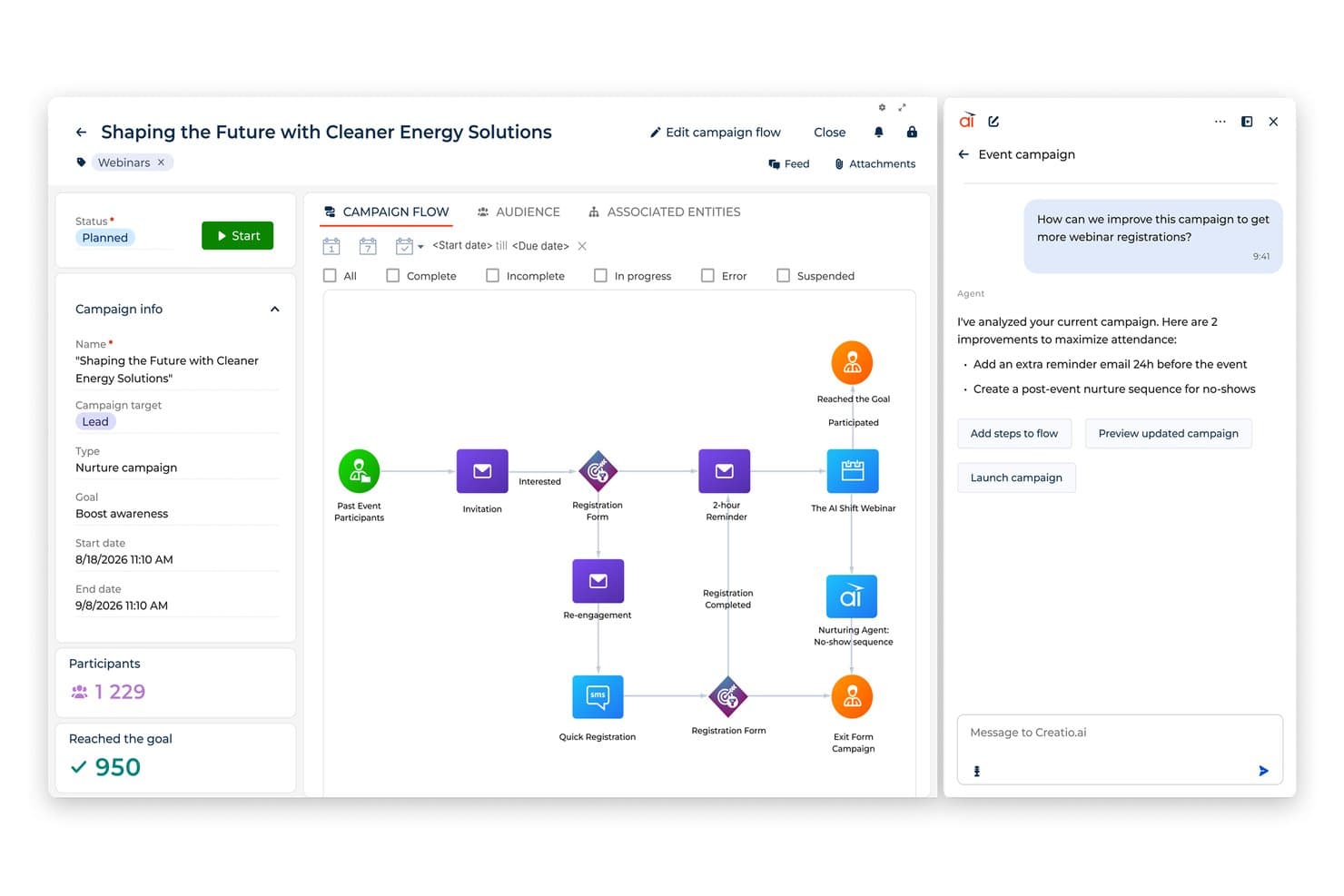
Creatio AI CRM helps higher education institutions optimize student outreach campaigns with embedded AI agents. Creatio AI CRM is an AI CRM and workflow platform where people and AI agents work together to help higher education institutions manage student-facing and administrative processes. The platform supports the student lifecycle from initial inquiry and recruitment through enrollment, onboarding, and ongoing engagement.
Why I picked Creatio AI CRM: For higher education institutions, Creatio AI CRM combines CRM functionality with AI agents and no-code workflow automation, allowing teams to configure and adapt processes without extensive technical resources. Its lead and opportunity management tools help track prospective students from inquiry through enrollment, supporting personalized communication and timely follow-ups. Campaign management capabilities enable admissions and marketing teams to create and manage multichannel recruitment campaigns with audience segmentation. The platform also supports workflow automation for processes such as application management, student onboarding, grant management, service requests, and other administrative tasks. Creatio AI CRM includes embedded AI agents that can assist teams with activities such as lead prioritization, workflow execution, and operational insights.
Standout Features & Integrations:
Features include grant management, support tickets, service requests, pipeline management, dashboards and analytics, contact management, task management, performance metrics, forecasting, opportunity management, referral tracking, territory management, activity dashboards, customizable fields, sales activity management, campaign management, workflow automation, lead management, and AI-powered process assistance.
Integrations include Accelo, Act!, ActiveCampaign, Acumatica, Adobe Analytics, Asana, Microsoft Exchange, Excel, Mailchimp, HubSpot Marketing Hub, Google Calendar, and Tableau.
Pros and Cons
Pros:
- AI-native, no-code platform reduces reliance on technical resources
- Extensive customization options for institution-specific workflows
- Automated reminders for lead and enrollment follow-ups
Cons:
- Extensive feature set can be overwhelming for smaller teams
- Initial workflow configuration can be time-consuming
Learn more about Creatio AI CRM: Best for AI-powered admissions and outreach automation
- Free demo available
- From $119/user/month (billed annually)
Visit WebsiteCustomer Rating:4.6/5
Shape automates outreach, admissions, and applications to boost student enrollment. Shape is an AI-powered CRM designed for educational institutions, focusing on automating outreach, admissions, and application processes to enhance student enrollment and retention. The platform supports higher education by providing tools for managing student prospects, improving communication, and integrating with Student Information Systems (SIS).
Why I picked Shape: Shape gives you a customizable student portal for securely collecting applications and handling large volumes with ease. With built-in communication tools like phone, text, email, and AI-driven lead scoring, you can optimize your outreach. Marketing tools like bulk messaging, drip campaigns, and customizable landing pages help boost conversion rates. The mobile app lets your team access everything on the go, so you can manage and engage with students from anywhere.
Standout Features & Integrations:
Features include a customizable student portal, an application management system, and integrated communication tools. AI-driven lead scoring helps prioritize outreach efforts. Marketing solutions such as bulk messaging and drip campaigns enhance conversion rates.
Integrations include Google Workspace, Zoom, Microsoft Outlook, QuickBooks, Mailchimp, Twilio, Docusign, HubSpot, Calendly, and Stripe.
Pros and Cons
Pros:
- Flexible automation for complex tasks
- Customizable workflows for campaigns
- Scalable for growing institutions
Cons:
- Time-consuming onboarding process
- Limited flexibility in certain areas
Learn more about Shape: Best CRM for ready-made data import solutions
- Free demo available
- Pricing upon request
Visit WebsiteCustomer Rating:4.2/5
TargetX enhances student recruitment, admissions, and retention with CRM solutions. TargetX is a CRM platform for higher education institutions, focused on improving student recruitment, admissions, and retention. It supports admissions teams and student success staff with tools for personalized communication, data-driven insights, and streamlined process management.
Why I picked TargetX: TargetX's Recruitment Suite helps your admissions team attract and engage prospective students with personalized communication tools and mobile-friendly applications. The Student Portal makes it easier for students to manage their enrollment tasks, while Telerecruiting lets your team run personalized call campaigns. Real-time reporting gives you the data you need to make informed decisions, and the platform works with systems like Salesforce and student information systems to keep everything connected.
Standout Features & Integrations:
Features include personalized communication tools, mobile-friendly application solutions, and real-time reporting. The Student Portal enables efficient enrollment task management, and Telerecruiting supports personalized call campaigns. The Recruitment Suite uses data-driven insights to enhance recruitment strategies.
Integrations include Salesforce, TargetX, Education Data Architecture (EDA), Enrollment Rx, CoPilot, Wiley Student Relationship Platform™, HandsOn Connect, PatronManager, Docusign Document Management, AC Events Enterprise, TrueDialog SMS, and more.
Pros and Cons
Pros:
- Flexible reporting for varied needs
- Customizable dashboards for departments
- Scalable for large student databases
Cons:
- Limited flexibility in certain modules
- Complex setup for advanced features
Learn more about TargetX: Best for scalability and customization
- Free demo available
- From $81.25/user/month (billed annually)

Salesforce Education Cloud enhances learner experiences with centralized data. Salesforce Education Cloud is a CRM tailored for the education sector, improving learner and institutional experiences. It centralizes student and prospect data, allowing for personalized interactions at scale.
Why I picked Salesforce Education Cloud: Recruitment and admissions features give your team the tools to create personalized application experiences and manage the review process in one place. You'll get a full view of student data, making it easy to set up data-driven alerts and schedule appointments with advisors. The alumni engagement portal helps you manage connections and events, while efficient gift processing makes fundraising easier. AI-driven analytics guide you through every stage of the student journey, ensuring you can offer personalized support when it's needed most.
Standout Features & Integrations:
Features include AI-driven automation for recruitment, holistic student data views for early intervention, and an alumni engagement portal for managing events and donations.
Integrations include PeopleSoft, Ellucian Banner, Workday, Ellucian Colleague, Slate, Google Analytics, Microsoft Dynamics 365, Campus Management (Anthology), Oracle Student Cloud, and Blackbaud.
Pros and Cons
Pros:
- Flexible reporting for varied needs
- Customizable workflows for departments
- Scalable for large student populations
Cons:
- Requires technical knowledge for setup
- Steep learning curve for new users
Learn more about Salesforce Education Cloud:

Ellucian enhances student success and streamlines operations with integrated SaaS. Ellucian offers technology solutions for higher education, providing integrated SaaS platforms that enhance student success and streamline operations. Its primary users are colleges and universities seeking to improve performance and student engagement through data-driven insights.
Why I picked Ellucian: Ellucian specializes in student information systems like Banner and Colleague, which streamline student record management. Its CRM tools focus on improving student recruitment, retention, and engagement. The platform also provides services for implementation, optimization, and training, ensuring your team maximizes its potential. Designed for higher education, Ellucian's solutions address key challenges to enhance institutional performance.
Standout Features & Integrations:
Features include student information systems for managing student records, CRM tools for enhancing student engagement, and services for implementation and training to help your team get the most out of the platform.
Integrations include Banner, Colleague, PowerCampus, Elevate, Quercus, Ethos, Degree Works, Payment Center, and eTranscripts.
Pros and Cons
Pros:
- Simple to implement with existing systems
- Customizable to specific school needs
- Scalable for growing institutions
Cons:
- Time-consuming to train staff
- Limited flexibility in certain modules
Learn more about Ellucian: Best for enrollment automation
- Free demo available
- From $107/month (billed annually)

Enrollsy manages enrollment and payment processing for child care, schools, and universities. Enrollsy is an online enrollment software for industries like child care, music schools, and universities. It manages enrollment, payment processing, and customer relationship management.
Why I picked Enrollsy: The software automates data entry and digital forms, so your team can manage enrollments without dealing with paper. You can customize payment options, whether it’s recurring payments or one-time fees. The reporting tools give you everything you need to track your data in one place. Enrollsy also offers web portals and app integrations to keep everyone in the loop.
Standout Features & Integrations:
Features include automated data entry, digital forms, customizable payment options, and a thorough reporting tool which all save time on administrative tasks. The web portals and app integrations offer multiple access options.
Integrations include QuickBooks, Stripe, Google Calendar, Mailchimp, Twilio, PayPal, Zoom, Google Analytics, Microsoft Teams, and Slack.
Pros and Cons
Pros:
- Supports recurring payment structures
- Flexible reporting tools for data tracking
- Customizable payment options are available
Cons:
- Limited flexibility in some features
- Requires technical setup for customization
Learn more about Enrollsy: Best for AI-driven student engagement
- Free demo available
- Pricing upon request

Element451 enhances staff productivity and student engagement with AI-powered tools. Element451 is an AI-powered CRM platform designed for higher education institutions, focusing on enhancing staff productivity and enriching student engagement. Its key business functions include providing AI assistants for both students and staff, knowledge discovery tools, and intelligent admissions automation.
Why I picked Element451: Element451 helps community colleges, public universities, trade schools, and online programs improve engagement and adapt to changing student expectations. With AI Assistants, both your students and staff get extra support, while Bolt Discovery uncovers important insights. The platform automates admissions processes, making things easier for your team. You’ll use data-driven insights and AI to transform student experiences and streamline operations, keeping everything running smoothly.
Standout Features & Integrations:
Features include AI assistants, knowledge discovery tools, and intelligent admissions automation. Your team can use these tools to understand student needs better and streamline administrative tasks. You’ll also find marketing automation, surveys, and student portals to enrich engagement.
Integrations include Slate, Google Analytics, Zapier, Mailchimp, Salesforce, HubSpot, Microsoft Dynamics 365, Qualtrics, LinkedIn, and Facebook.
Pros and Cons
Pros:
- AI-driven engagement insights
- Customizable automation for admissions
- Scalable for diverse institutions
Cons:
- Time-consuming onboarding process
- Complex reporting options overwhelm users
Learn more about Element451:

Slate supports admissions, communication, and data-informed decision-making for higher education. Slate is a CRM platform tailored for higher education, supporting admissions, student success, and advancement departments. It unifies communication, application processing, and decision-making, offering a customizable and integrated solution for campus systems.
Why I picked Slate: Slate gives you a unified platform for managing admissions, donor relations, and events all in one place. It supports the entire student journey, from recruitment through alumni relations, using real-time data insights and automation to keep things running smoothly. You can customize it to fit your existing processes, making integration easier. By combining everything in one system, Slate helps your team cut down on the need for multiple tools and boosts overall efficiency.
Standout Features & Integrations:
Features include customizable dashboards, real-time data insights, and automated workflows. You can manage admissions, track student success, and handle alumni relations all in one place. It also offers event management and donor-tracking functionalities.
Integrations include Common App, ACT, College Board, Parchment, Ellucian, Banner, PeopleSoft, Oracle, Salesforce, and Microsoft Dynamics 365.
Pros and Cons
Pros:
- Real-time data insights available
- Customizable workflows for specific needs
- Scalable for growing institutions
Cons:
- Limited flexibility in some features
- Time-consuming onboarding process
Learn more about Slate:

Embark supports admissions for higher education with recruiting and enrollment tools. Embark is an admissions CRM software tailored for higher education institutions, designed to help with recruiting, managing online applications, and enrolling students. Its main user base comprises colleges, universities, and fellowship programs focused on streamlining their admissions processes.
Why I picked Embark: The platform helps your team collaborate on reviewing applications efficiently. You can access real-time data and reporting through a personalized admin dashboard, making it easy to stay on top of things. It also integrates with your existing data systems, keeping your workflow organized and smooth.
Standout Features & Integrations:
Features include customizable online applications, a collaborative online review process, and real-time data reporting via a personalized dashboard. You can manage the entire admissions lifecycle, from recruitment to enrollment, all in one place. The system supports a smooth integration with existing data systems, enhancing your data management capabilities.
Integrations include PeopleSoft, Ellucian, Salesforce, Oracle, Workday, Blackbaud, Slate, Technolutions, Google Analytics, and HubSpot.
Pros and Cons
Pros:
- Easy to integrate with systems
- Customizable workflows for unique needs
- Scalable for large applicant pools
Cons:
- Steep learning curve for administrators
- High complexity for advanced features
Learn more about Embark:
Outro software CRM para o ensino superior
Eis algumas opções adicionais de software CRM para o ensino superior que não foram incluídas na minha lista restrita, mas que ainda vale a pena conhecer:
- 11Zoho CRMBest for integrated marketing tools
- 12LeadSquaredBest for lead-improvement-focused features
- 13MerittoBest for all-in-one enrollment management
- 14ZendeskBest for student support ticketing
- 15Creatix CampusBest for AI-driven, low-code platform
- 16Maestro SISBest for cloud-hosted centralization
- 17Full FabricBest for personalized student engagement
How I Evaluate CRM Software for Higher Education
I evaluate admissions CRMs in two layers: the baseline must-haves like enrollment pipeline tracking and SIS integration, and the differentiators—like AI yield scoring—that set vendors apart.
Core Functionality (Table Stakes For This List)
When I'm selecting tools for my list, I rank each one on a scale from 0 (does not offer the functionality) to 5 (excels in this area) for each core functionality listed below. Then, I calculate the tool's total score into a percentage. Each tool needs to achieve a minimum total score of 55% to be considered for inclusion.
- Student Lifecycle CRM: I check whether the platform tracks contacts from first inquiry through alumni status, not just the admissions window.
- Enrollment Pipeline Management: Each tool should let you build term-specific funnels so you can compare fall vs. spring yield without manual workarounds.
- Multi-Channel Recruitment Outreach: I look for segmented email, SMS, and campaign tools that let you target prospects, parents, and counselors separately.
- SIS & Ed-Tech Integrations: Connectors to systems like Banner, PeopleSoft, or Workday Student matter here—generic API access alone isn't enough.
- Higher Ed Data Model: Prebuilt fields for academic programs, intended majors, test scores, and application terms show a platform was designed for this space.
- Enrollment Analytics & Reporting: Dashboards should surface yield rates, funnel conversion, and recruiter performance tied to admissions cycles out of the box.
Once I have a list of tools that meet the criteria, I consider what sets each platform apart.
Differentiating Factors (What Sets Vendors Apart)
Here's how I compare and contrast different vendors:
Standout Features
AI-driven lead scoring is a major differentiator. I look for models that predict enrollment likelihood using engagement patterns and historical yield data, so admissions teams can prioritize high-fit prospects during peak cycle. Event management tools also matter, especially when they track campus visit attendance and tie it back to funnel conversion. Platforms that extend beyond enrollment into advancement give you donor pipeline tracking and gift stewardship, so your institution doesn't need a separate system for fundraising.
Beyond Features
FERPA compliance is the first thing I check—any platform handling student records needs to demonstrate clear data governance controls. Implementation timelines also weigh heavily, because a missed go-live window can mean running a full admissions cycle on the old system. I evaluate institution type fit too, since a CRM built for large research universities with decentralized colleges operates very differently from one designed for small private institutions.
Como escolher software CRM para o ensino superior
É fácil perder-se em listas extensas de funcionalidades e estruturas de preços complexas. Para o ajudar a manter-se concentrado enquanto percorre o seu processo específico de seleção de software, eis uma lista de verificação com os fatores a ter em conta:
| Fator | O que considerar |
| Escalabilidade | O software acompanhará o crescimento da sua instituição? |
| Integrações | Integra-se com os seus sistemas existentes? |
| Personalização | Pode adaptá-lo às suas necessidades específicas? |
| Facilidade de utilização | É fácil de utilizar pela sua equipa |
| Orçamento | Enquadra-se nas suas limitações financeiras? |
| Medidas de segurança | Protege adequadamente os seus dados? |
| Suporte | Está disponível um suporte ao cliente fiável |
| Formação | Existem recursos de formação suficientes para os utilizadores? |
Utilize esta lista de verificação para manter o seu processo de seleção de software organizado e concentrado.
Tendências no software CRM para o ensino superior
Na minha investigação, consultei inúmeras atualizações de produtos, comunicados de imprensa e registos de versões de diferentes fornecedores de software CRM para o ensino superior. Eis algumas das tendências emergentes que estou a acompanhar:
- Suporte aos estudantes baseado em IA: Os chatbots e assistentes virtuais de IA estão a tornar-se cada vez mais comuns, ajudando a responder às perguntas dos estudantes, a orientá-los nos processos administrativos e a fornecer suporte personalizado.
- Análise preditiva para as matrículas: As ferramentas de análise preditiva estão a ser integradas para prever as tendências de matrículas dos estudantes, identificar estudantes em risco e otimizar as estratégias de recrutamento. Estas ferramentas ajudam as instituições a tomar decisões baseadas em dados, melhorando a retenção dos estudantes e direcionando os esforços de recrutamento de forma mais eficaz.
- Perfis abrangentes dos estudantes: Os CRM estão a evoluir para criar perfis detalhados dos estudantes que incluem o desempenho académico, as atividades extracurriculares e os interesses pessoais. Estes dados centralizados ajudam a adaptar as comunicações e os serviços de suporte às necessidades individuais dos estudantes, melhorando a sua experiência educativa global.
- Maior privacidade e segurança dos dados: Com o aumento das preocupações relacionadas com a privacidade dos dados, os fornecedores de CRM estão a incorporar medidas de segurança avançadas para proteger as informações dos estudantes. A conformidade com regulamentos como o GDPR e o FERPA está a tornar-se uma funcionalidade padrão, garantindo que as instituições podem proteger dados sensíveis.
- Gamificação para promover o envolvimento: Alguns CRM estão a introduzir elementos de gamificação para aumentar o envolvimento dos estudantes. Isto inclui funcionalidades como distintivos de conquista, tabelas de classificação e módulos interativos que tornam as tarefas administrativas e a aprendizagem mais envolventes e agradáveis para os estudantes.
O que é o software CRM para o ensino superior?
O software CRM para o ensino superior ajuda as instituições a gerir as relações com estudantes, antigos alunos, docentes, funcionários e parceiros. Utilizadas habitualmente por responsáveis pelas admissões, gestores de matrículas e profissionais dos serviços de apoio aos estudantes, estas ferramentas melhoram a comunicação e o envolvimento ao longo do ciclo de vida do estudante. Ao centralizarem os dados e simplificarem processos como o recrutamento, as admissões e a retenção, oferecem um valor significativo.
Funcionalidades essenciais, como o acompanhamento dos dados dos estudantes, as comunicações automatizadas e a análise de dados, permitem uma gestão eficiente e eficaz das relações. Em última análise, estas ferramentas melhoram a eficiência operacional das instituições e aumentam a satisfação dos estudantes.
Funcionalidades do software CRM para o ensino superior
Ao selecionar software CRM para o ensino superior, procure as seguintes funcionalidades essenciais:
- Gestão de candidaturas: Simplifica o processo de admissões ao automatizar o acompanhamento e o processamento das candidaturas.
- Perfis dos estudantes: Centraliza os dados dos estudantes, proporcionando uma visão abrangente do percurso académico e das interações de cada estudante.
- Integração com sistemas de gestão da aprendizagem (LMS): Garante uma troca harmoniosa de dados entre o CRM e as plataformas educativas, melhorando a gestão da aprendizagem.
- Gestão de cursos: Facilita a criação, o agendamento e a gestão de cursos e inscrições em turmas.
- Acompanhamento da assiduidade: Monitoriza e regista a assiduidade dos estudantes, contribuindo para a conformidade e a análise do desempenho.
- Gestão de classificações: Permite introduzir, armazenar e analisar as classificações dos estudantes, apoiando o acompanhamento do desempenho académico.
- Ferramentas de comunicação: Disponibiliza canais para interagir com estudantes, docentes e funcionários através de e-mails, SMS e notificações.
- Envolvimento dos antigos alunos: Gere as relações com os diplomados, apoiando as redes de antigos alunos e os esforços de angariação de fundos.
- Análise de dados e relatórios: Fornece informações sobre os dados dos estudantes e o desempenho institucional através de relatórios e painéis personalizáveis.
- Funcionalidades de segurança: Garante a proteção dos dados através de medidas como a encriptação SSL e a autenticação de dois fatores.
Benefícios do software CRM para o ensino superior
A implementação de software CRM para o ensino superior proporciona vários benefícios para a sua equipa e para a sua instituição. Eis alguns dos benefícios que pode esperar:
- Recrutamento de estudantes melhorado: os sistemas CRM ajudam a gerir potenciais candidatos e a acompanhar pedidos de informação, tornando os processos de recrutamento mais eficientes e aumentando as taxas de matrícula.
- Comunicação melhorada: as ferramentas de comunicação automatizada e personalizada garantem interações atempadas e relevantes com estudantes, docentes e antigos alunos.
- Gestão centralizada de dados: todos os dados dos estudantes são armazenados num único local, facilitando o acesso e a análise das informações para uma melhor tomada de decisões.
- Gestão de eventos: o software CRM pode promover e gerir eventos de forma eficaz, garantindo uma maior participação e envolvimento.
- Processos sem papel: a transição para formulários e documentos digitais reduz a papelada e as tarefas administrativas, poupando tempo e recursos.
- Melhores relações com antigos alunos: a manutenção de registos detalhados das interações com antigos alunos ajuda a cultivar relações duradouras e a aumentar os seus contributos.
- Acompanhamento do desempenho: os sistemas CRM disponibilizam funcionalidades de análise e elaboração de relatórios para monitorizar a eficácia das campanhas de recrutamento e de outras iniciativas.
Custos e preços do software CRM para o ensino superior
A seleção de software CRM para o ensino superior requer uma compreensão dos vários modelos de preços e planos disponíveis. Os custos variam consoante as funcionalidades, a dimensão da equipa, os complementos, entre outros fatores. A tabela abaixo resume os planos comuns, os seus preços médios e as funcionalidades normalmente incluídas nas soluções de software CRM para o ensino superior:
Tabela de comparação de planos de software CRM para o ensino superior
| Tipo de plano | Preço médio | Funcionalidades comuns |
| Plano gratuito | $0 | Gestão básica de contactos, marketing por correio eletrónico e elaboração limitada de relatórios |
| Plano pessoal | $5-$25/ utilizador/ mês | Gestão de contactos, modelos de correio eletrónico, gestão de tarefas e análise básica |
| Plano empresarial | $30-$100/ utilizador/mês | Elaboração avançada de relatórios, automatização de fluxos de trabalho, integrações com outro software e painéis personalizados |
| Plano empresarial de grande dimensão | $100-$300/ utilizador/mês | Personalização completa, funcionalidades de segurança avançadas, suporte dedicado e integrações ilimitadas |
Detalhamento dos tipos de planos de software CRM para o ensino superior, respetivos custos e funcionalidades.
Perguntas frequentes sobre software CRM para o ensino superior
Eis algumas respostas a perguntas comuns sobre software CRM para o ensino superior:
Os sistemas CRM podem integrar-se com o software universitário existente?
Sim, a maioria dos sistemas CRM pode integrar-se com o seu software existente, como sistemas de informação de estudantes (SIS), sistemas de gestão da aprendizagem (LMS) e plataformas de correio eletrónico. A integração garante que os dados fluem sem interrupções entre os sistemas, reduzindo a necessidade de introdução manual de dados e melhorando a sua precisão. Permite também obter uma visão mais abrangente das interações e do desempenho dos estudantes.
Como é que o software CRM apoia o envolvimento dos antigos alunos?
O software CRM ajuda a manter e a fortalecer as relações com os antigos alunos, acompanhando as suas interações, doações e participação em eventos. A sua equipa pode utilizar o CRM para enviar comunicações personalizadas, planear e gerir eventos e acompanhar os contributos dos antigos alunos. Isto promove um sentimento de comunidade e incentiva o apoio e o envolvimento contínuos da sua rede de antigos alunos.
Que considerações de segurança dos dados devem ser tidas em conta ao utilizar software CRM?
A segurança dos dados é fundamental ao utilizar software CRM, especialmente no ensino superior. Certifique-se de que o CRM escolhido cumpre os regulamentos de proteção de dados, como o RGPD ou a FERPA. Procure funcionalidades como encriptação de dados, controlos de acesso e auditorias de segurança regulares. A sua equipa também deve receber formação sobre as melhores práticas de segurança dos dados, para proteger informações sensíveis dos estudantes e da instituição.
Como é que o software CRM ajuda a reter os estudantes?
O software CRM pode acompanhar o envolvimento e o progresso académico dos estudantes, permitindo à sua equipa identificar estudantes em risco e intervir atempadamente. Ao monitorizar as interações e prestar apoio atempado, pode resolver potenciais problemas antes que estes conduzam ao abandono dos estudos. As ferramentas CRM também podem facilitar campanhas de comunicação direcionadas, para manter os estudantes informados e envolvidos ao longo do seu percurso académico.
É possível personalizar o software CRM para necessidades institucionais específicas?
Sim, muitos sistemas CRM oferecem opções de personalização para se adaptarem às necessidades específicas da sua instituição. Pode adaptar fluxos de trabalho, campos de dados e ferramentas de elaboração de relatórios aos seus processos e objetivos. A personalização garante que o sistema CRM está alinhado com os seus requisitos específicos, tornando-o mais eficaz na gestão de relações e na melhoria da eficiência global.