

Avis sur Less Annoying CRM 2026 : Avantages, Inconvénients, Fonctionnalités et Tarifs
Less Annoying CRM se distingue par sa simplicité et ses tarifs transparents, ce qui en fait une solution idéale pour les petites équipes à la recherche d’un CRM simple, sans fioritures ni la complexité de fonctionnalités superflues.

Nous évaluons les outils de manière indépendante, et les commissions contribuent au financement de nos tests. Consultez notre politique de transparence, notre méthodologie, ou suggérez un outil.
Less Annoying CRM is a CRM software built for small businesses that need contact management, pipeline tracking, and task follow-ups without a steep learning curve. I'd consider it if your team wants a no-fuss system that does the basics well—and doesn't want to pay for the layers of complexity that come with a tool like HubSpot.
Less Annoying CRM Evaluation Summary

4.9/5
- From $15/user/month
- 30-day free trial available
Pourquoi faire confiance à nos recommandations de logiciels
6,700+
Reviews
20
Industry experts
16+
Evaluation factors
14
Years
Nos avis reflètent notre jugement indépendant — et non un argumentaire de vente. Découvrez comment nous restons transparents.
Pour ce guide, nous avons évalué les outils grâce à des tests pratiques et une recherche indépendante, en notant les outils selon nos critères de sélection.
Nos avis reflètent notre jugement éditorial humain, et non un argumentaire de vente.
Less Annoying CRM Overview
If you’re judging CRM software on simplicity, transparent pricing, and fast onboarding, Less Annoying is hard to beat. The interface is clean, support is responsive, and you won’t get lost in endless configuration. While it lacks advanced automation and deep integrations, I think it’s a smart pick for small teams or solo operators who want to track contacts, pipelines, and tasks without a learning curve.
If you’re comparing options and value clarity over customization, Less Annoying stands out—especially for businesses that don’t need complex reporting or multi-system workflows.
Pros
- Simple contact, task, and pipeline management for small teams.
- Responsive, human customer support included for all users.
- Flat-rate pricing with no hidden fees or contracts.
Cons
- Limited automation and workflow customization options.
- Lacks advanced reporting and analytics features.
- No built-in mobile app for iOS or Android.
Is Less Annoying CRM Right For Your Needs?
Who Would be a Good Fit for Less Annoying CRM?
Less Annoying CRM is a smart choice for small businesses, solo professionals, and teams that want a straightforward CRM without the overhead of complex features or high costs. If your workflow centers on managing contacts, tracking simple pipelines, and keeping tasks organized, you’ll find Less Annoying’s flat-rate pricing and responsive support appealing. It’s especially well-suited for industries and roles where simplicity, transparency, and quick onboarding matter more than deep customization or advanced analytics.
- Real Estate AgentsContact and pipeline tracking is simple and tailored for relationship management.
- Nonprofit OrganizationsAffordable pricing and easy donor tracking fit tight budgets and small teams.
- Consulting FirmsProject and client tracking is clear without unnecessary features or clutter.
- FreelancersSolo users can manage leads and follow-ups without paying for extras.
- Small Retail ShopsBasic customer tracking and follow-up reminders help maintain repeat business.
- Education ProvidersSimple student and parent communication tracking without complex integrations.
Who Would be a Bad Fit for Less Annoying CRM?
Less Annoying CRM isn’t built for large enterprises, teams needing advanced automation, or industries that rely on deep integrations and analytics. If your business requires multi-step workflows, custom reporting, or a mobile app for field teams, you’ll likely find Less Annoying limiting. It’s not the right choice for organizations that need to connect their CRM to a wide range of external tools or require granular user permissions.
- Enterprise Sales TeamsNo advanced reporting, territory management, or multi-level permissions.
- SaaS CompaniesLacks product usage tracking, subscription management, and API depth.
- Field Service TeamsNo native mobile app for on-the-go access or updates.
- Marketing DepartmentsLimited campaign tracking, segmentation, and marketing automation features.
- Healthcare PracticesNo HIPAA compliance or industry-specific data security controls.
- Manufacturing FirmsNo inventory, order management, or supply chain integration capabilities.
Comment nous testons et notons les outils
Nous avons passé des années à construire, affiner et améliorer notre système de test et de notation des logiciels. La grille d’évaluation est conçue pour saisir toutes les nuances dans le choix d’un logiciel et pour identifier ce qui rend un outil efficace, en mettant l’accent sur les aspects essentiels du processus de décision. Vous trouverez ci-dessous le détail exact de notre méthode de test et de notation selon sept critères. Cela nous permet de fournir une évaluation impartiale des logiciels basée sur la fonctionnalité principale, les fonctionnalités remarquables, la facilité d’utilisation, l’onboarding, le support client, les intégrations, les avis clients et le rapport qualité-prix.
Fonctionnalités principales (25 % de la note finale)
Le point de départ de notre évaluation est toujours la fonctionnalité principale de l’outil. Dispose-t-il des fonctions et caractéristiques de base auxquelles un utilisateur peut s’attendre ? Certaines de ces fonctionnalités de base sont-elles réservées à des formules plus onéreuses ? Nous attendons d’un outil qu’il tienne la comparaison avec les capacités minimales de ses concurrents.
Fonctionnalités remarquables (25 % de la note finale)
Nous évaluons ensuite les fonctionnalités remarquables, rares ou originales, qui vont au-delà des fonctionnalités principales habituellement trouvées dans ce type d’outils. Un score élevé reflète des fonctionnalités spécialisées ou innovantes qui accélèrent le produit, l’optimisent ou apportent une valeur ajoutée à l’utilisateur. Nous évaluons également la facilité d’intégration de l’outil aux autres logiciels généralement présents dans l’écosystème technologique, afin d’étendre ses fonctionnalités et son utilité. Les outils qui offrent de nombreuses intégrations natives, connexions tierces et accès API pour des intégrations personnalisées obtiennent la meilleure note.
Facilité d’utilisation (10 % de la note finale)
Nous évaluons la rapidité et la facilité d’exécution des tâches principales à l’aide de l’outil. Les logiciels les mieux notés sont bien conçus, intuitifs, proposent des applis mobiles, fournissent des modèles et facilitent la réalisation de tâches complexes.
Onboarding (10 % de la note finale)
Nous savons combien il est important d’adopter rapidement une nouvelle plateforme en équipe. Nous évaluons donc la facilité de prise en main de l’outil avec un minimum de formation. Nous étudions la rapidité avec laquelle un membre peut être opérationnel et commencer à utiliser l’outil sans expérience préalable. Un score élevé indique qu’aucun ou très peu de support est requis.
Support client (10 % de la note finale)
Nous examinons la rapidité et la facilité avec lesquelles il est possible de sortir d’une impasse et de trouver de l’aide par téléphone, chat en direct ou base de connaissances. Les outils et entreprises qui proposent une assistance en temps réel obtiennent la meilleure note, tandis que les chatbots sont les moins bien notés.
Avis clients (10 % de la note finale)
Au-delà de nos propres tests et évaluations, nous prenons en compte le score net d’appréciation des clients actuels et passés. Nous examinons la probabilité qu’ils choisissent à nouveau l’outil pour ses fonctionnalités principales. Un score élevé reflète une forte satisfaction des clients actuels ou passés.
Rapport qualité-prix (10 % de la note finale)
Enfin, en tenant compte de tous les autres critères, nous comparons le prix moyen des forfaits d’entrée de gamme avec les fonctionnalités de base et évaluons la valeur ajoutée selon les autres critères. Un logiciel offrant plus pour moins sera mieux noté.
Core Features
Contact Management
Store, organize, and search all your contacts in one place. Add custom fields and notes to keep relationship details front and center.
Pipeline Tracking
Visualize leads and deals as they move through your sales process. Drag-and-drop interface makes updating deal stages quick and intuitive.
Task and Calendar Management
Create tasks, set reminders, and view everything on a built-in calendar. Sync with Google Calendar for a unified schedule.
Team Collaboration
Share contacts, pipelines, and notes with your team. Assign tasks and see updates in real time for better coordination.
Custom Fields
Add fields tailored to your business needs, like referral sources or contract dates. This flexibility helps you capture the data that matters most.
Daily Agenda Emails
Receive a daily summary of your tasks and events by email. Stay on top of follow-ups and appointments without logging in.
Ease of Use
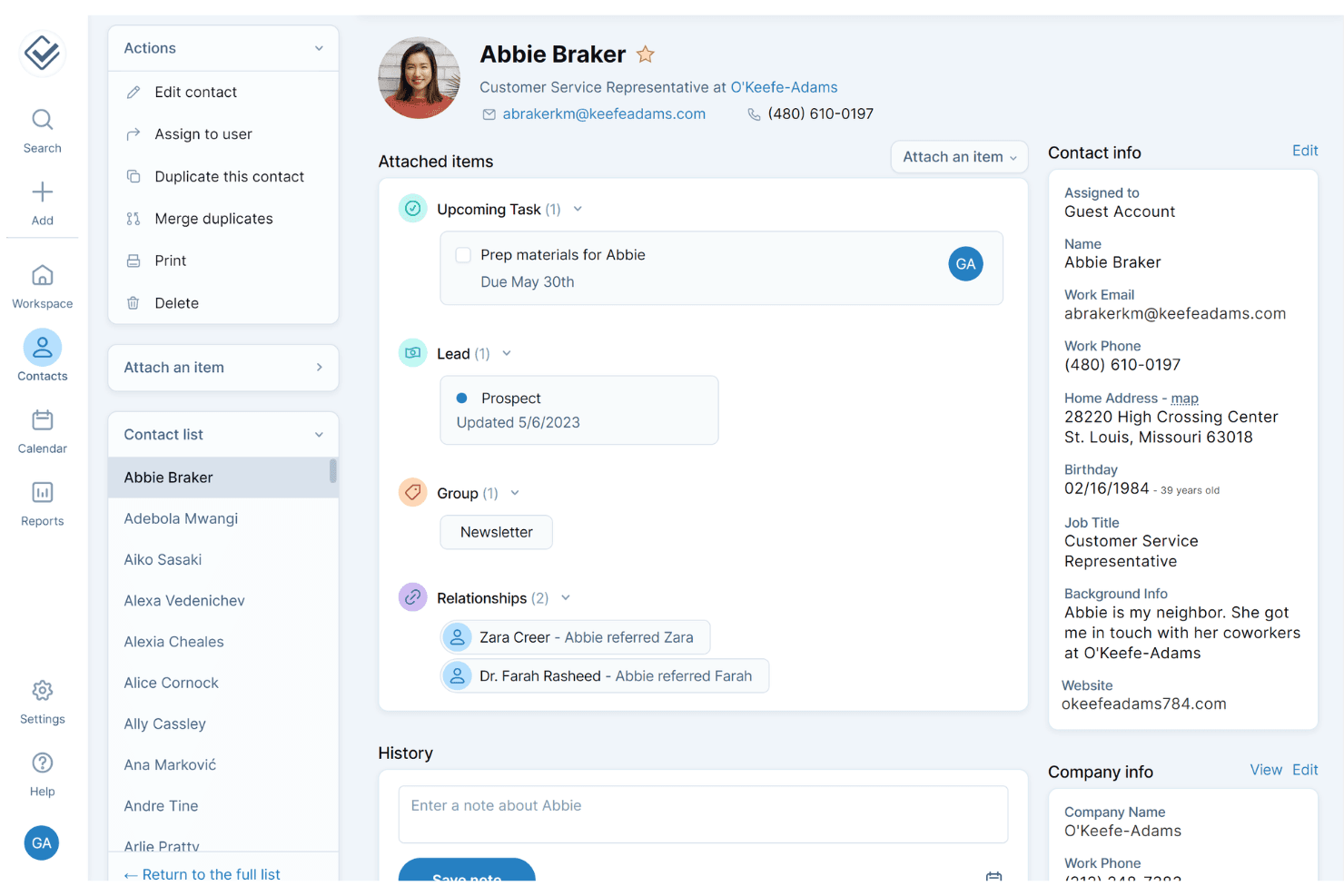
Less Annoying CRM is one of the most approachable CRM software options I’ve used. The interface is clean, navigation is straightforward, and setup takes minutes—not hours. Users consistently mention how quickly they can add contacts, update pipelines, and find information without training or manuals. There’s no clutter or hidden menus, so even non-technical team members can get started right away. This simplicity makes it a favorite for small teams and solo users.
Integrations
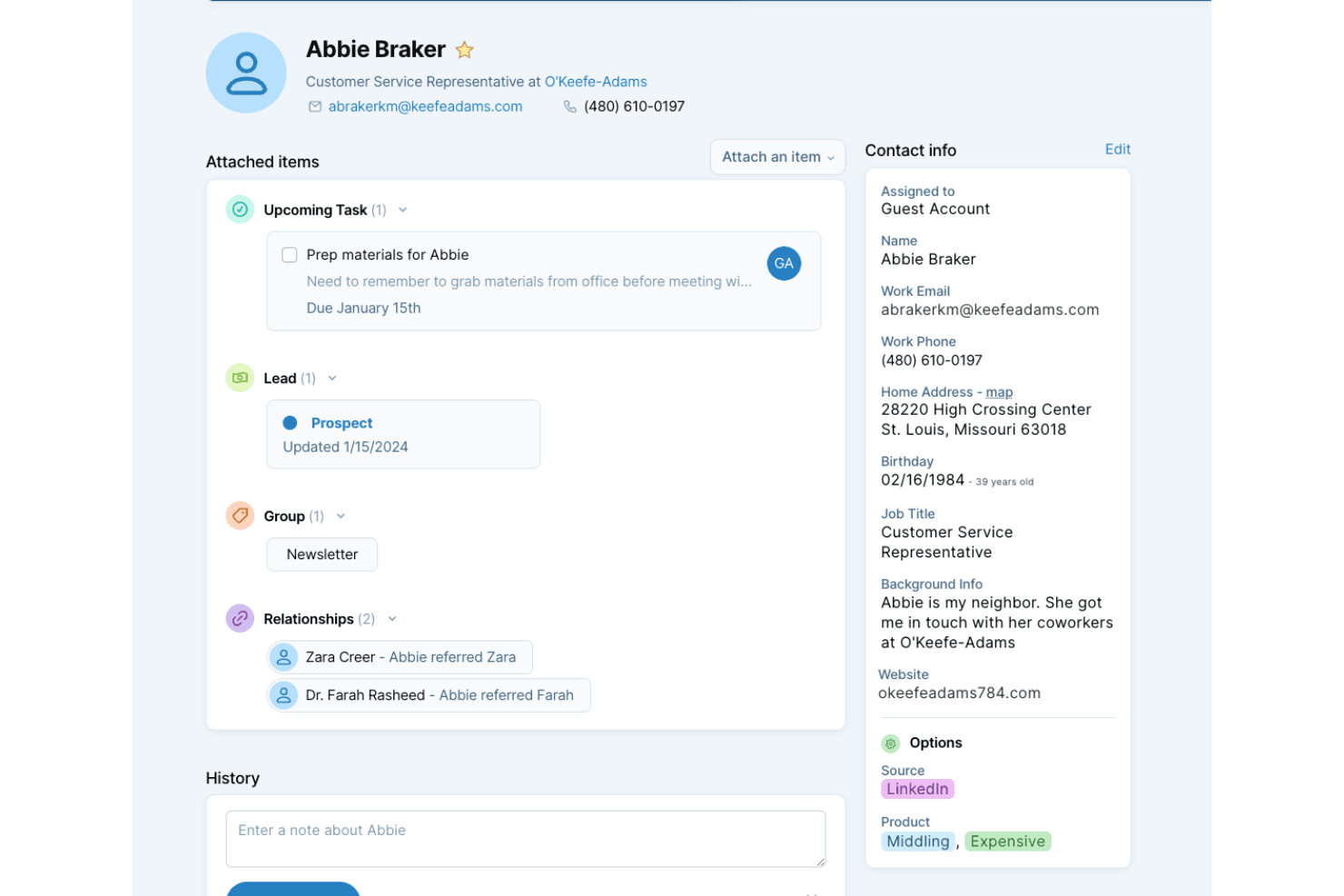
Less Annoying CRM integrates with Mailchimp, Google Calendar, Outlook Calendar, Google Contacts, Zapier, QuickBooks Sync, Badger Maps, JustCall, Pabbly Connect, and LeadsBridge, among others.
Less Annoying CRM also offers an API and connects with thousands of other apps through Zapier and similar third-party integration tools.

Less Annoying CRM Specs
- 2-Factor Authentication: Yes
- API: Yes
- Calendar Management: Yes
- Call Tracking: No
- Campaign Management: No
- Click-to-Dial: Yes
- Contact Management: Yes
- Contact Sharing: Yes
- Custom Data Forms: No
- Customer Management: Yes
- Dashboard: Yes
- Data Export: Yes
- Data Import: Yes
- Data Visualization: Yes
- Email Integration: Yes
- External Integrations: Yes
- File Sharing: Yes
- File Transfer: No
- Google Apps Integration: No
- Lead Management: Yes
- Lead Scoring: Yes
- Marketing Automation: No
- Mobile App: No
- Multi-User: Yes
- Notifications: Yes
- Pipeline Management: Yes
- Sales Automation: Yes
- Scheduling: Yes
- Social-Media Integration: No
- Task Scheduling/Tracking: Yes
- Third-Party Plugins/Add-Ons: Yes


