


Apollo-Bewertung: Vorteile, Nachteile, wichtigste Funktionen und Preisleitfaden


Building a reliable outbound pipeline gets harder when prospect data, enrichment, outreach, and follow-up are spread across separate tools. Contact information goes stale, reps lose time switching between platforms, and sales leaders are left trying to connect activity back to actual pipeline.
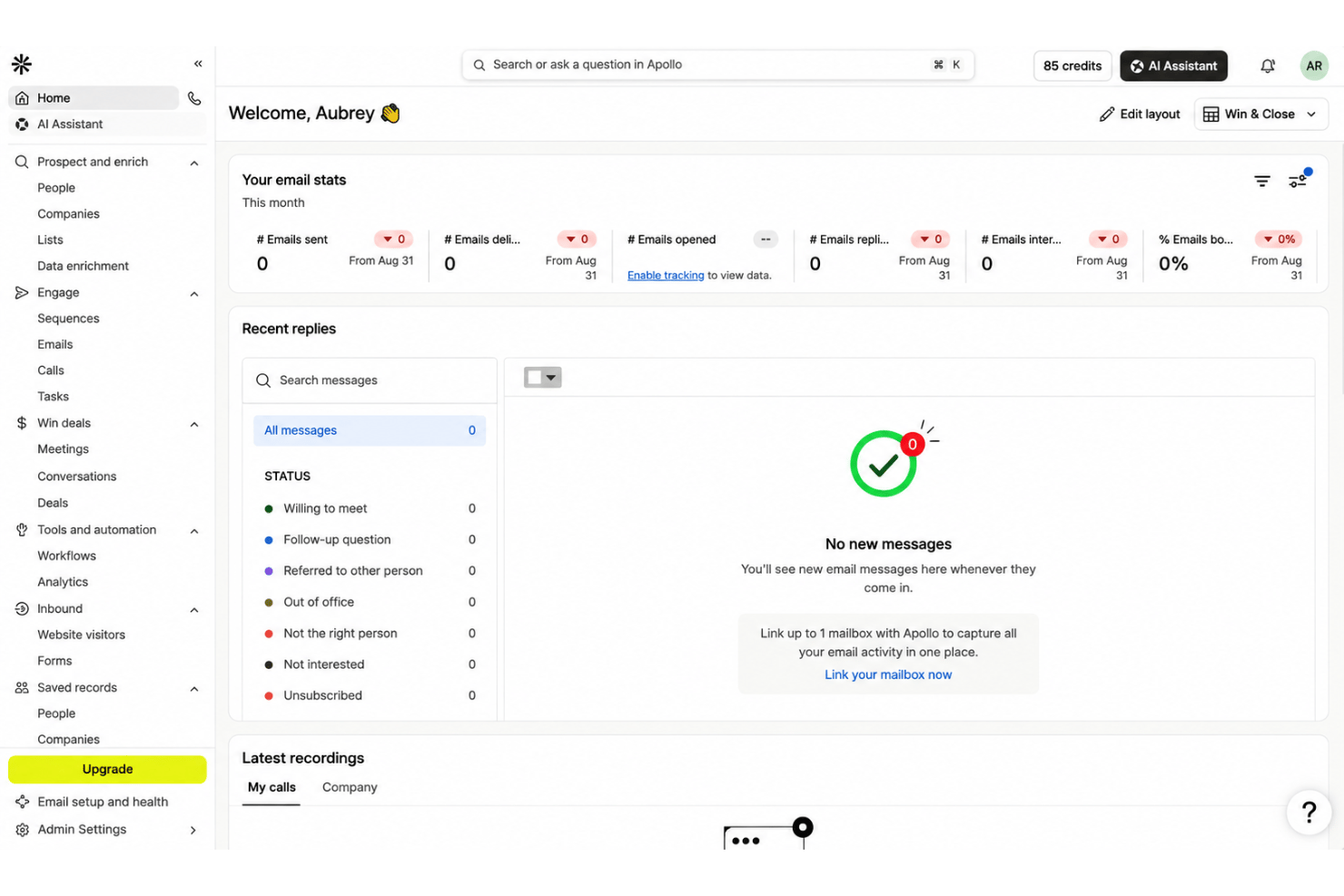
Apollo is a sales intelligence software platform that combines B2B contact data, enrichment, prospecting, and sales engagement tools in one system. It helps teams identify potential buyers, enrich account and contact data, run multi-channel outreach, manage calling and email workflows, and use AI to support prospecting and execution.
In this review, I’ve evaluated Apollo to help you determine whether it’s the right fit for your sales needs.
Apollo.io Evaluation Summary
- From $49/user/month (billed annually)
- Free plan + 14-day free trial + free demo available
Warum Sie unseren Software-Empfehlungen vertrauen können
Unsere Bewertungen spiegeln unser unabhängiges Urteilsvermögen wider – keine Verkaufsstrategie. Erfahren Sie, wie wir transparent bleiben.
Für diesen Leitfaden haben wir Tools mithilfe von praktischen Tests und unabhängiger Recherche bewertet und dabei unsere Bewertungskriterien angewendet.
Unsere Bewertungen spiegeln unser menschliches redaktionelles Urteilsvermögen wider, keine Verkaufsstrategie.
Apollo.io Overview
In my opinion, Apollo stands out for combining sales intelligence, enrichment, outreach, and AI-powered execution in one platform. Its large B2B database, waterfall enrichment, sequencing, dialer, workflow automation, and CRM integrations make it especially useful for teams looking to consolidate their GTM stack. I also like that Apollo includes deliverability tools and newer AI capabilities such as AI Assistant and MCP integrations, though its credit model can be confusing and some individual modules may not go as deep as dedicated point solutions.
pros
-
Offers a large B2B database with real-time verification and waterfall enrichment across additional providers.
-
Includes email deliverability tools such as warmup, bounce monitoring, and automatic pausing on high bounce rates.
-
Integrates with Claude, ChatGPT, and Perplexity for prospecting and enrichment inside existing AI workflows.
cons
-
Credit usage across contact reveals, enrichment, and AI actions can be difficult to predict.
-
Data accuracy can vary, especially for mobile numbers and contacts outside North America.
-
Enterprise admin controls and company hierarchy features are still less mature than some legacy platforms.
Is Apollo.io Right For Your Needs?
Who Would be a Good Fit for Apollo.io?
Apollo is a strong fit for B2B teams that want prospecting, enrichment, outreach, and pipeline execution in the same system. I think it makes the most sense for organizations running a consistent outbound motion, especially those looking to reduce reliance on separate data, sequencing, and enrichment tools.
-
SaaS and Software Companies
Apollo helps SaaS teams identify target accounts, enrich prospect data, run outbound sequences, and build pipeline.
-
Mid-Market Sales Teams
Growing sales teams can use Apollo for prospecting, lead scoring, sequencing, calling, meetings, and CRM enrichment without stitching together several tools.
-
Revenue Operations Teams
RevOps teams can manage enrichment, lead routing, workflow automation, analytics, and CRM data quality while keeping sales execution connected.
-
B2B Agencies and Consultancies
Agencies and professional services firms can build targeted lists, enrich contact data, and run repeatable outreach across different markets.
-
Recruiting and Staffing Firms
Recruiting and staffing firms can use Apollo’s database, filters, enrichment, and outreach tools to identify and engage business professionals, though it is not designed to replace an applicant tracking system.
-
Founders and Small Sales Teams
Smaller teams can access prospecting, contact data, sequencing, and enrichment without investing in a large sales stack.
Who Would be a Bad Fit for Apollo.io?
Apollo is less suitable for teams outside B2B sales or those that need highly specialized tools and infrastructure. I’d also be cautious if your outbound depends heavily on non-US mobile data or your organization has strict deployment and compliance requirements.
-
B2C and Consumer-Only Businesses
Apollo’s database and workflows are designed around business buyers rather than individual consumers.
-
Inbound-Only Teams
Teams with little or no outbound prospecting, sequencing, or lead follow-up may use only a small portion of the platform.
-
Customer Success and Support Teams
Apollo focuses on revenue generation rather than post-sale support, ticketing, or customer-success workflows.
-
Highly Regulated Enterprises
Organizations requiring additional certifications, on-premise deployment, or specific data residency guarantees should validate requirements before committing.
-
Teams With Custom GTM Infrastructure
Companies with bespoke enrichment, routing, CPQ, or deal-desk systems may find Apollo overlaps awkwardly with existing workflows.
-
APAC- or EMEA-Heavy Dialing Teams
Apollo’s phone coverage is stronger in North America, so teams relying heavily on non-US mobile numbers should test coverage against their own lists first.
Wie wir Tools testen & bewerten
Wir haben Jahre damit verbracht, unser System zur Softwarebewertung und -prüfung aufzubauen, zu verfeinern und kontinuierlich zu verbessern. Der Bewertungsmaßstab ist darauf ausgelegt, die Feinheiten der Software-Auswahl und die Effektivität eines Tools abzubilden, wobei der Fokus auf entscheidende Aspekte des Auswahlprozesses gelegt wird. Nachfolgend können Sie genau sehen, wie unser Test- und Bewertungssystem anhand von sieben Kriterien funktioniert. Dadurch sind wir in der Lage, eine objektive Einschätzung der Software auf Basis von Kernfunktionalität, besonderen Merkmalen, Benutzerfreundlichkeit, Onboarding, Kundensupport, Integrationen, Kundenbewertungen und Preis-Leistungs-Verhältnis zu geben.
Kernfunktionalität (25% der Gesamtnote)
Unser Bewertungsprozess beginnt immer mit der Kernfunktionalität eines Tools. Verfügt es über die grundlegenden Funktionen und Merkmale, die ein Nutzer erwarten würde? Sind einige dieser Kernfunktionen nur in teureren Tarifen verfügbar? Grundsätzlich erwarten wir, dass ein Tool mit den Grundfunktionen seiner Wettbewerber mithalten kann.
Besondere Merkmale (25% der Gesamtnote)
Im nächsten Schritt bewerten wir außergewöhnliche Zusatzfunktionen, die über den üblichen Funktionsumfang hinausgehen. Eine hohe Bewertung spiegelt spezialisierte oder einzigartige Eigenschaften wider, welche das Produkt schneller, effizienter oder für den Nutzer wertvoller machen. Wir bewerten außerdem, wie einfach sich andere typische Tools zur Erweiterung der Funktionalität und des Nutzens integrieren lassen. Lösungen mit zahlreichen nativen Integrationen, Drittanbieter-Anbindungen und API-Zugängen für eigene Anpassungen schneiden am besten ab.
Benutzerfreundlichkeit (10% der Gesamtnote)
Wir berücksichtigen, wie schnell und einfach sich Aufgaben mit der Kernfunktionalität durch das Tool erledigen lassen. Hoch bewertete Software ist gut gestaltet, intuitiv bedienbar, bietet mobile Apps, Vorlagen und gestaltet sogar komplexe Aufgaben einfach.
Onboarding (10% der Gesamtnote)
Uns ist wichtig, wie schnell Teams eine neue Plattform übernehmen, daher bewerten wir, wie leicht ein Tool ohne umfangreiche Schulungen erlernbar und nutzbar ist. Wir betrachten, wie schnell Teammitglieder ohne Vorerfahrung loslegen können. Hoch bewertete Lösungen zeichnen sich dadurch aus, dass nur wenig oder keine Unterstützung notwendig ist.
Kundensupport (10% der Gesamtnote)
Wir prüfen, wie schnell und einfach es ist, Unterstützung per Telefon, Live-Chat oder Wissensdatenbank zu erhalten. Anbieter, die Echtzeit-Support bieten, erzielen die besten Noten, während Chatbots am schlechtesten abschneiden.
Kundenbewertungen (10% der Gesamtnote)
Zusätzlich zu unseren eigenen Tests berücksichtigen wir den Net Promoter Score von aktuellen und früheren Kunden. Wir prüfen, ob Nutzer das Tool für die Kernfunktionalitäten erneut wählen würden. Eine hohe Softwarebewertung spiegelt einen hohen Weiterempfehlungswert aktueller oder früherer Kunden wider.
Preis-Leistungs-Verhältnis (10% der Gesamtnote)
Abschließend bewerten wir unter Berücksichtigung aller Kriterien den durchschnittlichen Preis für Einstiegs-Tarife im Verhältnis zu den Kernfunktionen und dem Wert der übrigen Kriterien. Software, die mehr Leistung für weniger Geld bietet, erzielt eine höhere Bewertung.
Core Features
Apollo Data and Prospecting
Search Apollo’s B2B database for contacts and companies using filters such as job title, industry, company size, location, and technology use. You can build prospect lists, reveal contact details, and use the Chrome extension to prospect directly from LinkedIn and company websites.
Data Enrichment
Fill in missing contact and company information and refresh existing records using Apollo’s enrichment tools. Waterfall enrichment can check additional data providers to improve coverage, while CRM enrichment helps keep Salesforce and HubSpot records current.
Outbound Sales Engagement
Build multistep sequences combining email, calls, LinkedIn actions, and tasks. Apollo also includes a dialer, email tracking, meeting scheduling, and deliverability tools such as warmup, bounce monitoring, and automatic pausing when bounce rates become too high.
Inbound Lead Conversion
Qualify, enrich, and route inbound leads as they enter your sales process. Apollo can use prospect and company data to help teams identify higher-value leads quickly and trigger follow-up actions without relying entirely on manual qualification.
Deal Execution and Conversation Intelligence
Capture sales conversations, review call insights, and track deal activity as opportunities move through the pipeline. These tools extend Apollo beyond prospecting by helping teams monitor conversations and keep follow-up actions connected to active deals.
Workflow Automation
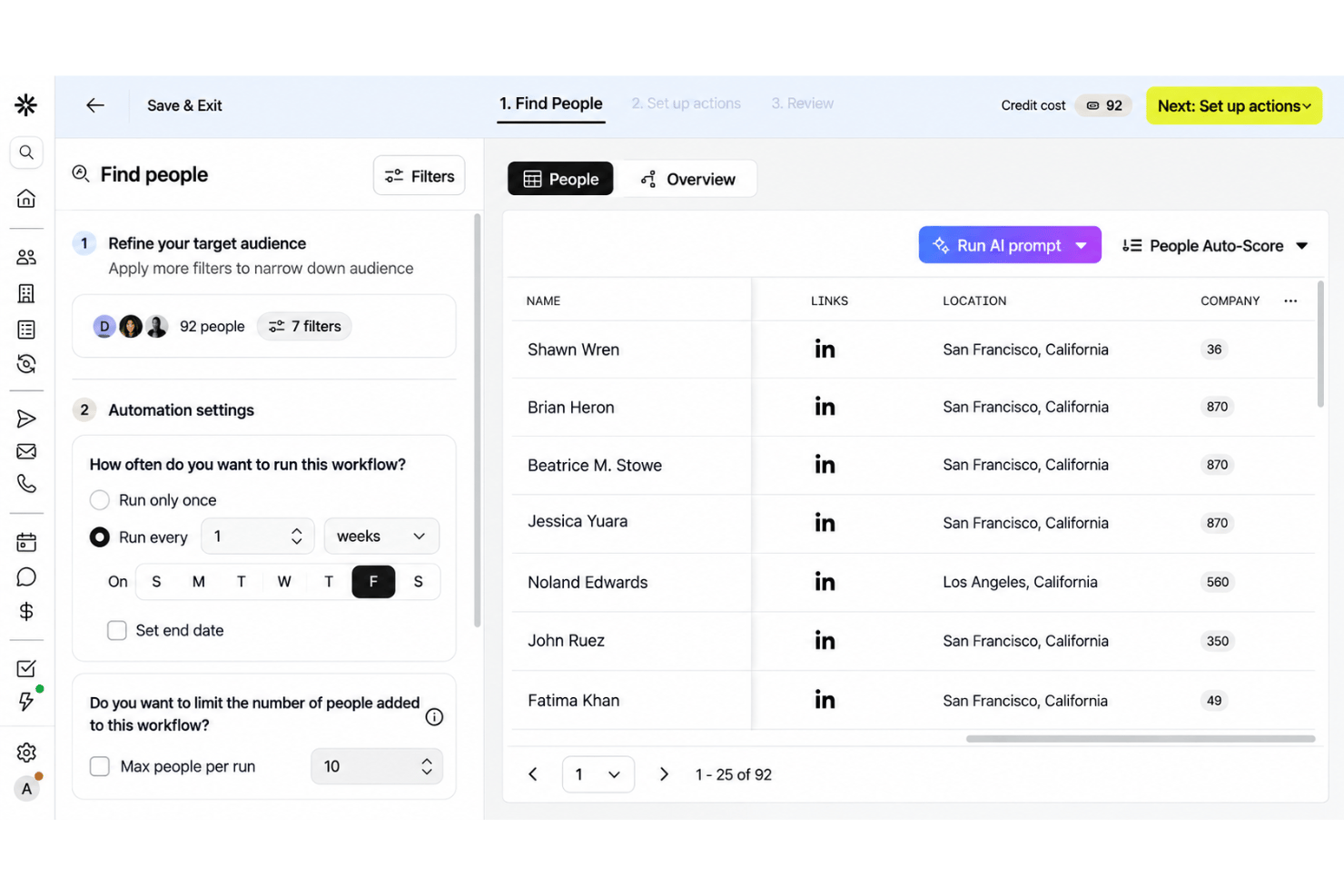
Create automated workflows for prospecting, enrichment, routing, and outreach based on predefined triggers and conditions. This can reduce repetitive list building and data-management work while keeping sales processes more consistent.
Standout Features
AI Assistant
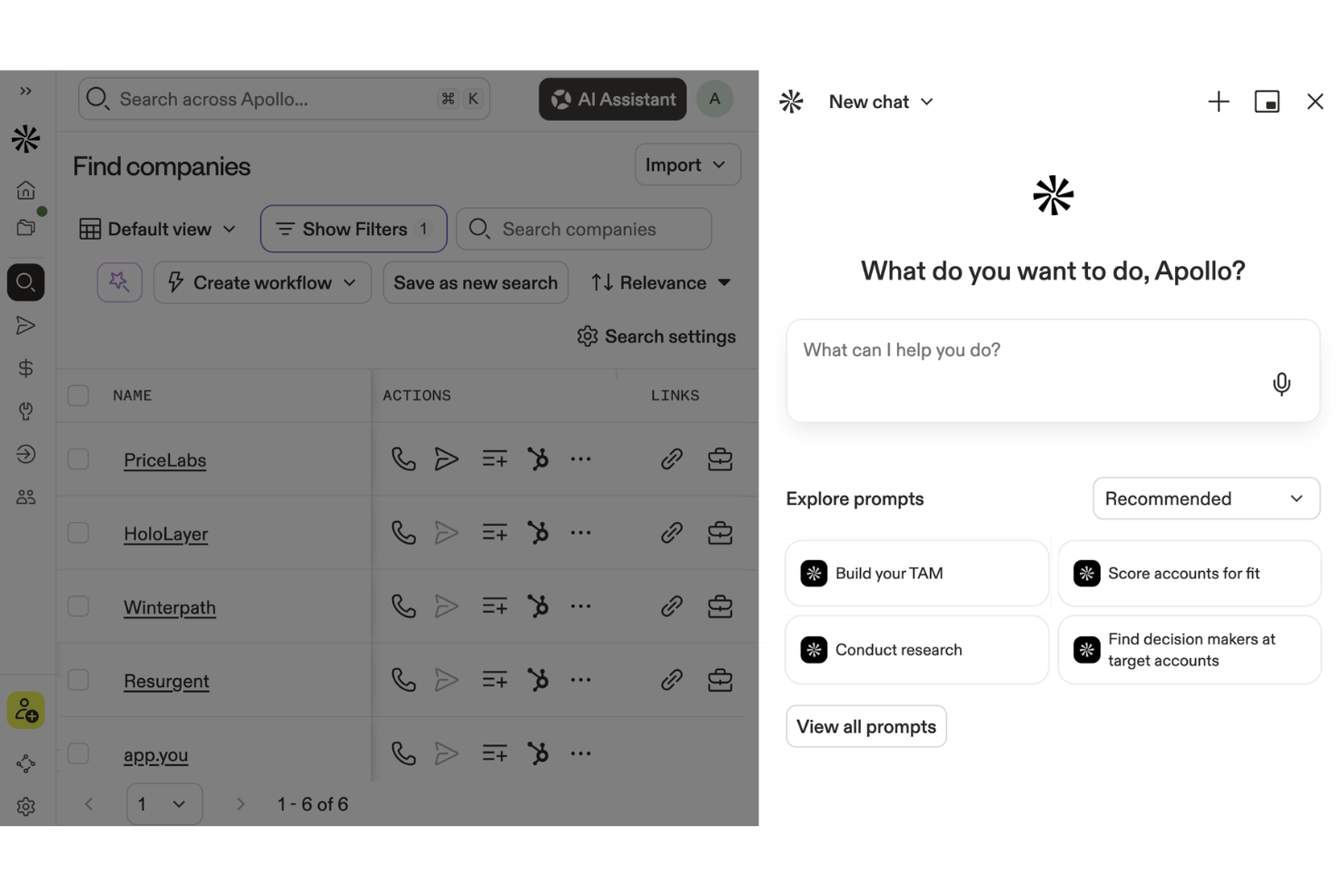
Apollo’s AI Assistant helps users research prospects, build lists, enrich records, and support outreach using natural-language prompts. Because it works across Apollo’s data and sales execution tools, teams can use AI for more than generating email copy or summarizing information.
Apollo MCP
Apollo MCP connects Apollo’s sales data and actions with AI tools such as Claude, ChatGPT, and Perplexity. Teams can search for prospects, enrich records, and initiate GTM workflows from within their existing AI assistants, making Apollo’s data accessible beyond the core platform.
Ease of Use
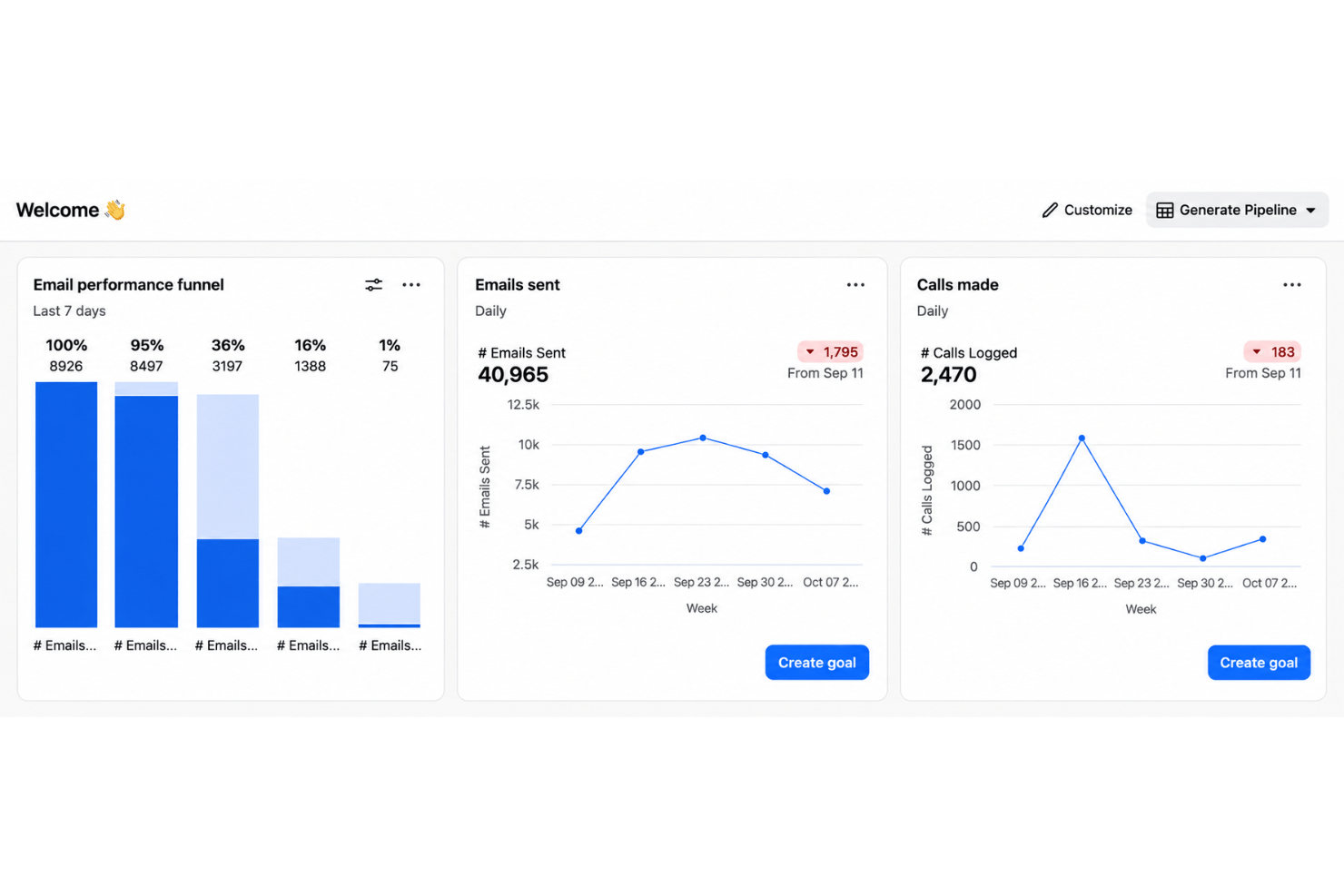
Apollo is relatively easy to get started with for basic prospecting, enrichment, and outreach. Its interface brings a wide range of tools together, which is convenient but can also feel busy at first. Core workflows are straightforward, while advanced automation, enrichment, and reporting take more time to learn. Overall, Apollo balances broad functionality with a manageable learning curve for most sales teams.
Onboarding
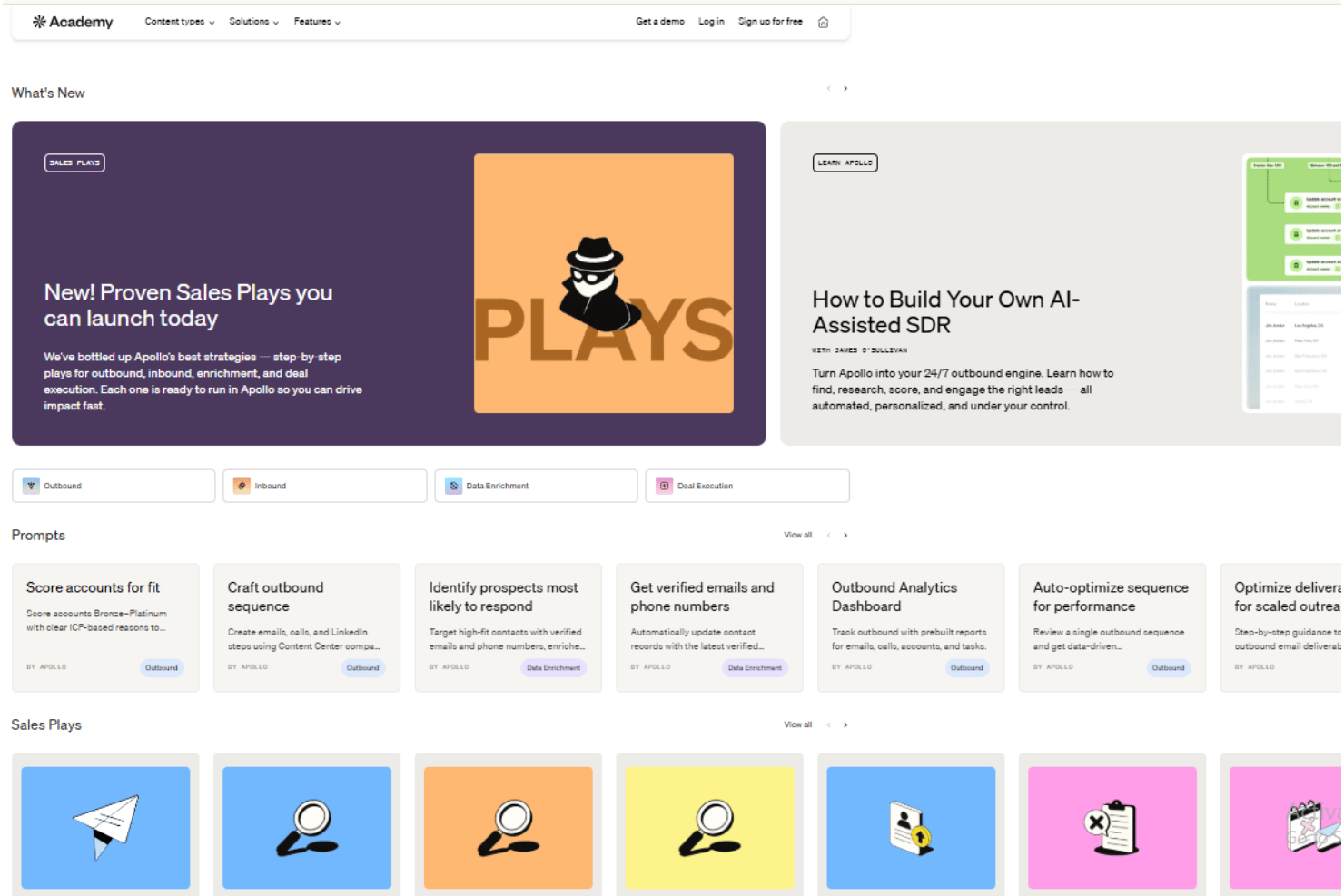
Apollo offers self-serve setup for free and entry-level users, with guided in-app steps, Apollo Academy, and documentation to help teams get started. Paid customers receive structured onboarding with a dedicated Onboarding Manager, while larger implementations can include CRM mapping, data migration, deliverability setup, workflow configuration, admin training, and a formal go-live process. More complex deployments can also use Professional Services.
Customer Support
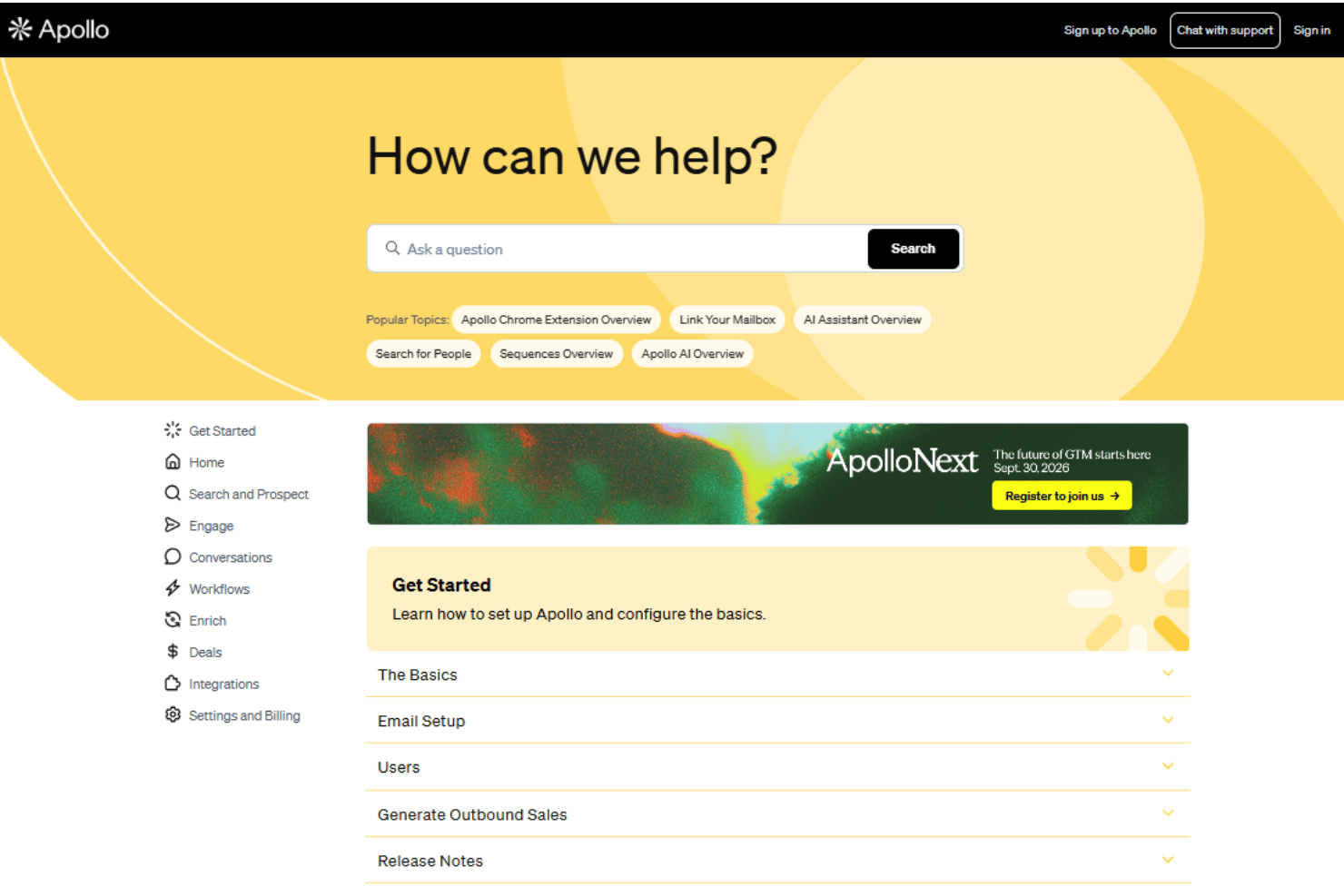
After onboarding, customers can access Apollo’s support team, knowledge base, Apollo Academy, in-app AI Assistant, and certified partner network for ongoing help. Larger accounts may also receive a GTM Engineer and Account Manager to assist with technical questions, workflow design, and continued platform adoption.
Integrations
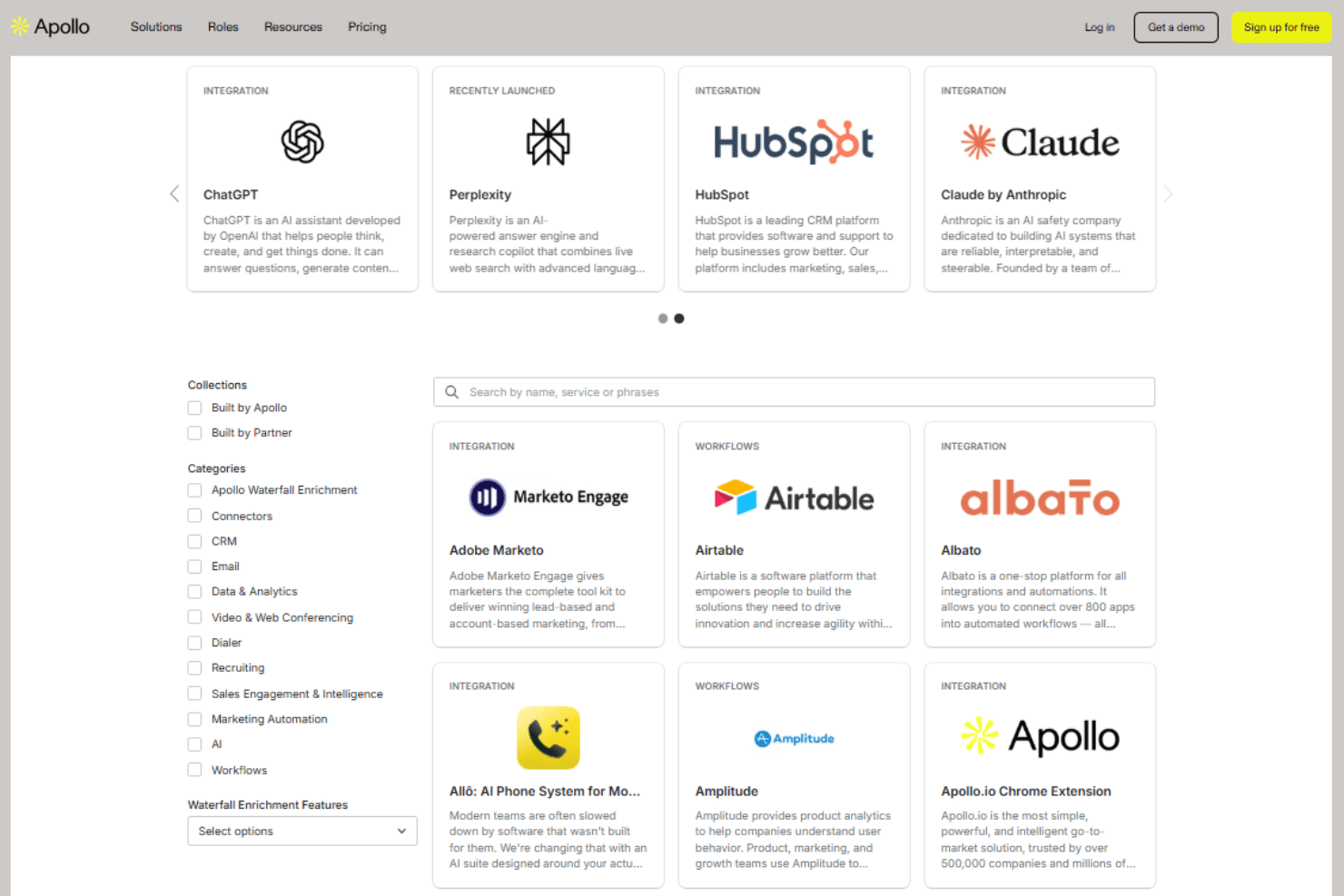
Apollo integrates with Salesforce, HubSpot, Outreach, LinkedIn via its Chrome extension, Claude, ChatGPT, Adobe Marketo, Salesloft, Slack, and Zapier, among others.
Apollo also offers an API and connects with third-party integration tools like Zapier for additional workflow automations.
Value for Money
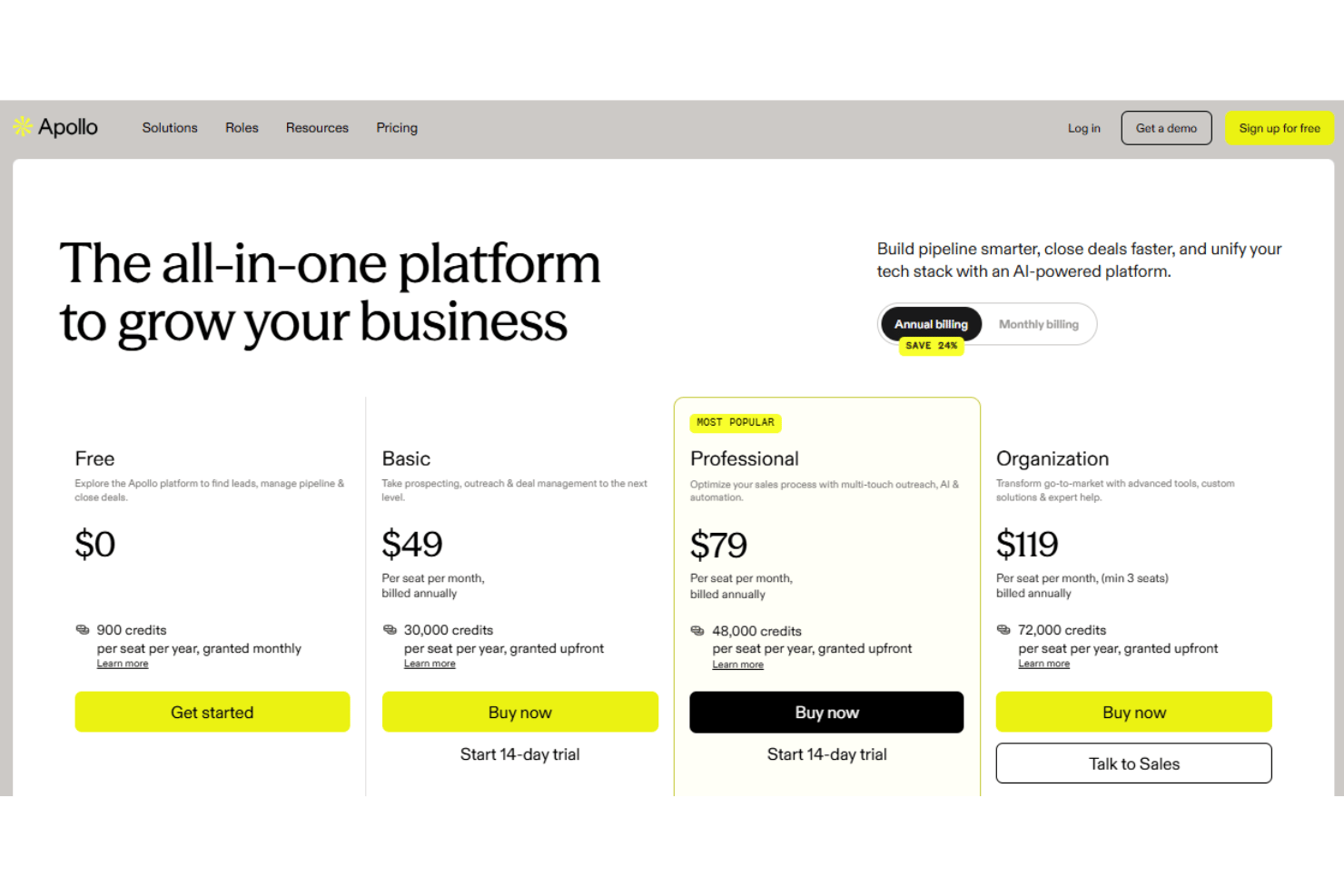
Apollo offers strong value for teams that want sales intelligence, enrichment, outreach, and AI capabilities without maintaining several separate tools. I think the breadth of features makes the higher tiers worthwhile for teams with more complex sales workflows, though Apollo’s credit-based usage model can make overall costs harder to predict as prospecting, enrichment, and AI activity increases.
- Free: Includes basic prospecting, contact and account data, limited sequences, CRM enrichment, AI Assistant access, and basic intent data.
- Basic: Adds unlimited sequences, advanced filters, waterfall enrichment, CRM integrations, deliverability tools, automated workflows, and expanded intent data.
- Professional: Adds A/Z testing, agentic workflows, expanded automation, advanced analytics, AI call insights, unlimited meeting events, and expanded email, mailbox, and call-recording capabilities.
- Organization: Adds customizable reporting, advanced security controls, SSO, more intent topics, higher workflow limits, and additional support for larger or more complex teams.
Apollo.io Specs
- API
- Approval Workflows
- Contact Management
- Conversion Tracking
- CRM Integration
- Custom Reports
- Dashboard
- Data Export
- Data Import
- Data Visualization
- Document Management
- Email Integration
- Employee Training
- External Integrations
- Forecasting
- Google Apps Integration
- Guided Selling
- Lead Management
- Lead Scoring
- Marketing Automation
- Multi-User
- Notifications
- Performance Reviews
- Pipeline Management
- Project Management
- Sales Automation
- Sales Motivator
- Sales Proposals
- Workflow Management
Apollo.io FAQs
Is Apollo just a B2B contact database?
Does Apollo integrate with Salesforce and HubSpot?
What types of prospecting data does Apollo provide?
How does Apollo handle data security and compliance?
Is there a free version of Apollo?
How quickly can teams get started with Apollo?
What customer support does Apollo offer?
Is Apollo a replacement for a CRM?
Who is Apollo a bad fit for?
Apollo.io Company Overview & History
Apollo is a B2B sales intelligence and AI go-to-market platform founded in 2015 and based in San Francisco, California. Founded by Tim Zheng and Ray Li, the company began with prospecting and sales intelligence tools before expanding into data enrichment, sales engagement, workflow automation, conversation intelligence, and AI-powered GTM execution. Today, Apollo serves millions of users across more than 600,000 companies and positions itself as an AI GTM system that combines data, intelligence, and execution.
Apollo Major Milestones
- 2015: Apollo was founded in San Francisco, California, initially launching as ZenProspect.
- 2016: Released its first product and participated in Y Combinator’s Winter 2016 batch.
- 2018: Rebranded from ZenProspect to Apollo and raised its Series A funding.
- 2022: Raised $110 million in Series C funding led by Sequoia Capital.
- 2023: Raised $100 million in Series D funding at a $1.6 billion valuation, achieving unicorn status.
- 2026: Expanded its positioning around an AI-native GTM system, including AI Assistant and agentic sales workflows.