

Intuit Enterprise Suite vs. Sage Intacct: Comparison and Reviews for 2026
Intuit Enterprise Suite and Sage Intacct both support revenue management through financial reporting, forecasting, cash flow visibility, and operational controls. Learn how their features, pricing, strengths, and tradeoffs compare in 2026.

We review tools independently, and commissions help fund our testing. See our transparency policy, our methodology, or suggest a tool.
When revenue data lives across separate finance, payment, and reporting tools, even simple questions can take too long to answer. Teams need a clearer way to track performance, forecast cash flow, and understand what’s driving revenue as the business grows.
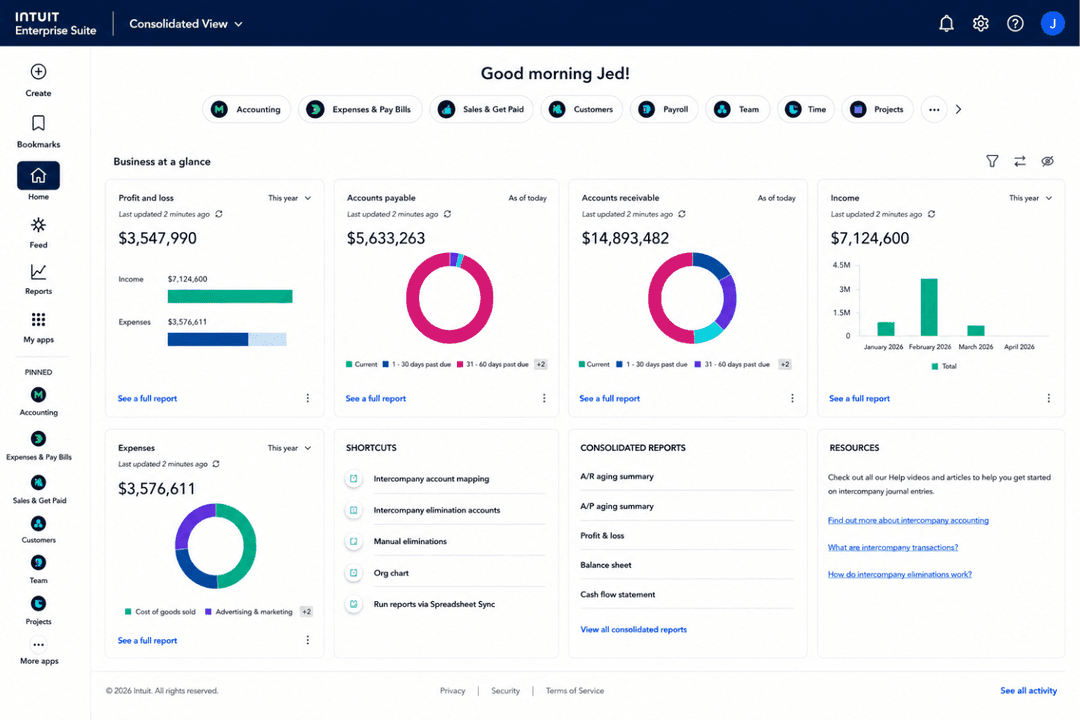
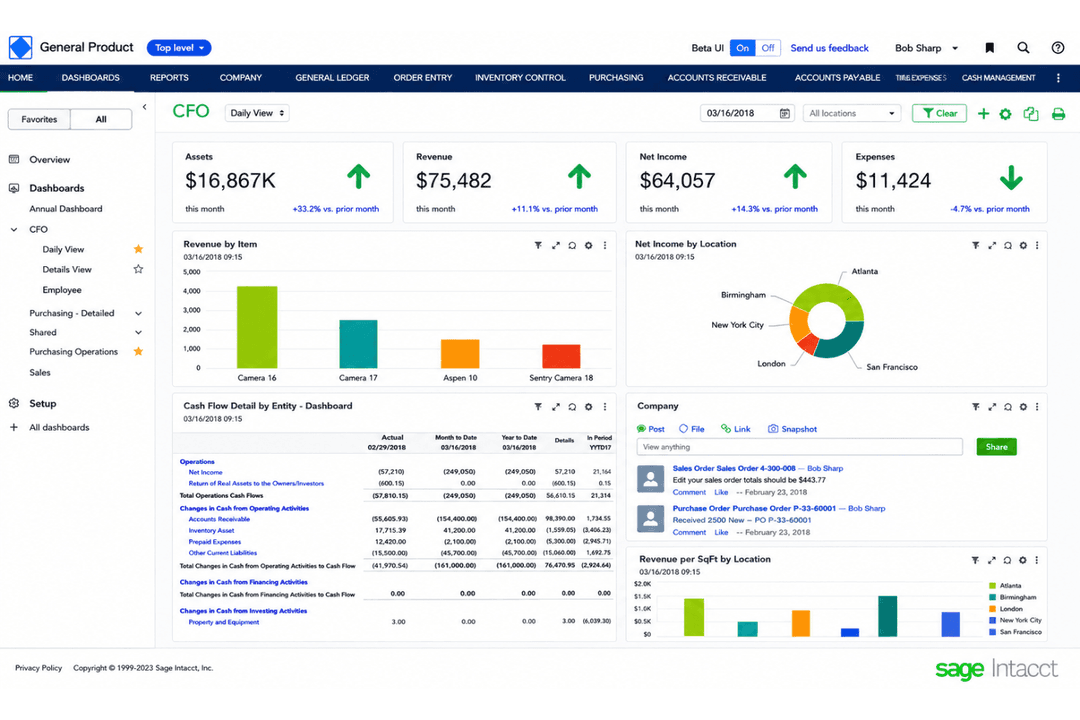
Intuit Enterprise Suite and Sage Intacct are both revenue management systems that help growing organizations improve financial visibility and control. Intuit Enterprise Suite focuses on revenue visibility, cash flow, payments, forecasting, and connected financial operations through the Intuit ecosystem, while Sage Intacct is more finance-focused with strong reporting, consolidations, dimensional accounting, and financial controls.
In this comparison, I’ll break down their features, pricing, pros and cons, security, ease of use, and ideal use cases to help you decide which platform fits your business best.
Intuit Enterprise Suite
4.6/5
- Free demo available
- Pricing upon request
Sage Intacct
4.3/5
- Free demo available
- From £1,200/month
Why Trust Our Software Recommendations
6,700+
Reviews
20
Industry experts
16+
Evaluation factors
14
Years
Our reviews reflect our independent judgment—not a sales pitch. Learn how we stay transparent.
For this guide, we evaluated tools using hands-on testing and independent research, scoring tools using our selection criteria.
Our reviews reflect our human editorial judgment, not a sales pitch.
| Intuit Enterprise Suite | Sage Intacct | |
|---|---|---|
| Free Trial | Free demo available | Free demo available |
| Pricing | Pricing upon request | From £1,200/month |
Intuit Enterprise Suite vs. Sage Intacct Pricing & Hidden Costs
Intuit Enterprise Suite and Sage Intacct both use custom pricing, so you’ll need to contact each vendor for a quote. Intuit Enterprise Suite uses flexible, contract-based pricing based on users, entities, selected capabilities, add-ons, integrations, and implementation needs. Sage Intacct pricing is also tailored, with costs shaped by users, modules, entities, and required functionality.
For hidden costs, both platforms may require added budget for implementation, data migration, training, integrations, workflow setup, support upgrades, and ongoing admin work. Sage Intacct costs can rise with added modules or finance complexity, while Intuit Enterprise Suite costs depend on the revenue, reporting, and operational needs the organization has to support. Ask both vendors for a full cost breakdown beyond the base subscription.
| Intuit Enterprise Suite | Sage Intacct | |
|---|---|---|
| Accounts Payable | Yes | Yes |
| Accounts Receivable | Yes | Yes |
| API | Yes | Yes |
| Budgeting | Yes | Yes |
| Calendar Management | No | No |
| Customer Management | No | Yes |
| Dashboard | Yes | Yes |
| Data Export | Yes | Yes |
| Data Import | Yes | Yes |
| Data Visualization | Yes | Yes |
| Expense Tracking | Yes | Yes |
| External Integrations | Yes | Yes |
| Forecasting | Yes | Yes |
| General Account Ledger | Yes | Yes |
| Inventory Tracking | Yes | Yes |
| Multi-User | Yes | Yes |
| Notifications | Yes | Yes |
| Payroll | Yes | Yes |
| Supplier Management | Yes | Yes |
| Tax Management | Yes | Yes |
| Integration | Intuit Enterprise Suite | Sage Intacct |
|---|---|---|
| IntegrationShopify | Intuit Enterprise Suite✅ | Sage Intacct ✅ |
| IntegrationSalesforce | Intuit Enterprise Suite✅ | Sage Intacct ✅ |
| IntegrationPayPal | Intuit Enterprise Suite✅ | Sage Intacct ✅ |
| IntegrationStripe | Intuit Enterprise Suite✅ | Sage Intacct ✅* |
| IntegrationDocuSign | Intuit Enterprise Suite✅ | Sage Intacct ✅* |
| IntegrationSquare | Intuit Enterprise Suite✅ | Sage Intacct ✅ |
| IntegrationAmazon Marketplace | Intuit Enterprise Suite✅ | Sage Intacct ✅* |
| IntegrationHubSpot | Intuit Enterprise Suite✅ | Sage Intacct ✅ |
| IntegrationKnowify | Intuit Enterprise Suite✅ | Sage Intacct ❌ |
| IntegrationWix | Intuit Enterprise Suite✅ | Sage Intacct ✅* |
| IntegrationAPI | Intuit Enterprise Suite✅ | Sage Intacct ✅ |
| IntegrationZapier | Intuit Enterprise Suite❌ | Sage Intacct ✅ |
*Available through a third-party connector, Sage Intacct Marketplace partner, API, or Zapier integration.
Together, Intuit Enterprise Suite and Sage Intacct cover a strong range of integrations across ecommerce, payments, CRM, finance, and revenue workflows. Intuit Enterprise Suite is more centered on direct app connections and the broader Intuit ecosystem, while Sage Intacct supports many connections through marketplace partners, third-party connectors, APIs, or Zapier. Overall, Intuit Enterprise Suite is the better fit for teams that want revenue, payment, and customer data connected with less setup, while Sage Intacct gives finance-led teams more flexible integration paths.
| Factor | Intuit Enterprise Suite | Sage Intacct |
|---|---|---|
| FactorData Encryption | Intuit Enterprise SuiteEncrypts data in transit and at rest to protect revenue, financial, payroll, and operational data. | Sage Intacct Uses encryption for data in transit and at rest to protect financial and business data. |
| FactorRegulatory Compliance | Intuit Enterprise SuiteSupports SOC reports, ISO 27001-certified practices, PCI DSS for applicable payment services, and VPAT documentation. | Sage Intacct Supports compliance frameworks for financial and regulated business environments. |
| FactorUser Access | Intuit Enterprise SuiteIncludes role-based access controls to limit access to sensitive revenue and financial data. | Sage Intacct Provides access controls, authentication, security logging, and MFA for critical systems. |
| FactorAudit & Activity Tracking | Intuit Enterprise SuiteSupports audit needs through permissions, financial controls, transaction visibility, and reporting oversight. | Sage Intacct Provides audit trails, security logging, and compliance-focused controls. |
| FactorUptime & Availability | Intuit Enterprise SuiteOffers enterprise security resources, though a specific IES uptime SLA is not publicly listed. | Sage Intacct Publishes availability and recovery details for covered services. |
Intuit Enterprise Suite covers the core controls growing teams need, including encryption, role-based access, SOC reports, ISO 27001-certified practices, and PCI DSS for applicable payment services. It also supports audit needs through permissions, transaction visibility, and financial controls. Sage Intacct offers additional compliance documentation, but Intuit Enterprise Suite gives revenue teams strong security coverage for managing financial workflows, reporting, payments, and operational data.
| Factor | Intuit Enterprise Suite | Sage Intacct |
|---|---|---|
| FactorUser Interface | Intuit Enterprise SuiteModern Intuit-style experience that feels familiar for teams used to QuickBooks and financial dashboards. | Sage Intacct Finance-focused workspace built around reporting, dashboards, dimensions, and controls. |
| FactorOnboarding | Intuit Enterprise SuiteGuided implementation with a dedicated customer success manager, migration help, training, reporting setup, and system connections. | Sage Intacct Offers implementation and training resources, with setup often centered on finance structures, dimensions, and reporting needs. |
| FactorLearning Curve | Intuit Enterprise SuiteEasier for Intuit-familiar teams, though revenue reporting and entity setup still need planning. | Sage Intacct May require more finance training due to dimensional accounting, consolidations, and reporting configuration. |
| FactorDay-to-Day Tasks | Intuit Enterprise SuiteHelps teams manage revenue visibility, cash flow, payments, reporting, approvals, and finance workflows with a more manageable setup. | Sage Intacct Strong for finance-led reporting, AP/AR, budgeting, consolidations, and audit-focused workflows. |
| FactorCustomization | Intuit Enterprise SuiteSupports configurable workflows, reports, permissions, integrations, and business processes without a heavy ERP build. | Sage Intacct Supports customizable dashboards, reports, dimensions, and roles, though setup may take more finance admin work. |
From an ease-of-use perspective, Intuit Enterprise Suite is more approachable for teams that want revenue visibility, cash flow tracking, payments, reporting, and finance workflows without a heavy setup. Its guided onboarding, dedicated customer success support, and Intuit-style experience make it easier for growing teams to adopt. Sage Intacct is also usable, but its finance-focused structure may require more training and configuration for teams managing dimensions, consolidations, and advanced reporting.
Intuit Enterprise Suite
- Connects revenue, cash flow, payments, and financial data for clearer visibility.
- Supports AI-powered reporting, forecasting, and insights for teams managing revenue performance.
- Helps manage multi-entity financial operations as the business grows.
- Setup requires planning around entities, reporting, workflows, and integrations.
- May be more than smaller teams need if they only want basic revenue tracking.
- Not a dedicated revenue tool, so advanced revenue recognition or subscription billing may require add-ons.
Sage Intacct
- Handles multi-entity consolidations with strong audit trails
- Automates ASC 606 revenue recognition requirements
- Offers highly customizable financial reporting and dashboards
- Advanced configuration often requires consulting or IT support
- Some users report slow response times in customer support
- UI can feel dated compared to modern finance platforms
Intuit Enterprise Suite
- Multi-Entity OrganizationsManage revenue and financial performance across multiple legal entities while consolidating reporting from one system.
- Professional Services FirmsTrack project revenue, manage financial performance, and improve visibility across teams and client work.
- Technology & SaaS CompaniesSupport growing revenue operations with AI-powered reporting, forecasting, and financial controls.
- Construction & Project-Based BusinessesManage project accounting, budgets, and revenue-related reporting for project-driven work.
- Manufacturing, Wholesale & DistributionMonitor revenue and financial performance across products, locations, and business units.
- Growing Mid-Market BusinessesUse enterprise-level financial management and reporting without taking on the full complexity of a traditional ERP.
Sage Intacct
- SaaS CompaniesHandles complex subscription billing, MRR/ARR reporting, and revenue recognition under ASC 606.
- Multi-Entity EnterprisesAutomates consolidations and supports intercompany transactions across locations or subsidiaries.
- Healthcare OrganizationsManages grants, multi-site operations, and regulatory compliance for healthcare accounting teams.
- Financial Services FirmsSupports detailed audit trails and robust controls for risk-sensitive, regulated environments.
- NonprofitsTracks restricted funds, grant revenue, and program-specific reporting with industry templates.
- Accounting ManagersProvides granular controls, custom dashboards, and real-time audit-ready data for proactive management.
Who Should Use Intuit Enterprise Suite, and Who Should Use Sage Intacct?
Intuit Enterprise Suite is a strong fit for growing and mid-market businesses that need clearer revenue visibility, cash flow tracking, payments, forecasting, and financial reporting without a heavy ERP setup. It works especially well for teams already using the Intuit ecosystem that want connected revenue and finance workflows, multi-entity reporting, AI-powered insights, and guided implementation.
Sage Intacct, on the other hand, may fit finance-led teams that need deeper accounting structure, consolidations, dimensional reporting, budgeting, and audit-focused controls. Overall, Intuit Enterprise Suite is better for teams that want a more manageable path to revenue and financial visibility, while Sage Intacct is better suited for organizations with more complex finance and reporting requirements.
| Intuit Enterprise Suite | Sage Intacct | |
|---|---|---|
| AI Focus | Intuit Enterprise Suite Uses Intuit AI Agents to support insights, workflow assistance, data cleanup, and financial operations. | Sage Intacct Uses AI more for finance-specific tasks like outlier detection, anomaly review, and accounting insights. |
| Ecosystem Fit | Intuit Enterprise Suite Built around Intuit tools for finance, payroll, payments, workforce management, marketing, and supported apps. | Sage Intacct Built around Sage’s finance ecosystem, with marketplace partners and accounting-focused integrations. |
| Implementation Approach | Intuit Enterprise Suite Uses guided onboarding with a dedicated customer success manager, migration help, training, and reporting setup. | Sage Intacct Often requires more finance-led setup around dimensions, consolidations, controls, and reporting structures. |
| Native Money Services | Intuit Enterprise Suite Includes payment processing, bill pay, and access to business lending through the Intuit ecosystem. | Sage Intacct Supports finance workflows, but some money movement capabilities may depend on partners or add-ons. |
| Product Orientation | Intuit Enterprise Suite Broader business management platform used for revenue visibility, cash flow, payments, forecasting, and financial operations. | Sage Intacct Accounting and financial management platform focused on finance structure, controls, reporting, and consolidations. |
| Audit & Compliance Support | Both support audit needs through financial controls, transaction visibility, permissions, and reporting oversight. |
|---|---|
| Cloud-Based Access | Both are cloud-based systems that help teams manage financial and revenue-related data online. |
| Multi-Entity Support | Both help organizations manage financial data across multiple entities, locations, or business units. |
| Reporting & Performance Tracking | Both help teams track financial performance, revenue trends, budgets, and business health through reports and dashboards. |
| User Permissions | Both include roles and permissions to help protect sensitive financial and revenue data. |