

Har du problemer med å holde tritt med de stadig skiftende markedsprisene? Du er ikke alene. Som produktansvarlig står du overfor utfordringen med å sette riktig pris for å holde deg konkurransedyktig, samtidig som du maksimerer fortjenesten. Programvare for dynamisk prissetting kan være løsningen, siden den tilpasser prisene basert på markedets etterspørsel og konkurrentenes handlinger.
Gjennom min erfaring med å teste og vurdere programvare har jeg funnet ut at disse verktøyene ikke bare sparer tid, men også forbedrer beslutningstakingen. Denne artikkelen gir deg en oversikt over mine beste anbefalinger, med objektiv og grundig undersøkt innsikt.
Du vil oppdage hvordan hver programvare kan tilpasses teamets behov og bidra til å løse utfordringer knyttet til prissetting. La oss se nærmere på de beste løsningene for dynamisk prissetting som er tilgjengelige i dag.
Why Trust Our Software Recommendations
6,700+
Reviews
20
Industry experts
16+
Evaluation factors
14
Years
Our reviews reflect our independent judgment—not a sales pitch. Learn how we stay transparent.
For this guide, we evaluated tools using hands-on testing and independent research, scoring tools using our selection criteria.
Our reviews reflect our human editorial judgment, not a sales pitch.
Sammenligningstabell for programvare for dynamisk prissetting
Denne sammenligningstabellen oppsummerer prisdetaljene for mine beste utvalgte programmer for dynamisk prissetting:
| Tool | Best For | Trial Info | Price | ||
|---|---|---|---|---|---|
| 1 | Best for omni-channel price alignment | No free trial available | Pricing upon request | Website | |
| 2 | Best with automated multibuy pricing rules | Free demo available | Pricing upon request | Website | |
| 3 | Best for retail pricing decisions with AI | Free plan + free demo | From €349/month | Website | |
| 4 | Best for price tracking for small retailers | 14-day free trial | From $99/month | Website | |
| 5 | Best for global price intelligence data | Free demo available | Pricing upon request | Website | |
| 6 | Best for vacation rental pricing | Free demo + 30-day free trial available | From $14.49/month | Website | |
| 7 | Best for Amazon seller pricing and ads | 14-day free trial | Pricing upon request | Website | |
| 8 | Best for airline revenue optimization | Free demo available | Pricing upon request | Website | |
| 9 | Best for automated hotel room pricing | Free demo + 14-day free trial available | From $148.50/property/month (billed annually) | Website | |
| 10 | Best for cost-to-serve industrial pricing | Free demo available | Pricing upon request | Website |


Anmeldelser av den beste programvaren for dynamisk prissetting
Nedenfor finner du mine detaljerte sammendrag av den beste programvaren for dynamisk prissetting som kom med på kortlisten. Anmeldelsene mine gir en detaljert gjennomgang av de viktigste funksjonene, fordelene og ulempene, integrasjonene og de ideelle bruksområdene for hvert verktøy, slik at du kan finne det som passer best for deg.
 Best for omni-channel price alignment
- No free trial available
- Pricing upon request
Visit WebsiteCustomer Rating:4.7/5
Quicklizard helps you eliminate price discrepancies between physical stores and digital storefronts Quicklizard is a dynamic pricing platform designed for retailers and brands managing complex pricing across multiple channels. It’s built for teams that need to react quickly to market changes and maintain pricing consistency at scale. If you’re looking to automate pricing decisions while keeping control over strategy and compliance, Quicklizard offers the flexibility and intelligence to support your goals.
Who Is Quicklizard Best For?
Quicklizard is a strong choice for retail and ecommerce teams in mid-sized to large organizations that need to manage and optimize pricing across multiple sales channels.
Why I Picked Quicklizard
For teams that need to keep pricing consistent across every sales channel, Quicklizard stands out for its omni-channel price alignment capabilities. I picked Quicklizard because it lets you synchronize pricing in real time across online stores, physical locations, and marketplaces, reducing the risk of price conflicts or customer confusion. The platform’s centralized pricing engine and automated update workflows ensure that any change you make is reflected everywhere you sell. This level of control is especially valuable for businesses managing complex product catalogs and multiple points of sale.
Quicklizard Key Features
Some other features that make Quicklizard a strong option for dynamic pricing management include:
- AI-driven price recommendations: The platform uses machine learning algorithms to suggest optimal prices based on real-time market and competitor data.
- Price elasticity modeling: Quicklizard analyzes historical sales and demand data to help you understand how price changes impact revenue and volume.
- Customizable pricing rules: You can set detailed rules and guardrails to ensure pricing stays within your business and compliance requirements.
- Automated competitor monitoring: The tool tracks competitor prices and market trends, allowing you to respond quickly to changes in your competitive landscape.
Quicklizard Integrations
Integrations include SAP, Oracle, Magento, Salesforce Commerce Cloud, Shopify, Kafka, Delavo, DataWeave, TGN, and Bright Data.
Pros and Cons
Pros:
- Supports both manual and automated pricing
- Real-time price updates across all channels
- Highly configurable rule-based pricing engine
Cons:
- Reporting features could be more customizable
- No free plan or public trial available
Learn more about Quicklizard: Best with automated multibuy pricing rules
- Free demo available
- Pricing upon request
Visit WebsiteCustomer Rating:4.6/5
Yieldigo Promo Planner with AI-powered discount optimization and margin insights. Yieldigo offers AI-driven dynamic pricing software designed for retailers and consumer goods companies looking to optimize complex pricing strategies. The platform helps pricing teams manage large product assortments, adapt to market changes, and automate pricing decisions. If your business needs to balance profitability, competitiveness, and operational efficiency, Yieldigo provides the tools to support data-driven pricing.
Who Is Yieldigo Best For?
Yieldigo is a good fit for retail pricing managers and commercial teams in medium to large retail and consumer goods companies seeking advanced, data-driven pricing optimization.
Why I Picked Yieldigo
For teams focused on optimizing promotions and complex discount structures, I picked Yieldigo because of its automated multibuy pricing rules. The platform allows you to set up and manage rules for multibuy offers, such as “buy two, get one free” or tiered discounts, directly within its pricing engine. Yieldigo’s AI-driven system automatically applies these rules across large product assortments, ensuring consistency and compliance with your pricing strategy. This makes it much easier to execute and monitor promotional campaigns without manual intervention.
Yieldigo Key Features
Some other features that make Yieldigo a strong choice for dynamic pricing include:
- AI-powered price optimization: The platform uses machine learning algorithms to recommend optimal prices based on demand, competition, and business goals.
- Scenario simulation: You can model and compare the impact of different pricing strategies before deploying them live.
- Real-time price updates: Yieldigo enables instant price changes across channels, ensuring your pricing stays current with market shifts.
- Flexible price zone management: The system supports creating and managing multiple pricing zones to tailor prices by region, store, or customer segment.
Yieldigo Integrations
Yieldigo connects to your ERP, POS, or data warehouse systems via secure SFTP transfers or APIs. An API is available for custom integrations. Native integrations are not currently listed.
Pros and Cons
Pros:
- Offers AI-driven price recommendations
- Provides scenario simulation for pricing strategies
- Handles complex price zone segmentation
Cons:
- Focuses mainly on retail and omni-channel use cases
- May require IT support for initial setup
Learn more about Yieldigo: Best for retail pricing decisions with AI
- Free plan + free demo
- From €349/month
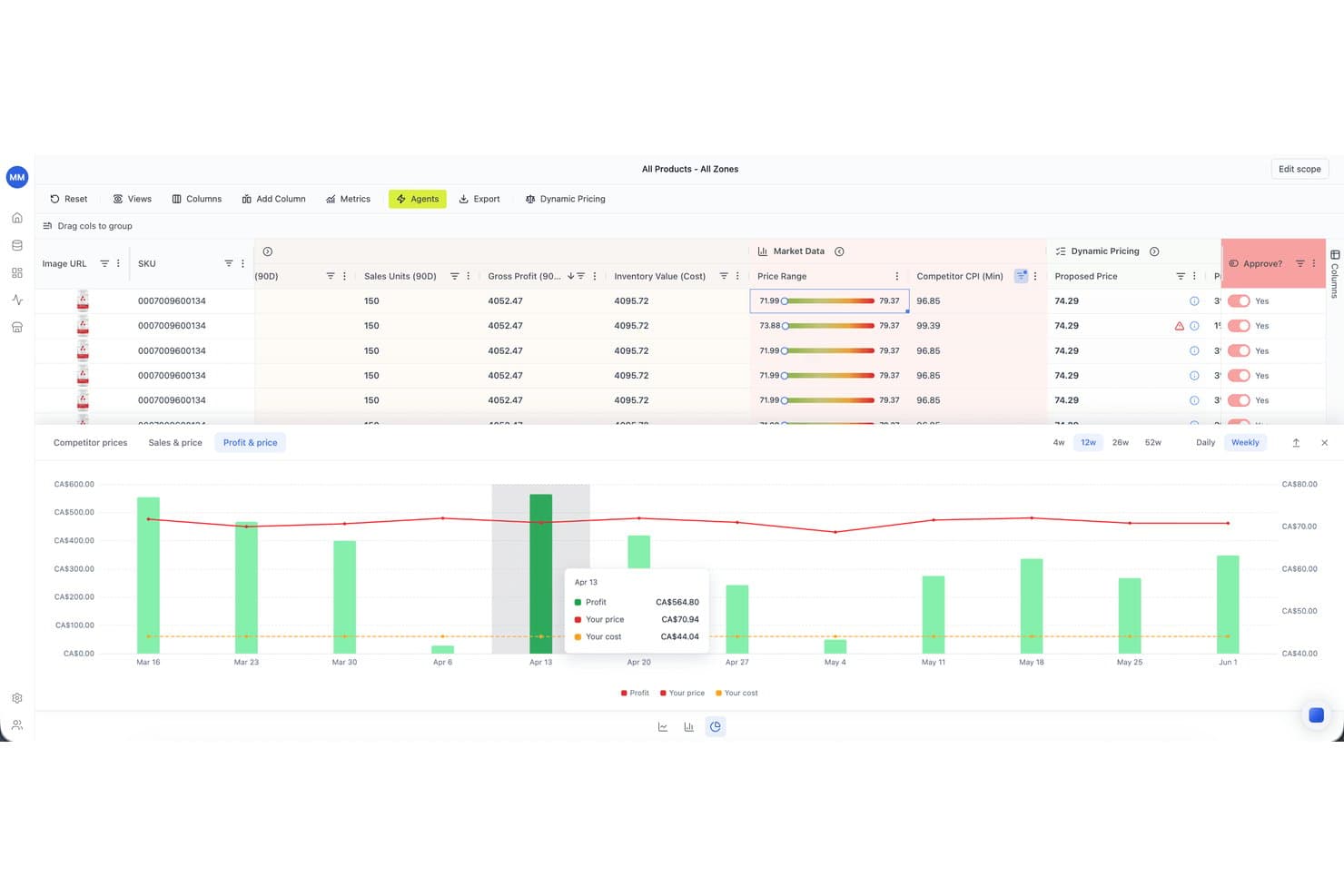
RetailGrid offers a dynamic pricing dashboard with competitor price tracking, proposed prices, profit charts, and one-click approval for automated repricing decisions. RetailGrid is a dynamic pricing platform for mid-market retailers that combines a rules-based pricing engine, AI-driven price optimization agents, competitor price monitoring, and elasticity modeling in a spreadsheet-style workspace.
Who Is RetailGrid Best For?
RetailGrid suits pricing teams at retail businesses generating between €10M and €500M in annual revenue who want to move beyond manual, spreadsheet-based pricing.
Why I Picked RetailGrid
RetailGrid earns its spot on my shortlist because of how it handles AI explainability in a way most pricing tools skip over entirely. Every price recommendation surfaces the exact rules applied, the math behind the output, and a margin impact preview before you commit. I also like the configurable autonomy model: you can set high-confidence SKUs to auto-apply while keeping sensitive categories in a human-review queue, with a full audit trail across both modes.
RetailGrid Key Features
- Agent-based pricing workflows: Modular AI agents handle rules-based pricing, elasticity analysis, and GMROI optimization.
- Competitor price monitoring layer: Tracks competitor prices across marketplaces and integrates directly into the pricing workspace.
- Spreadsheet-style data grid: Familiar interface for reviewing, filtering, and editing pricing recommendations by SKU.
- Direct ecommerce platform integrations: Built-in connections for Shopify, Magento, BigCommerce, WooCommerce, and ERP systems.
RetailGrid Integrations
RetailGrid offers native integrations with Shopify, Magento, BigCommerce, WooCommerce, Wix, and SAP Commerce Cloud, and provides an API for custom integrations.
Pros and Cons
Pros:
- Pricing audit trail with detailed rule history
- Supports region and channel-based zone pricing
- Explainable AI recommendations for every price change
Cons:
- Limited customer segment-based pricing models
- No deal desk or B2B quote workflows
Learn more about RetailGrid: Best for price tracking for small retailers
- 14-day free trial
- From $99/month
Visit WebsiteCustomer Rating:4.7/5
Prisync helps track competitor prices and automate dynamic pricing. Prisync is a competitor price tracking and dynamic pricing software designed for large and small e-commerce businesses. It helps you monitor competitor prices, automate pricing adjustments, and analyze price changes and stock availability.
Why I picked Prisync: It's tailored for small retailers who need efficient price management. Its standout feature is competitor price monitoring, which lets you stay competitive without constant manual input. Prisync also offers automated pricing adjustments, ensuring your prices are always optimized.
Standout features and integrations:
Features include a user-friendly dashboard, stock availability tracking, and flexible subscription plans for businesses of all sizes. The software provides detailed analytics on pricing trends, helping you make informed decisions. It also offers proactive customer support and a free onboarding service to maximize its benefits.
Integrations include Shopify, Google Shopping, Magento, WooCommerce, and more.
Pros and Cons
Pros:
- Responsive customer support team
- Daily competitor-price updates
- Intuitive price tracking interface
Cons:
- Responsive customer support team
- Time-intensive product setup
Learn more about Prisync: Best for global price intelligence data
- Free demo available
- Pricing upon request
Visit WebsiteCustomer Rating:4.5/5
Intelligence Node benchmarks competitors to guide pricing. Intelligence Node is a dynamic pricing and analytics platform for retailers and brands, focused on price optimization and competitive benchmarking. It helps businesses make informed pricing decisions to increase profitability and market positioning.
Why I picked Intelligence Node: It's tailored for price optimization and offers in-depth market insights. Real-time price tracking allows your team to stay competitive by adjusting prices quickly. The platform's competitive benchmarking provides a clear view of market trends and competitor strategies. With its data-driven approach, you can refine your pricing models for maximum effectiveness.
Standout features and integrations:
Features include a pricing audit tool that identifies gaps in pricing strategy. The software offers a personalized pricing engine to cater to specific customer segments. It also provides a visual merchandising tool to optimize product displays based on pricing data.
Integrations are not publicly listed.
Pros and Cons
Pros:
- High SKU data accuracy
- MAP monitoring included
- Ethical data scraping across global sites
Cons:
- No native inventory management features
- May drive aggressive pricing
Learn more about Intelligence Node: Best for vacation rental pricing
- Free demo + 30-day free trial available
- From $14.49/month
Visit WebsiteCustomer Rating:4.5/5
PriceLabs optimizes vacation rental pricing with automated revenue insights. PriceLabs is a dynamic pricing and revenue management tool tailored for vacation rentals, serving Airbnb hosts, Vrbo hosts, property managers, and hotels. It provides automated pricing, portfolio analytics, and market insights to maximize revenue potential.
Why I picked PriceLabs: It's specifically designed for vacation rentals, making it an ideal choice for your property management needs. The Hyper Local Pulse algorithm offers data-driven pricing that adapts to market changes. Customizable minimum stay recommendations help you optimize occupancy rates.
Standout features and integrations:
Features include the Listing Optimizer, which improves your Airbnb listing content for better visibility and bookings. The platform offers real-time reporting to track your property's performance. It also provides market dashboards for insights into local trends.
Integrations include Airbnb, Vrbo, Booking.com, Guesty, Hostfully, Escapia, Track, Streamline, Rentals United, and more.
Pros and Cons
Pros:
- Smart minimum stay length recommendations
- Strong channel manager integration
- Smart vacation pricing automation
Cons:
- Requires manual base price calibration
- Complex rule configuration
Learn more about PriceLabs: Best for Amazon seller pricing and ads
- 14-day free trial
- Pricing upon request
Visit WebsiteCustomer Rating:4.2/5
Feedvisor helps boost Amazon seller margins through pricing automation. Feedvisor is a dynamic pricing and intelligence platform tailored for Amazon sellers, focusing on price optimization and inventory management. It helps e-commerce businesses maximize profitability and improve their Amazon marketplace performance.
Why I picked Feedvisor: It's specifically designed for Amazon sellers, offering tools that optimize pricing and inventory. The repricer feature allows you to adjust prices in real time to stay competitive. The platform's inventory management feature ensures you maintain optimal stock levels.
Standout features and integrations:
Features include a revenue intelligence dashboard that provides a thorough view of your sales performance. The software offers advertising optimization tools to improve your Amazon ad campaigns. Additionally, it provides detailed analytics to help you understand customer behavior and market trends.
Integrations include Amazon Seller Central, Walmart Marketplace, Shopify, Amazon Advertising, Walmart Advertising, Google Ads, and more.
Pros and Cons
Pros:
- Strong analytics dashboards
- Automated Amazon Buy Box win optimization
- AI-powered Amazon repricing
Cons:
- Limited historical data import window
- Expensive for small sellers
Learn more about Feedvisor:

PROS helps manage airline pricing strategies to maximize revenue. PROS is a pricing and revenue management software tailored for the airline industry, focusing on dynamic pricing and sales optimization. It serves airlines by improving pricing strategies and overall revenue management.
Why I picked PROS: It's specifically designed for airlines, offering tailored solutions for complex pricing needs. The Revenue Management feature helps your team adjust prices in real time to maximize revenue. The software's dynamic pricing capabilities ensure you remain competitive in fluctuating markets. With its demand forecasting tools, you can better anticipate market trends and adjust strategies accordingly.
Standout features and integrations:
Features include a price optimization engine that tailors pricing strategies to market conditions. The software offers a sales effectiveness feature that improves sales performance through data insights. Additionally, it provides a customer segmentation tool to personalize pricing and promotions.
Integrations include SAP, Salesforce, Oracle, Microsoft Dynamics, Adobe, Enable, DocuSign, Google Flights, and more.
Pros and Cons
Pros:
- Enterprise optimization focus
- Aligns pricing with sales
- AI pricing guidance engine
Cons:
- Higher setup costs
- Longer implementation cycles
Learn more about PROS: Best for automated hotel room pricing
- Free demo + 14-day free trial available
- From $148.50/property/month (billed annually)

RoomPriceGenie adjusts room rates based on demand. RoomPriceGenie is a revenue management solution tailored for the hospitality industry, including hotels, bed and breakfasts, and serviced apartments. It focuses on real-time pricing optimization and automated room pricing to boost revenue.
Why I picked RoomPriceGenie: It's specifically crafted for the hospitality sector, offering tools to improve pricing strategies. The autopilot function lets your team make hands-off pricing adjustments. Real-time surge protection ensures you capitalize on demand spikes. The rate calendar provides a clear view of pricing trends and helps in planning.
Standout features and integrations:
Features include a group displacement calculator that helps evaluate group bookings against transient demand. The system offers detailed reporting and analytics to track performance. Additionally, its intuitive interface simplifies the management of pricing strategies.
Integrations include Mews, Cloudbeds, RoomRaccoon, Little Hotelier, RMS, Guestline, SiteMinder, Clock, and more.
Pros and Cons
Pros:
- Simple hospitality pricing focus
- Improves occupancy forecasting
- Automated hotel rate adjustments
Cons:
- Dependent on PMS integrations
- Limited for large portfolios
Learn more about RoomPriceGenie:

Zilliant helps elevate pricing accuracy for manufacturers. Zilliant is a pricing and sales optimization software designed for industrial sectors, helping businesses optimize their pricing strategies and improve sales effectiveness. It serves manufacturers, distributors, and service providers by offering data-driven pricing insights.
Why I picked Zilliant: It's tailored for industrial sectors, providing precise pricing strategies that align with business objectives. The Price IQ feature delivers dynamic pricing recommendations, ensuring competitive pricing. Margin IQ helps your team maintain healthy profit margins by providing actionable insights. The software's ability to integrate with existing systems makes it a versatile choice for large enterprises.
Standout features and integrations:
Features include a sales optimizer that identifies opportunities for cross-selling and upselling. The tool offers real-time pricing analytics to monitor market trends. Additionally, it provides customer-specific pricing, improving personalized sales strategies.
Integrations include SAP, Oracle, Salesforce, Conga, Enable, DataXstream, and more.
Pros and Cons
Pros:
- Integrates with sales systems
- Machine learning pricing guidance
- Scientific cost-plus markup optimization
Cons:
- Requires technical expertise
- Requires custom logic configuration work
Learn more about Zilliant:
Annen programvare for dynamisk prissetting
\u003cspan style=\u0022font-weight: 400\u0022\u003eHer er noen flere alternativer for programvare for dynamisk prissetting som ikke kom med på kortlisten min, men som likevel er verdt å se nærmere på:\u003c/span\u003e
- 11VendavoBest for B2B deal and contract pricing
- 12CompeteraBest for large-scale demand-based pricing
- 13PriceShapeBest for real-time competitive pricing
- 14RevionicsBest for grocery pricing and promotions
- 15Impact AnalyticsBest for AI-driven demand forecasting
- 16BlackCurveBest for margin-based retail pricing
- 17PricevaBest for competitor price scraping
- 18VistaarBest for beverage industry pricing
- 19Luxe PricingBest for luxury brand pricing
- 20SYMSONBest for demand-based price analytics
- 21SciativeBest for real-time AI-driven price adjustments
- 22Twenty5Best for small businesses
- 23TrellisBest for pricing insights from retail data
How I Evaluate Dynamic Pricing Software
I split my evaluation into baseline criteria—like real-time repricing and elasticity modeling—and differentiators that separate tools built for deal desks from those built for retail shelves.
Core Functionality (Table Stakes For This List)
When I'm selecting tools for my list, I rank each one on a scale from 0 (does not offer the functionality) to 5 (excels in this area) for each core functionality listed below. Then, I calculate the tool's total score into a percentage. Each tool needs to achieve a minimum total score of 65% to be considered for inclusion.
- Real-Time Price Adjustment: I check whether a platform can reprice automatically based on live triggers like demand spikes, inventory drops, or competitor moves—not just batch updates on a daily schedule.
- Rules-Based Pricing Engine: Each tool's rule builder matters here. I look for multi-condition logic that lets you set guardrails like floor prices, margin thresholds, and segment-specific caps.
- Competitor & Market Data Ingestion: I evaluate how well the platform pulls in external pricing signals, whether through native scrapers, marketplace feeds, or third-party data partnerships.
- Price Optimization Algorithms: The quality of a tool's ML or statistical models is key. I look for approaches that go beyond static rules to recommend price points tuned for margin, volume, or conversion goals.
- Segmentation & Elasticity Modeling: I consider how granularly each tool lets you differentiate pricing across customer tiers, product lines, or channels based on measured demand sensitivity.
- Scenario Simulation & Forecasting: Before any price change goes live, your team should be able to model the impact. I evaluate whether the tool supports multi-variable what-if scenarios with projected revenue or margin outcomes.
Once I have a list of tools that meet this criteria, I consider what sets each platform apart.
Differentiating Factors (What Sets Vendors Apart)
Here's how I compare and contrast different vendors:
Standout Features
Explainable AI matters here. When a model recommends a price increase on a renewal, your sales team needs to understand why. I look for outputs that surface elasticity data, win rates, and competitive positioning behind each recommendation. Revenue leakage detection is another differentiator—tools that flag patterns like systematic over-discounting on mid-market deals. I also evaluate deal desk workflow support, especially platforms that embed pricing guardrails directly into CPQ or quoting flows.
Beyond Features
Integration depth is where I start. A dynamic pricing tool is only useful if it connects to your CRM, CPQ, and billing systems—otherwise price recommendations sit in a silo. I also evaluate industry and business model fit. A platform tuned for SaaS subscription pricing works differently than one designed for ecommerce or hospitality. Time-to-value matters too. I look for vendors that offer pre-built pricing models or templates, since configuring elasticity models from scratch can stretch implementation well past the first quarter.
Slik velger du programvare for dynamisk prissetting
Det er lett å gå seg vill i lange funksjonslister og komplekse prisstrukturer. For å hjelpe deg med å holde fokus mens du går gjennom den unike prosessen med å velge programvare, har jeg laget en sjekkliste over faktorer du bør ha i mente:
| Faktor | Hva du bør vurdere |
|---|---|
| FaktorSkalerbarhet | Hva du bør vurdereKan programvaren vokse sammen med virksomheten din? Vurder om den kan håndtere økte datamengder og flere brukere uten redusert ytelse. Se etter løsninger som støtter den forventede veksten din. |
| FaktorIntegrasjoner | Hva du bør vurdereKan den integreres med systemene du allerede bruker? Sjekk om den er kompatibel med e-handelsplattformer, CRM-systemer og datakilder for å sikre en jevn dataflyt og redusere manuelt arbeid. |
| FaktorTilpasningsmuligheter | Hva du bør vurdereKan du tilpasse programvaren etter behovene dine? Vurder om verktøyet lar deg konfigurere prisregler og dashbord slik at de samsvarer med virksomhetens strategier og rapporteringskrav. |
| FaktorBrukervennlighet | Hva du bør vurdereHvor brukervennlig er grensesnittet? Et intuitivt verktøy kan spare tid og redusere behovet for opplæring. Vurder om team uten teknisk bakgrunn kan navigere i og bruke programvaren effektivt. |
| FaktorImplementering og innføring | Hva du bør vurdereEr oppsettet enkelt? Vurder hvilke ressurser som trengs for en smidig overgang. Se etter leverandører som tilbyr støtte ved innføringen, for eksempel opplæringsøkter, veiledninger og dedikert hjelp. |
| FaktorKostnad | Hva du bør vurdereEr prissettingen transparent og innenfor budsjettet? Vurder de totale eierkostnadene, inkludert abonnementsavgifter, skjulte kostnader og potensielle besparelser fra forbedrede prisstrategier. |
| FaktorSikkerhetstiltak | Hva du bør vurdereBeskytter programvaren sensitive data? Sørg for at programvaren tilbyr kryptering, samsvar med standarder og effektive tilgangskontroller for å holde dataene dine sikre og oppfylle regulatoriske krav. |
| FaktorTilgjengelig kundestøtte | Hva du bør vurdereEr kundestøtten tilgjengelig når du trenger den? Sjekk om leverandøren tilbyr kundestøtte døgnet rundt, flere kontaktkanaler og et responsivt supportteam som kan hjelpe med eventuelle problemer eller spørsmål. |
Hva er programvare for dynamisk prissetting?
Programvare for dynamisk prissetting er et verktøy som justerer priser basert på markedets etterspørsel, konkurrentenes priser og andre eksterne faktorer. Forhandlere, e-handelsansvarlige og prisanalytikere bruker ofte disse verktøyene til å optimalisere prisstrategier og øke inntektene. Sanntidsdataanalyse, automatisert prisjustering og overvåking av konkurrenter bidrar til å ta velinformerte prisbeslutninger. Samlet sett gir disse verktøyene virksomheter muligheten til å forbli konkurransedyktige og maksimere fortjenesten.
Funksjoner
Når du velger programvare for dynamisk prissetting, bør du se etter følgende viktige funksjoner:
- Prisoptimalisering: Analyserer markedsdata for å fastsette optimale priser, noe som sikrer konkurransedyktighet og maksimerer inntektene.
- Overvåking av konkurrenter: Følger konkurrentenes priser i sanntid, slik at du raskt kan gjøre justeringer for å opprettholde markedsposisjonen.
- Automatisert prisjustering: Oppdaterer automatisk prisene basert på forhåndsdefinerte regler, noe som reduserer manuelt arbeid og øker effektiviteten.
- Inntektsstyring: Gir innsikt i salgstrender og lønnsomhet, slik at virksomheter kan ta velinformerte prisbeslutninger.
- Prediktiv analyse: Forutser markedstrender og kundeadferd, slik at proaktive prisstrategier kan iverksettes.
- Tilpassede prisregler: Gjør det mulig for virksomheter å fastsette spesifikke prisstrategier tilpasset deres unike behov og markedsforhold.
- Sanntidsdataanalyse: Gir umiddelbar innsikt i prisytelsen og støtter rettidige beslutninger.
- Scenarioplanlegging: Evaluerer mulige resultater av ulike prisstrategier og hjelper virksomheter med å velge den beste tilnærmingen.
- Analyse av kundeadferd: Analyserer kjøpsmønstre for å tilpasse prisstrategier og maksimere kundetilfredsheten.
- Sikkerhetstiltak: Sikrer databeskyttelse med kryptering og funksjoner for overholdelse av regelverk, slik at sensitiv informasjon holdes trygg.
Fordeler
Implementering av programvare for dynamisk prissetting gir flere fordeler for teamet og virksomheten din. Her er noen av fordelene du kan se frem til:
- Økte inntekter: Ved å optimalisere prisene basert på markedsforhold kan virksomheter maksimere inntektspotensialet sitt.
- Bedre konkurranseevne: Sanntidsovervåking av konkurrenter hjelper deg med å ligge foran ved å justere prisene raskt.
- Tidsbesparelse: Automatisert prisjustering reduserer tiden som brukes på manuelle oppdateringer, slik at ressurser frigjøres til andre oppgaver.
- Bedre beslutningstaking: Prediktiv analyse og scenarioplanlegging gir innsikt som fører til mer velinformerte prisstrategier.
- Økt kundetilfredshet: Tilpassede prisregler og analyse av kundeadferd gjør det mulig å skreddersy prisene etter kundenes forventninger.
- Datasikkerhet: Sikkerhetstiltak beskytter sensitiv informasjon og holder virksomhetens og kundenes data trygge.
- Tilpasning til markedet: Med sanntidsdataanalyse kan virksomheter raskt tilpasse seg endrede markedstrender og etterspørsel.
Kostnader & priser
Valg av programvare for dynamisk prissetting krever en forståelse av de ulike prismodellene og abonnementene som er tilgjengelige. Kostnadene varierer basert på funksjoner, teamstørrelse, tillegg og mer. Tabellen nedenfor oppsummerer vanlige abonnementer, gjennomsnittsprisene deres og typiske funksjoner som er inkludert i løsninger for programvare for dynamisk prissetting:
Sammenligningstabell for programvare for dynamisk prissetting
| Abonnementstype | Gjennomsnittspris | Vanlige funksjoner |
|---|---|---|
| AbonnementstypeGratisabonnement | Gjennomsnittspris$0 | Vanlige funksjonerGrunnleggende konkurrentovervåking, begrensede prisoppdateringer og viktig analyse. |
| AbonnementstypePersonlig abonnement | Gjennomsnittspris$20-$100/måned | Vanlige funksjonerAvansert prisoptimalisering, konkurrentanalyse og grunnleggende rapporteringsverktøy. |
| AbonnementstypeBedriftsabonnement | Gjennomsnittspris$100-$239/måned | Vanlige funksjonerTilpassede prisregler, sanntidsdataanalyse og forbedrede rapporteringsfunksjoner. |
| AbonnementstypeForetaksabonnement | Gjennomsnittspris$399-$569/måned | Vanlige funksjonerOmfattende integrasjonsmuligheter, prediktiv analyse, omfattende sikkerhetsfunksjoner og dedikert brukerstøtte. |
Vanlige spørsmål om programvare for dynamisk prissetting
Her er noen svar på vanlige spørsmål om programvare for dynamisk prissetting:
Hvordan samler programvare for dynamisk prissetting inn data?
Programvare for dynamisk prissetting samler inn data fra ulike kilder, for eksempel konkurrenters nettsteder, markedstrender og salgshistorikk. Den bruker nettskraping og API-integrasjoner til å innhente denne informasjonen i sanntid. Du kan angi parametere for å fokusere på bestemte konkurrenter eller markedssegmenter. Disse dataene bidrar til å ta informerte prisbeslutninger. Sørg for at teamet ditt jevnlig gjennomgår disse datakildene for å kontrollere nøyaktighet og relevans, slik at programvaren gjenspeiler de mest oppdaterte markedsforholdene.
Kan programvare for dynamisk prissetting integreres med de eksisterende systemene mine?
Ja, det meste av programvaren for dynamisk prissetting kan integreres med eksisterende systemer som CRM, ERP og e-handelsplattformer. Kontroller programvarens integrasjonsmuligheter før du kjøper den. Dette sikrer en jevn datastrøm og reduserer manuell dataregistrering. Hvis systemene dine er unike, bør du spørre leverandøren om muligheter for spesialtilpasset integrasjon. Et godt integrert system forbedrer effektiviteten og hjelper deg med å ta bedre prisbeslutninger.
Kreves det opplæring for å bruke programvare for dynamisk prissetting?
Ja, det kreves ofte opplæring for å bruke programvare for dynamisk prissetting effektivt. Selv om mange verktøy har intuitive grensesnitt, kan det være nødvendig med veiledning for å forstå avanserte funksjoner og analyser. Leverandører tilbyr vanligvis opplæringsmateriell som videoer, veiledninger eller webinarer. Involver teamet ditt i disse ressursene for å utnytte programvarens fulle potensial. Kontinuerlig læring sikrer at teamet ditt kan tilpasse seg oppdateringer eller nye funksjoner som leverandøren introduserer.