

Prissetting spiller en direkte rolle for inntekter, marginer og konkurranseevne i alle netthandelsvirksomheter. Men det blir stadig vanskeligere å holde prisene i tråd med markedsforhold, konkurrentaktivitet og kundeetterspørsel ved hjelp av manuell håndtering. Programvare for prissetting av netthandel hjelper team med å reagere raskere ved å bruke data som grunnlag for prisbeslutninger og redusere avhengigheten av gjetting.
Jeg har testet og vurdert en rekke plattformer for prissetting. Denne listen omfatter både rene verktøy for prissetting av netthandel og plattformer for prissetting i virksomheter som brukes av netthandels-, omnikanal- og B2B-forhandlere. I denne artikkelen deler jeg mine beste valg innen programvare for prissetting av netthandel, med vekt på funksjonene som hjelper team med å håndtere prisendringer, beskytte marginer og holde seg konkurransedyktige.
Ved slutten av artikkelen vil du ha et tydeligere bilde av hvilke verktøy som passer for forretningsmodellen og prisstrategien din, slik at det blir enklere å velge en løsning som støtter vekst og gode resultater på lang sikt.
Why Trust Our Software Recommendations
6,700+
Reviews
20
Industry experts
16+
Evaluation factors
14
Years
Our reviews reflect our independent judgment—not a sales pitch. Learn how we stay transparent.
For this guide, we evaluated tools using hands-on testing and independent research, scoring tools using our selection criteria.
Our reviews reflect our human editorial judgment, not a sales pitch.
Sammenligningstabell for programvare for prissetting av netthandel
Denne sammenligningstabellen oppsummerer prisopplysningene for mine beste utvalgte løsninger for prissetting av netthandel:
| Tool | Best For | Trial Info | Price | ||
|---|---|---|---|---|---|
| 1 | Best with automated pricing workflows | Free demo available | Pricing upon request | Website | |
| 2 | Best with explainable AI-driven pricing decisions | Free plan + free demo | From €349/month | Website | |
| 3 | Best for AI-driven pricing insights | Free demo available | Pricing upon request | Website | |
| 4 | Best for global market analysis | Free demo available | Pricing upon request | Website | |
| 5 | Best for B2B pricing solutions | Free demo + 14-day free trial available | Pricing upon request | Website | |
| 6 | Best for dynamic pricing updates | Free trial available | From $299/month | Website | |
| 7 | Best for product-matching pricing intelligence | Free demo available | Pricing upon request | Website | |
| 8 | Best for real-time price tracking | 7-day free trial + free demo available | From 49€/month (billed annually) | Website | |
| 9 | Best for small to midsize businesses | Free plan + free trial available | From $49/month | Website | |
| 10 | Best for AI-powered retail price intelligence | Free demo available | Pricing upon request | Website |


Vurderinger av den beste programvaren for prissetting av netthandel
Nedenfor finner du mine detaljerte sammendrag av den beste programvaren for prissetting av netthandel som kom med på kortlisten. Vurderingene mine gir en detaljert gjennomgang av de viktigste funksjonene, fordelene og ulempene, integrasjonene og ideelle bruksområdene for hvert verktøy, slik at du kan finne det som passer best for deg.
 Best with automated pricing workflows
- Free demo available
- Pricing upon request
Visit WebsiteCustomer Rating:4.6/5
Example Grocery offers a comprehensive dashboard displaying bulk pricing metrics, alerts, revenue analysis by product type, and more. Yieldigo offers a data-driven pricing platform designed for retailers and ecommerce businesses looking to optimize their pricing strategies. The software appeals to teams managing large product catalogs and complex pricing requirements across multiple channels. Yieldigo helps users address challenges like dynamic market shifts, margin protection, and maintaining price consistency at scale.
Who Is Yieldigo Best For?
Yieldigo is a good fit for retail and ecommerce teams—especially those in mid-sized to large organizations—who need advanced pricing automation and optimization across complex product assortments.
Why I Picked Yieldigo
When I evaluated ecommerce pricing software, I looked for tools that could automate complex pricing tasks without constant manual intervention. Yieldigo stands out for its automated pricing workflows, which let users set up rules and triggers that adjust prices in real time based on market data, inventory levels, and competitor activity.
I appreciate how the platform’s workflow engine can handle large product assortments and multiple pricing scenarios, reducing the risk of errors and missed opportunities. This makes Yieldigo especially useful for ecommerce teams that need to react quickly to changing market conditions while maintaining control over pricing strategy.
Yieldigo Key Features
Some other features that make Yieldigo valuable for ecommerce pricing teams include:
- AI-driven price optimization: The platform uses artificial intelligence to analyze sales data and recommend optimal prices for each product.
- Scenario simulation: Users can model different pricing strategies and forecast their impact before making changes live.
- Centralized pricing dashboard: Yieldigo provides a unified dashboard for monitoring, managing, and adjusting prices across all channels.
- Competitor price monitoring: The tool tracks competitor pricing in real time, allowing users to respond quickly to market changes.
Yieldigo Integrations
Integrations are not publicly listed; however, many custom integrations can be configured through Yieldigo's API or via secure SFTP data transfer.
Pros and Cons
Pros:
- Includes automated competitor price monitoring
- Supports centralized pricing management across channels
- Provides scenario simulation for pricing strategies
Cons:
- Advanced features may require technical expertise
- Fewer pre-built ecommerce platform integrations
Learn more about Yieldigo: Best with explainable AI-driven pricing decisions
- Free plan + free demo
- From €349/month
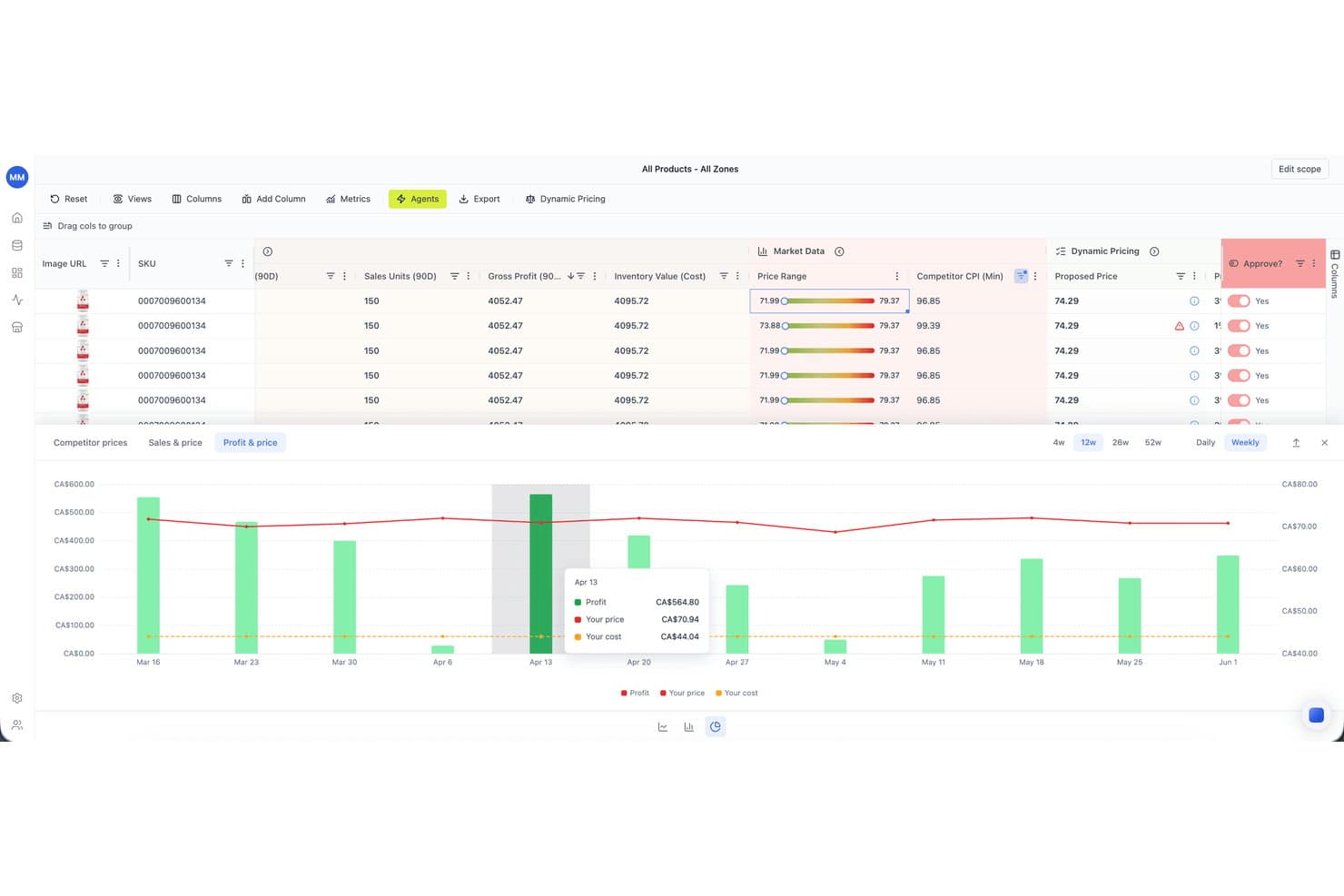
RetailGrid offers a dynamic pricing dashboard with competitor price tracking, proposed prices, profit charts, and bulk approval controls for ecommerce products. RetailGrid is an AI-driven ecommerce pricing platform built for mid-market retailers that combines dynamic repricing, competitor price monitoring, rule-based pricing strategies, and elasticity-based price optimization in a spreadsheet-native workspace.
Who Is RetailGrid Best For?
RetailGrid is a strong fit for pricing analysts and category managers who need auditable AI recommendations without relying on an IT team or implementation partner.
Why I Picked RetailGrid
I picked RetailGrid because every AI price recommendation comes with a visible confidence score and a plain-language explanation of the reasoning behind it. Pricing analysts can interrogate why the platform suggests a markdown on a slow-moving SKU before approving it, rather than trusting opaque output. I also like that the Price Elasticity and GMROI Optimization agents work together, grounding recommendations in both demand data and inventory returns at the same time.
RetailGrid Key Features
- Spreadsheet-native workspace: Enables pricing teams to manage and edit large product catalogs using familiar grid-based tools.
- Multi-channel price orchestration: Lets users coordinate and update prices across online stores, regions, and channels from a central interface.
- Shopify and Magento integrations: Connects directly to major ecommerce platforms for automated SKU syncing and price updates.
- Built-in dashboards: Provides real-time views into margin, price changes, and competitive position with configurable analytics.
RetailGrid Integrations
RetailGrid offers native integrations with Shopify and Magento. An API is available for custom integrations.
Pros and Cons
Pros:
- Handles up to 200,000 SKUs natively
- Built-in grid interface for batch editing prices
- Confidence scores and explanations on every recommendation
Cons:
- Competitor price refresh limited to every 4 hours
- No native Amazon Seller Central integration
Learn more about RetailGrid: Best for AI-driven pricing insights
- Free demo available
- Pricing upon request
Visit WebsiteCustomer Rating:4.5/5
Intelligence Node interprets pricing and competitor signals in real time. Intelligence Node is a dynamic pricing software and analytics platform tailored for retailers and brands seeking data-driven pricing decisions. It helps businesses by offering real-time competitive insights and pricing analytics to optimize their pricing strategies.
Why I picked Intelligence Node: With AI-driven insights that help you make informed pricing decisions, this platform tracks billions of products daily, giving you a detailed view of market trends. Its pricing engine allows you to implement intelligent pricing rules based on real-time data. Customizable reports and dashboards help you monitor performance effectively.
Standout features and integrations:
Features include visual merchandising analytics, which help you understand product placement effectiveness. The platform offers price elasticity analysis to gauge customer response to price changes, and its trend forecasting tools provide insights into future market shifts.
Integrations are not publicly listed.
Pros and Cons
Pros:
- Trend forecasting tools
- Real-time data tracking
- AI-driven insights
Cons:
- Complex learning process
- Pricing details are not transparent
Learn more about Intelligence Node: Best for global market analysis
- Free demo available
- Pricing upon request
Visit WebsiteCustomer Rating:4.2/5
NetRivals extracts worldwide pricing data to inform market strategy. NetRivals is a pricing intelligence platform designed for retailers and brands aiming to gain insights from global market data. It helps businesses by providing real-time price monitoring and market analysis to inform pricing strategies.
Why I picked NetRivals: It offers extensive global market analysis, which is practical if your business operates in multiple regions. The platform monitors millions of products across various markets, providing comprehensive data. Its dynamic pricing capabilities allow you to adjust prices based on real-time market conditions, and customizable dashboards and reports help you keep track of your pricing performance.
Standout features and integrations:
Features include image recognition technology that helps you identify products across different markets. You can organize your product catalogue using filters and custom tags, and the historical pricing data feature allows you to analyze market trends over time.
Integrations include Shopify, Adobe Commerce, WooCommerce, PrestaShop, Akeneo PIM, Shopware, Dropbox, Google Drive, and more.
Pros and Cons
Pros:
- Historical data analysis
- Customizable dashboards
- Extensive market coverage
Cons:
- Best suited to teams with dedicated pricing or analytics resources
- Limited integration
Learn more about NetRivals: Best for B2B pricing solutions
- Free demo + 14-day free trial available
- Pricing upon request

Vendavo models B2B price scenarios for manufacturing and distribution. Vendavo is a pricing software tailored for B2B enterprises, helping them optimize pricing strategies and improve profitability. It serves industries such as manufacturing and distribution by offering solutions for pricing analysis and strategy development.
Why I picked Vendavo: With a focus on B2B pricing solutions, Vendavo is ideal for businesses needing complex pricing structures. The software offers margin and profit analysis tools, which help you understand the financial impact of pricing decisions. Its price setting and management features allow you to maintain competitive pricing across various markets. Advanced analytics provide insights into customer behavior and market trends.
Standout features and integrations:
Features include deal guidance tools that help you negotiate better terms with customers. The software offers rebate management to help streamline discount processes, and it also provides predictive analytics to anticipate market changes and adjust strategies accordingly.
Integrations include SugarCRM, Salesforce, Oracle, Microsoft Dynamics, Infor, Adobe Commerce, Shopify, BigCommerce, and more.
Pros and Cons
Pros:
- Predictive analytics tools
- Effective margin analysis
- Advanced analytics capabilities
Cons:
- Steep learning curve
- Complex implementation process
Learn more about Vendavo:

PriceShape updates retail prices dynamically based on competitor shifts. PriceShape is a pricing optimization tool designed for retailers and brands aiming to enhance their pricing strategies. It focuses on providing dynamic pricing updates and competitor monitoring to help businesses stay competitive.
Why I picked PriceShape: Its dynamic pricing capabilities allow you to adjust prices in real time based on market changes. The tool's competitor monitoring feature keeps you informed about pricing trends. Daily market scans ensure you have up-to-date information for smarter pricing decisions, and customizable dashboards make it easy to access the data you need.
Standout features and integrations:
Features include product performance analysis, which helps you understand which items are driving sales, intelligent pricing automation for setting rules for automatic price adjustments, and marketing optimization tools that help you allocate your budget effectively.
Integrations include Shopify, Tableau, Power BI, Google Data Studio, Google Analytics, and more.
Pros and Cons
Pros:
- Detailed competitor insights
- Customizable dashboards
- Real-time price adjustments
Cons:
- Complex for small businesses
- May require technical setup
Learn more about PriceShape: Best for product-matching pricing intelligence
- Free demo available
- Pricing upon request

Skuuudle provides reliable price scraping to support pricing alignment. Skuuudle is a pricing intelligence tool designed for retailers and brands needing detailed product pricing insights. It assists businesses by providing competitive pricing data and market analysis to refine their pricing strategies.
Why I picked Skuuudle: It focuses on matching your products with those of your competitors, which provides valuable granular pricing details. The platform offers detailed competitor pricing analysis, allowing you to make informed decisions, and customizable pricing reports help you track price performance over time. Skuuudle's market analysis tools provide insights into industry trends, helping you stay competitive.
Standout features and integrations:
Features include a user-friendly dashboard that presents pricing data clearly. The software offers historical data tracking to analyze pricing changes over time and provides large-scale price scraping to help you stay aware of significant market shifts.
Integrations are not publicly listed.
Pros and Cons
Pros:
- User-friendly dashboard
- Historical data tracking
- Comprehensive market analysis
Cons:
- Large volume of data to review
- Limited integration
Learn more about Skuuudle: Best for real-time price tracking
- 7-day free trial + free demo available
- From 49€/month (billed annually)

Boardfy scans price changes and feeds data into pricing workflows. Boardfy is an e-commerce pricing software designed for businesses and brands to monitor competitor and distributor prices in real time. It's ideal for those needing dynamic pricing automation and price intelligence dashboards.
Why I picked Boardfy: It offers First-Mover Technology for tracking market trends, which helps you stay ahead of competitors, and its real-time price monitoring allows you to adjust your pricing strategies quickly. The dynamic pricing automation is user-friendly, making it accessible even if you're not tech-savvy. With campaign optimization tools for platforms such as Google Shopping, Boardfy offers a practical solution for managing your pricing.
Standout features and integrations:
Features include a user-friendly interface, dynamic pricing automation, and campaign optimization for Google Shopping. Its real-time price monitoring helps you keep up with competitors.
Integrations include Shopify, WooCommerce, Adobe Commerce, Amazon, Google Shopping, BigCommerce, Prestashop, eBay, OpenCart, FNAC, and more.
Pros and Cons
Pros:
- Dynamic pricing automation
- Easy setup process
- Real-time monitoring
Cons:
- Limited customization options
- Limited to certain e-commerce platforms
Learn more about Boardfy: Best for small to midsize businesses
- Free plan + free trial available
- From $49/month

Pricefy simulates pricing outcomes based on live market conditions. Pricefy is a pricing optimization tool tailored for small to midsize businesses looking to enhance their pricing strategies. It helps users manage and adjust prices based on market trends and competitor data.
Why I picked Pricefy: It offers features specifically designed for small to mid-size businesses, making it accessible and effective for those with limited resources. The platform provides easy-to-use price monitoring and adjustment tools. Pricefy's pricing rules and alerts ensure you stay competitive without needing complex configurations, and real-time data helps you make informed decisions quickly.
Standout features and integrations:
Features include customizable pricing rules that let you set parameters based on your business needs. The software offers a user-friendly interface that simplifies the process of monitoring price changes. Real-time alerts notify you of significant market shifts, allowing for quick adjustments.
Integrations include Shopify, WooCommerce, Adobe Commerce, BigCommerce, PrestaShop, Wix, and more.
Pros and Cons
Pros:
- Real-time market alerts
- Customizable pricing rules
- Easy-to-use interface
Cons:
- Limited advanced analytics
- Basic reporting features
Learn more about Pricefy: Best for AI-powered retail price intelligence
- Free demo available
- Pricing upon request

Minderest traces pricing trends to support competitive positioning. Minderest is a pricing intelligence platform tailored for retailers and brands looking to optimize their pricing strategies through market data. It helps businesses by offering detailed competitor analysis and pricing insights to refine pricing decisions.
Why I picked Minderest: It excels in providing AI-powered retail price intelligence, helping you stay competitive in dynamic markets. The platform offers comprehensive competitor pricing analysis, giving you a clear view of market trends, and its customizable reports allow you to track performance effectively. Additionally, Minderest price monitoring tools provide real-time updates, ensuring you make informed decisions.
Standout features and integrations:
Features include advanced analytics and dynamic pricing capabilities. This allows you to better understand pricing trends and consumer behavior and adjust prices based on real-time data. Its user-friendly dashboard provides a clear overview of all pricing activities.
Integrations include Shopify, Adobe Commerce, Power BI, PrestaShop, Tableau, Looker Studio, Google Shopping, and more.
Pros and Cons
Pros:
- AI-assisted dynamic pricing features
- Real-time price monitoring
- Comprehensive competitor analysis
Cons:
- Lengthy contract requirement
- Repricing options are limited in flexibility for complex or highly customized rules
Learn more about Minderest:
Annen programvare for prissetting av netthandel
Her er noen flere alternativer innen programvare for prissetting av netthandel som ikke kom med på kortlisten min, men som likevel er verdt å se nærmere på:
- 11PriceEdgeBest for custom pricing models
- 12RepricerBest for marketplace price adjustments
- 13Price2SpyBest for competitor price monitoring
- 147LearningsBest for machine learning optimization
- 15DealavoBest for e-commerce price optimization
- 16WiserBest for large-scale pricing strategies
- 17PricefxBest for scalable pricing solutions
- 18OmniaBest for omnichannel pricing
- 19Dynamic Pricing AIBest for AI-driven pricing models
- 20ReactevBest for real-time market analysis
How I Evaluate ecommerce Pricing Software
I evaluate every tool across two layers: the baseline features it must have—like dynamic repricing and competitor tracking—and the differentiators that set the best apart.
Core Functionality (Table Stakes For This List)
When I'm selecting tools for my list, I rank each one on a scale from 0 (does not offer the functionality) to 5 (excels in this area) for each core functionality listed below. Then, I calculate the tool's total score into a percentage. Each tool needs to achieve a minimum total score of 65% to be considered for inclusion.
- Dynamic Repricing Engine: I look for automated price adjustments that fire based on real-time triggers—like a competitor dropping a price on a top-selling SKU or inventory dipping below a set threshold.
- Competitor Price Monitoring: The tool should track and match competitor products across marketplaces and retail sites, with updates frequent enough to act on before you lose the buy box.
- Rule-Based Pricing Strategies: I evaluate how flexible the rule builder is—whether you can layer conditions like margin floors, category-level caps, and seasonal overrides into a single strategy.
- Price Optimization & AI Recommendations: I check whether the platform goes beyond static suggestions and factors in demand elasticity, historical sales patterns, or predictive modeling to surface price points.
- Ecommerce Platform Integrations: Native connections to platforms like Shopify, BigCommerce, Magento, and Amazon matter here, especially bidirectional sync that pushes price updates and pulls catalog data.
- Pricing Analytics & Reporting: Dashboards should surface margin trends, revenue impact by SKU or category, and competitive positioning—not just a log of what prices changed and when.
Once I have a list of tools that meet this criteria, I consider what sets each platform apart.
Differentiating Factors (What Sets Vendors Apart)
Here's how I compare and contrast different vendors:
Standout Features
A/B price testing is a big differentiator—I look for tools that let you run controlled experiments on specific SKU groups before committing to a full rollout. Multi-channel price orchestration matters just as much, especially when you're managing different margin targets across your DTC site, Amazon, and wholesale accounts from one place. I also evaluate MAP compliance monitoring, since tracking whether resellers honor your pricing policies across dozens of listings saves hours of manual auditing.
Beyond Features
I check how well each tool fits into a RevOps tech stack—native connectors to your CRM, ERP, and BI tools mean pricing data actually flows into forecasts and pipeline reports. Scalability is another factor I weigh, since a tool that works for a 500-SKU catalog can fall apart at 100,000. I also evaluate AI transparency, because if your team can't explain why a price changed to leadership, even the smartest algorithm creates more problems than it solves.
Slik velger du programvare for prissetting av netthandel
Det er lett å gå seg vill i lange funksjonslister og komplekse prisstrukturer. For å hjelpe deg med å holde fokus mens du går gjennom den unike prosessen din for valg av programvare, får du her en sjekkliste over faktorer du bør ha i bakhodet:
| Faktor | Hva du bør vurdere |
|---|---|
| FaktorSkalerbarhet | Hva du bør vurdereKan programvaren vokse i takt med virksomheten din? Vurder om den kan håndtere økte datamengder og flere brukere uten ytelsesproblemer. Se etter løsninger som støtter fremtidig ekspansjon. |
| FaktorIntegrasjoner | Hva du bør vurdereKan den integreres med de eksisterende systemene dine? Kontroller kompatibiliteten med netthandelsplattformen, CRM-systemet og ERP-systemet ditt for å sikre sømløs dataflyt og unngå manuell dataregistrering. |
| FaktorTilpasningsmuligheter | Hva du bør vurdereKan du tilpasse programvaren til de spesifikke behovene dine? Vurder om den lar deg opprette egendefinerte prisregler og rapporter som passer forretningsmodellen din. |
| FaktorBrukervennlighet | Hva du bør vurdereEr programvaren intuitiv og enkel å navigere i? Se etter et brukervennlig grensesnitt som minimerer opplæringstiden og hjelper teamet ditt med å komme raskt i gang. |
| FaktorImplementering og oppstart | Hva du bør vurdereHvor lang tid tar det å implementere løsningen? Vurder tiden og ressursene som kreves til oppsett og opplæring. Se etter leverandører som tilbyr omfattende støtte ved oppstart. |
| FaktorKostnad | Hva du bør vurderePasser prisen inn i budsjettet ditt? Sammenlign kostnaden med konkurrentenes og vurder verdien løsningen gir. Se etter transparente priser uten skjulte gebyrer. |
| FaktorSikkerhetstiltak | Hva du bør vurdereEr det etablert tiltak for datasikkerhet? Sørg for at programvaren følger standarder for databeskyttelse og tilbyr funksjoner som kryptering og tilgangskontroller. |
Hva er programvare for prissetting av netthandel?
Programvare for prissetting i netthandel er et verktøy som hjelper virksomheter med å fastsette og justere priser på nettproduktene sine basert på markedsdata og konkurrentanalyse. Forhandlere, prisanalytikere og inntektsansvarlige bruker vanligvis disse verktøyene til å optimalisere prisstrategier og øke lønnsomheten. Automatiserte prisoppdateringer, konkurrentovervåking og tilpassbare prisregler støtter informerte beslutninger og effektive prisprosesser. Samlet sett hjelper disse verktøyene virksomheter med å forbli konkurransedyktige og tilpasningsdyktige i et dynamisk marked.
Funksjoner
Når du velger programvare for prissetting i netthandel, bør du se etter følgende viktige funksjoner:
- Automatiserte prisoppdateringer: Juster prisene automatisk basert på markedsdata i sanntid, slik at du kan holde deg konkurransedyktig uten manuell inngripen.
- Konkurrentovervåking: Følg med på konkurrentenes priser for å få innsikt i markedstrender og fastsette informerte og dynamiske prisstrategier.
- Tilpassbare prisregler: Opprett spesifikke regler som er tilpasset virksomhetens behov, slik at du får fleksible og strategiske prisjusteringer.
- Dynamiske prisingsfunksjoner: Juster prisene i sanntid basert på etterspørsel og markedsforhold med dynamiske prisingsverktøy for å maksimere inntektsmulighetene.
- Verktøy for scenarioplanlegging: Test ulike prisstrategier før implementering for å forstå potensiell innvirkning på salg og lønnsomhet.
- Avansert analyse: Få detaljert innsikt i prisingsresultater og kundeatferd for å ta datadrevne beslutninger.
- Omfattende rapportering: Få tilgang til detaljerte rapporter som gir en tydelig oversikt over pristrender og resultatmålinger.
- Brukervennlig grensesnitt: Naviger enkelt i programvaren med et intuitivt design som reduserer læringskurven for teamet ditt.
- Varsler i sanntid: Motta varsler om betydelige markedsendringer, slik at du raskt kan justere prisstrategiene.
- Sporing av historiske data: Analyser tidligere pristrender for å informere fremtidige prisbeslutninger og strategier.
Fordeler
Implementering av programvare for prissetting i netthandel gir flere fordeler for teamet og virksomheten din. Her er noen av fordelene du kan se frem til:
- Økt konkurranseevne: Automatiserte prisoppdateringer og konkurrentovervåking hjelper deg med å ligge foran i markedet ved å justere prisene i sanntid.
- Bedre beslutningstaking: Avansert analyse og verktøy for scenarioplanlegging gir datadrevet innsikt for å fastsette effektive prisstrategier.
- Økt effektivitet: Tilpassbare prisregler, automatiseringsverktøy basert på kunstig intelligens og dynamiske prisingsfunksjoner reduserer den manuelle arbeidsmengden, slik at teamet ditt kan fokusere på strategiske oppgaver.
- Bedre lønnsomhet: Varsler i sanntid og sporing av historiske data gjør det mulig å reagere raskt på markedsendringer og maksimere inntektsmulighetene.
- Fleksibilitet i prisstrategiene: Tilpassbare prisregler gjør det mulig å skreddersy prisstrategier etter spesifikke markedsforhold og virksomhetsbehov.
- Større markedsinnsikt: Omfattende rapportering gir et tydelig bilde av pristrender og resultater, noe som støtter strategisk planlegging.
- Brukervennlig opplevelse: Et intuitivt grensesnitt sikrer en kort læringskurve, slik at teamet ditt enkelt kan ta i bruk programvaren.
Kostnader & priser
Valg av programvare for prissetting i netthandel krever en forståelse av de ulike prismodellene og abonnementene som er tilgjengelige. Kostnadene varierer basert på funksjoner, teamstørrelse, tillegg og mer. Tabellen nedenfor oppsummerer vanlige abonnementer, gjennomsnittsprisene deres og typiske funksjoner som er inkludert i programvareløsninger for e-handel:
Sammenligningstabell for abonnementer for programvare for prissetting i netthandel
| Abonnementstype | Gjennomsnittspris | Vanlige funksjoner |
|---|---|---|
| AbonnementstypeGratisabonnement | Gjennomsnittspris$0 | Vanlige funksjonerGrunnleggende konkurrentovervåking, begrenset rapportering og manuelle prisoppdateringer. |
| AbonnementstypePersonlig abonnement | Gjennomsnittspris$25-$50/bruker/måned | Vanlige funksjonerAutomatiserte prisoppdateringer, konkurrentanalyse og tilpassede prisregler. |
| AbonnementstypeBedriftsabonnement | Gjennomsnittspris$75-$150/bruker/måned | Vanlige funksjonerDynamisk prising, avansert analyse og verktøy for scenarioplanlegging. |
| AbonnementstypeVirksomhetsabonnement | Gjennomsnittspris$200-$500/bruker/måned | Vanlige funksjonerAvansert rapportering, varsler i sanntid og full integrasjonsstøtte. |
Vanlige spørsmål om programvare for prissetting av netthandel
Her er noen svar på vanlige spørsmål om programvare for prissetting av netthandel:
Hvordan integreres programvare for prissetting av netthandel med eksisterende systemer?
Programvare for prissetting av netthandel integreres vanligvis med de nåværende netthandelsplattformene, CRM-systemene og ERP-systemene dine. Du bør undersøke om programvaren støtter API-er eller programtillegg for enkel integrasjon. Mange verktøy fungerer for eksempel direkte med plattformer som Shopify eller Adobe Commerce, slik at du automatisk kan oppdatere priser og synkronisere data.
Kan programvare for prissetting av netthandel håndtere flere valutaer?
Ja, de fleste programmer for prissetting av netthandel kan håndtere flere valutaer, noe som er viktig hvis du driver virksomhet i forskjellige land. Du kan angi prisregler basert på valutasvingninger og lokale markedsforhold. Kontroller alltid om verktøyet oppdaterer valutakursene i sanntid for å sikre nøyaktige priser.
Kreves det opplæring for å bruke programvare for prissetting av netthandel?
Ja, det er vanligvis nødvendig med noe opplæring, spesielt hvis programvaren tilbyr avanserte funksjoner. Mange leverandører tilbyr opplæringsressurser, blant annet veiledninger, webinarer og trinnvise guider. Det er lurt å benytte seg av disse for å hjelpe teamet ditt med å komme raskt i gang og få mest mulig ut av verktøyets funksjoner.
Hvordan vet jeg om programvare for prissetting av netthandel passer for virksomheten min?
For å avgjøre om programvaren passer for deg, bør du vurdere prisutfordringene og virksomhetsmålene dine. Undersøk om programvarens funksjoner samsvarer med behovene dine, for eksempel dynamisk prissetting eller overvåking av konkurrenter. Det kan også være lurt å teste en demoversjon for å se hvordan den passer med de eksisterende prosessene og teamets kompetanse.